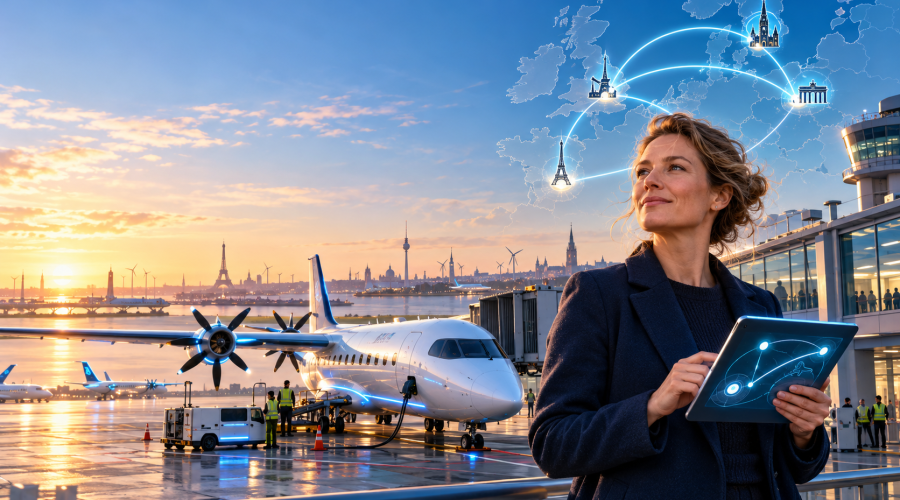
Electric flights in Europe could become bookable within a decade
Usagevpn.com – Booking an electric flight in Europe could become a realistic option for travellers within around 10 years, according to Dutch mechanical engineering professor Maarten Steinbuch. The shift would focus first on shorter regional routes, where battery-powered aircraft may offer a way to cut aviation’s reliance on fossil fuels.
The Netherlands is already home to companies pursuing this technology. Start-up Elysian Aircraft is developing a battery-electric passenger plane designed to carry 90 people. Its initial target range is 800 kilometres, with an eventual goal of reaching 1,000 kilometres.
Those distances could make electric aircraft suitable for a substantial number of European connections. The challenge is significant: aircraft need enough stored energy to carry passengers safely while retaining the range, performance and operational reliability expected by airlines.
A design intended for today’s airports
Elysian’s proposed aircraft is intended to use existing airport infrastructure. Its large wing is a key part of the design, but a wide wingspan can create difficulties at conventional gates. To address this, the company plans folding wingtips.
“There will be six engines. And we have folding wingtips, so that we fit into the current gates’ infrastructure of the airports, because the wings are very large,” says Elysian co-founder Daniel Jacobson.
Jacobson says a 90-seat aircraft capable of flying up to 1,000 kilometres without fossil-fuel emissions could make a meaningful difference to aviation’s environmental impact. He argues that this type of plane could eventually serve a large share of flights worldwide.
“By being able to transport 90 passengers for initially 800 kilometres and eventually 1,000 kilometres you can reduce emissions to zero, from half the world’s flights,” Jacobson says. “That is a very large amount of flight activity in the world. And you reduce total emissions from aerospace by 20 per cent.”
Aviation remains a difficult sector to decarbonise. It contributes about six per cent of global heating when carbon dioxide and non-CO2 effects are included. The impact can be particularly pronounced in wealthier countries, where flying accounts for a larger share of individual climate footprints.
Calls for a faster move towards electric aviation
The aviation industry has made climate commitments, but critics say progress has not matched the scale of the problem. The International Civil Aviation Organization adopted a carbon-neutral growth target from 2020, although emissions from international aviation have risen since then.
Climate Action Tracker has described the ICAO target as “Highly insufficient”, in part because it relies heavily on carbon-offsetting measures rather than direct reductions in aircraft emissions.
Steinbuch believes policymakers should support a more decisive transition to zero-emission aircraft. In his view, improving existing aircraft is useful, but it should be accompanied by investment in electric planes, charging infrastructure and the manufacturers seeking to build them.
“There is not enough attention yet to have a revolution in airspace electrification. So, it’s more an evolution and not yet a revolution,” Steinbuch says.
He points to the electric-car market as evidence that transport technology can advance quickly when regulation, investment and consumer demand align. Electric-car sales rose each year between 2020 and 2025, and electric models represented one in four cars sold globally in 2025, according to the International Energy Agency.
That growth has helped displace oil demand, while clearer deadlines have encouraged manufacturers to expand their electric offerings. Steinbuch argues that similarly firm policy signals could help aviation companies prepare for a future in which electric aircraft become part of regular passenger travel.
FAQ: What electric flights could mean for European travellers
When could passengers book an electric flight in Europe?
Steinbuch’s estimate is that passengers could be able to book electric flights within about 10 years. The timetable will depend on aircraft development, certification, charging systems and airline adoption.
Which routes could electric aircraft serve first?
Early battery-electric aircraft are expected to be best suited to shorter regional journeys. Elysian Aircraft is targeting flights of 800 kilometres initially and up to 1,000 kilometres later, potentially connecting many European city pairs.
Will electric planes use existing airports?
Developers are working to make electric aircraft compatible with current airport operations. Elysian’s folding-wingtip concept is intended to allow its large-wing aircraft to fit existing airport gate infrastructure.
Will electric flights eliminate aviation emissions?
Battery-electric aircraft would avoid fossil-fuel emissions during flight, but their overall environmental impact would also depend on how electricity and batteries are produced. They could nevertheless offer an important route towards reducing emissions on suitable short-haul services.