60 Years of Notting Hill: 10 Essential Songs
Usagevpn.com – This August, west London’s streets will once again pulse with drumming, steelpan, and thousands of costumed revelers as the Carnival reaches its 60th edition. What started as a modest neighbourhood gathering has grown into one of the largest street festivals on the planet — a two-day spectacle peaking on bank-holiday Monday and woven so deeply into London’s cultural identity that its absence would feel like silence where music should be.
To grasp why the event carries such weight, look back to the late 1950s, when the Windrush generation arrived in Britain carrying entire sonic traditions from Jamaica and the wider Caribbean. Those traditions collided with a neighbourhood already fractured by racial hostility. The 1958 race riots shook the area to its foundations, and the following year brought a deeper wound: the murder of Kelso Cochrane, an Antiguan carpenter beaten to death by a gang of white men. Against that backdrop of fear, local social worker Rhaune Laslett decided in 1966 to organise a children’s street party — a small, hopeful gesture aimed at stitching the community back together.
The party took a turn toward something far larger when Trinidadian steelpan player Russell Henderson and his band stepped onto Portobello Road. That single afternoon planted the seed from which the entire festival would grow. By the following decade, sound systems — mobile hi-fi rigs imported from Jamaican yard culture — had become its beating heart. Organiser Leslie Palmer pushed the event further into Caribbean masquerade and live performance, insisting the music had to speak for the young people filling the streets.
“The sound systems were the voice of the youth.”
Since those early days, the sonic palette has expanded relentlessly. Calypso gave way to reggae, dub, and soca; those in turn yielded space for jungle, drum and bass, hip-hop, grime, and UK garage. Each generation of selectors has layered new frequencies onto the old, ensuring the soundtrack never calcifies.
What a Sound System Actually Is
For readers unfamiliar with the tradition, a sound system is not merely a speaker stack. It is a curated musical identity: a named project with a resident selector, a signature collection of rare pressings, and a following that treats each set as a communal ritual. Across the Carnival weekend, dozens of these systems occupy corners and road-closures, each offering a distinct sonic signature while collectively forming the event’s audio landscape.
Ten Voices, Ten Tracks: The Anniversary Playlist
To mark the 60 years of Notting Hill milestone, a dozen-odd veterans — selectors, MCs, costume makers, photographers, and board members — were each asked to name a single track that, for them, crystallises what the festival means. The resulting playlist spans four decades and every corner of the Caribbean-to-London sound map.
Mikey Dread — “Guess Who’s Coming to Dinner,” Black Uhuru (1979)
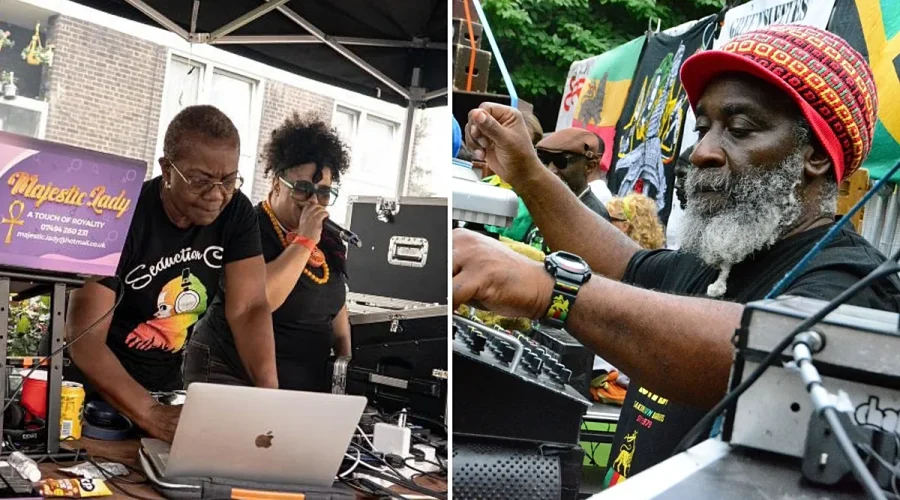
Co-founder of the Channel One Sound System and behind the decks at the Carnival since 1983, Dread is arguably the single most recognisable selector in west London’s history. This weekend he will be spinning conscious reggae and exclusive dubplates from the corner of Westbourne Park Road, drawing on a catalogue built over four decades.
Wayne Campbell — “Warrior Charge,” Aswad (1980)
Campbell is a documentary photographer who has spent more than fifteen years embedded in the Carnival’s daily life. He recently co-released Carnival of Resistance, a photobook made with fellow photographer Crichlow, documenting the sound systems, masquerade dancers, and the broader spirit of community defiance the festival embodies.
Linett — “Rum & RedBull,” Beenie Man, Future Fambo, Seanizzle
Linett broke into London’s sound-system scene as a teenager and became one of the first women ever to take the selector’s position at the Carnival. She now sits on the Carnival Board and has devoted decades to ensuring young women get their turn behind the decks.
Oxman — “Police and Thieves,” Junior Murvin (1976)
Primary host and selector of Greensleeves Hi-Fi — a project carrying the name of one of reggae’s most storied labels — Oxman will share deck duties with Becca D and YNG CPTN at The Hoxton in Shepherd’s Bush over the weekend.
Lady Banton — “Three Little Birds,” Bob Marley & The Wailers (1977)
Banton founded Seduction City Sound more than thirty years ago, making it the first all-female-led sound system to operate at the Carnival. Three decades later she remains behind the decks, and this Sunday she will be performing on Telford Road, closing out a career that helped reshape who gets to define the festival’s sound.
FAQ: Practical Questions About the 60th Anniversary
When and where does the 60th edition take place?
The Carnival runs across a bank-holiday weekend in August, with the main street parade and sound-system sets concentrated on Sunday and Monday in and around Portobello Road, Westbourne Park Road, and Shepherd’s Bush. Road closures begin early Sunday morning and lift late Monday evening.
Is there an entry fee?
The street festival itself is free. Individual sound-system corners, masquerade stages, and partner venues such as The Hoxton may charge separately for seated or ticketed sets.
How can first-time visitors navigate the event safely?
Arrive early to avoid peak crowds, carry water, and follow the published road-closure map. Sound-system corners are spread across multiple streets, so plan a route in advance. Keep an eye on children near road-closure boundaries, and use official transport guidance once closures are in effect.
What should I listen for if I am new to the sound?
Start with the calypso and reggae sets for historical context, then drift toward soca, drum and bass, and grime corners to hear how the palette has evolved. Each selector curates a distinct identity, so moving between corners across the weekend gives the fullest picture of the festival’s sonic range.