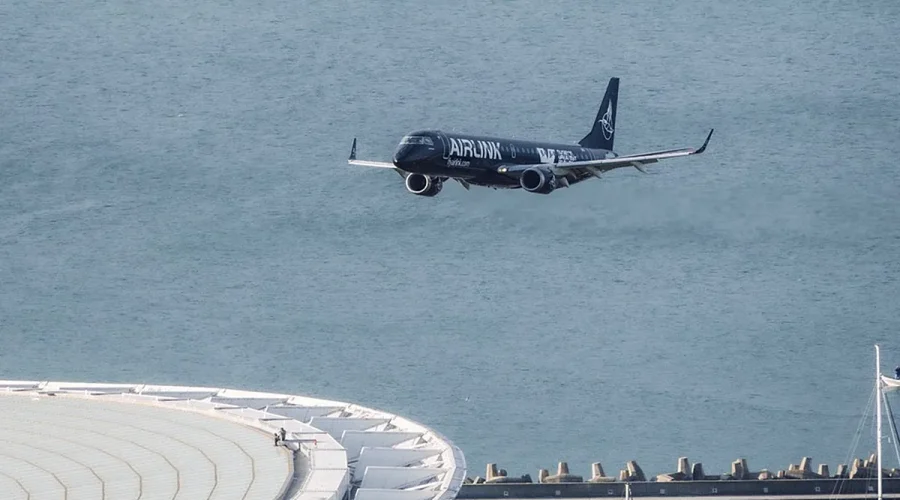
Two Jets, One Stadium, and a Debate That Split the Aviation World
Usagevpn.com – On a packed weekend in Cape Town, two commercial jets carved a low arc directly over the roof of DHL Stadium while more than 50,000 rugby fans looked up from their seats. The aircraft belonged to Airlink, a South African carrier, and the manoeuvre was timed to precede a test match between the Springboks and New Zealand’s All Blacks. What followed was not merely a roar of approval from the terraces. Within hours, clips of the flyover had spread across social platforms, drawing both thunderous applause and pointed criticism from pilots, engineers, and aviation regulators who questioned whether such a display belonged in the modern era of commercial flight.
The Flyover Itself
Flight-tracking data compiled by Flightradar24 placed the lead aircraft at an altitude of roughly 41 to 46 feet above the stadium’s roofline at the moment of closest approach. The second jet trailed behind in formation. The pair was travelling at approximately 150 knots — a speed that translates to around 173 miles per hour — while threading a corridor above one of the largest sporting venues in southern Africa. DHL Stadium, which seats close to 55,000 spectators, had been filled to capacity for the international rugby fixture, meaning tens of thousands of people stood directly beneath the flight path.
The spectacle was not accidental. Airlink later confirmed that the manoeuvre had been rehearsed in advance and required explicit clearance from national aviation authorities. The South African Civil Aviation Authority and Air Traffic Navigation Services both provided what the airline described as “valuable guidance, approval and support” to ensure the pass could be executed safely over a live sporting event.
Airlink’s Public Defence
By Sunday, the airline had issued a formal statement addressing the wave of commentary that had accumulated over the preceding 48 hours. The carrier acknowledged the public conversation without conceding that anything had gone wrong.
“Airlink notes the concerns expressed in various social media and online forums regarding yesterday’s formation flyby over Cape Town’s DHL Stadium,” the statement read. “The flight demanded careful planning and rehearsal, as it required navigating at low altitude at around 150 knots. The South African Civil Aviation Authority and Air Traffic Navigation Services provided valuable guidance, approval and support to ensure a safe flyby.”
Alongside the written statement, Airlink posted additional video and still imagery of the pass on its X account, captioning the material with three words: “Planning. Precision. Performance.” The tone was unapologetic — the airline framed the event as a showcase of operational capability rather than an incident requiring explanation.
Government Praise
Gayton McKenzie, South Africa’s Minister for Sports, Arts and Culture, embraced the stunt publicly. Speaking to reporters, he characterised the flyover as “spectacular” and used the moment to extol the skill of South African flight crews.
“It’s a well known fact that we have the best pilots in the world, that was spectacular, next time I will ask the pilots to land on the field, prepare to be amazed further,” McKenzie said.
The minister’s remarks landed in a context where rugby remains a dominant cultural force in South Africa. International test matches draw enormous crowds, and sponsors or airlines occasionally stage aerial displays to heighten the spectacle. Yet the minister’s suggestion of a future landing on the playing surface — however tongue-in-cheek — only intensified scrutiny from those who viewed the original flyover as already pushing operational boundaries.
A Pilot’s Unease
Not every voice in the aviation community shared the minister’s enthusiasm. Scott Bateman, a Scottish commercial pilot, posted a detailed critique on social media that quickly gained traction among fellow aviators. Bateman did not dispute the numbers; he questioned the culture they represented.
“The lead aircraft reportedly cleared the stadium roof by around 40–50 feet,” he wrote. “Hundreds of professional aviators around the world have looked at those images and expressed concern. That deserves more than ‘nothing to see here’.”
He went further, framing the episode within a longer history of how aviation earned its safety record.
“It became safe by relentlessly examining the things that nearly didn’t.”
Bateman’s argument was not that the flight was reckless or that anyone was in immediate danger. Rather, he contended that the industry’s hard-won safety culture depends on treating every near-miss, every marginal clearance, and every “it worked this time” as a prompt for deeper inquiry — not as a reason to celebrate. In his view, normalising low-altitude formation passes over packed stadiums, however well rehearsed, risks eroding the institutional habit of questioning assumptions.
Why the Debate Matters
The episode sits at a familiar intersection: commercial aviation’s marketing ambitions colliding with its operational conservatism. Airlines have long used aircraft as moving billboards — flyovers at grand openings, airshows, and sporting events are not new. What distinguishes this particular incident is the altitude. A clearance of barely half a football pitch above a structure housing 50,000 people is a figure that most commercial operators would avoid outside a controlled airshow environment, where terrain, weather, and crowd density are managed under a different regulatory umbrella.
South Africa’s aviation regulator has historically maintained strict separation standards for commercial operations. The fact that both the Civil Aviation Authority and Air Traffic Navigation Services signed off on the manoeuvre suggests the flight operated within existing rules. Yet the public conversation it triggered raises a question regulators will likely revisit: whether current frameworks adequately account for the psychological and reputational dimensions of spectacle flying over densely populated venues, even when every technical parameter is met.
For the fans beneath the jets that weekend, the memory is probably one of awe — two silver shapes slicing the sky above a rugby match, the roar of the crowd swallowed by engine noise. For the pilots and engineers who studied the footage afterwards, the memory is a data point: another instance where “it worked” and “it should be examined” pull in opposite directions. Airlink’s jets have landed. The debate, however, is still climbing.
Related Reading
Frequently Asked Questions
What is South African airline Airlink defends dramatic?
South African airline Airlink defends dramatic is the main topic of this guide. The article explains the context, practical details, and next steps readers should understand.
Why does South African airline Airlink defends dramatic matter?
South African airline Airlink defends dramatic matters because readers are looking for a useful answer, not just a short summary. Good content should match search intent and help them decide what to do next.