South Korea Says US Cancelled Joint Marine Drills
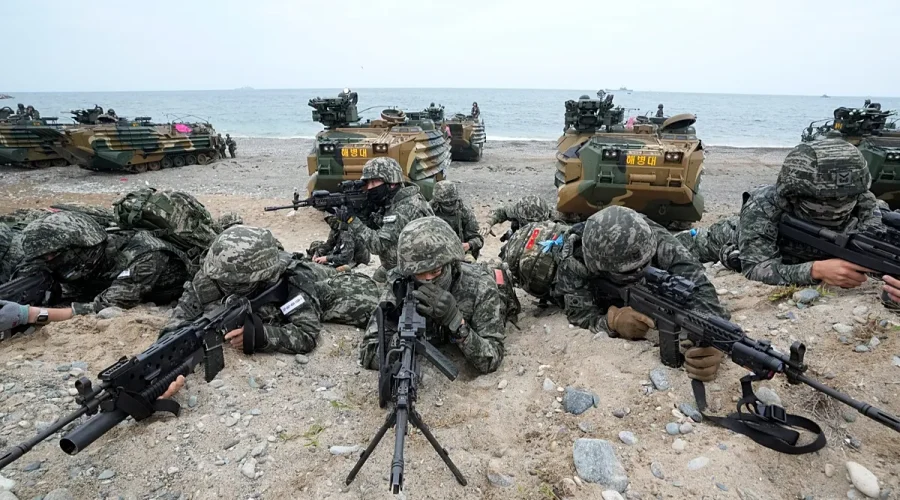
Usagevpn.com – South Korea says US cancelled its planned participation in a major amphibious landing exercise scheduled for next month, Seoul confirmed on Monday. The decision stems from what the Republic of Korea Marine Corps described as constrained force availability tied to the ongoing war in Iran. The scrapped manoeuvre — the biennial Ssangyong drill — represents the most significant single-year contraction in combined US–ROK maritime training in recent memory.
Scope of the Cancelled Exercise
The Ssangyong operation is a heavyweight amphibious rehearsal that pairs the marine components of both militaries. In a standard cycle, surface vessels push landing craft toward simulated beaches while fixed-wing and rotary-wing aircraft deliver close air support and troop transport. Infantry then executes beachhead seizures, inland advances, and combined-arms coordination under conditions replicating the full spectrum of an assault landing. Its purpose is straightforward: guarantee that, should a crisis demand a joint amphibious operation, the two forces can execute it without friction.
Washington chose outright cancellation over a scaled-down version, signalling that the drawdown of Marine units to the Middle East theatre has fallen below the threshold at which even a reduced Ssangyong would remain operationally viable. For Seoul, missing an entire rehearsal cycle erodes the institutional memory and interoperability that only repeated large-scale practice can sustain.
A Broader Pattern of Contraction
The amphibious cancellation does not stand alone. Just last week, President Donald Trump ordered that the annual Ulchi Freedom Shield exercise — the largest combined land-based drill between the two militaries — be compressed from its traditional eleven-day duration to five days. At the time, the president cited the exercise’s cost and argued its scale projected an “inappropriate and hostile” signal toward Pyongyang, while underscoring the personal rapport he has cultivated with Kim Jong-un.
Viewed together, the two actions constitute the most pronounced simultaneous reduction of US–ROK combined training in decades. Seoul-based analysts note that the timing, coinciding with active combat operations in the Middle East, indicates Marine and Army units previously earmarked for the Pacific are now committed to sustaining the Iran campaign.
Seoul’s Official Account
At a Monday press briefing, Han Seung-jeon, spokesperson for the Republic of Korea Marine Corps, outlined the timeline.
“The US Marine Corps formally notified our forces in June that its ability to deploy forces during this year’s Ssangyong exercise would be constrained due to the situation in the Middle East.”
He confirmed that consultations between the two capitals are ongoing regarding a possible resumption of the amphibious component, though he offered no timetable or conditions for a restart. The Pentagon had not responded to a request for comment as of the Monday briefing.
Diplomatic Backdrop: The Trump–Kim Axis
The reductions arrive against a diplomatic backdrop shaped by the president’s stated desire to rekindle the personal relationship built with Kim during his first term. Speaking on Wednesday, Trump stressed the importance of “getting along” with the North Korean leader and noted that Pyongyang now fields 57 “very powerful” nuclear weapons. South Korean intelligence, by contrast, estimates the North’s arsenal at between 80 and 120 warheads — a gap underscoring how rapidly the programme has expanded since the last direct summit.
Trump and Kim met three times during the first term, culminating in the 2019 Hanoi summit, which ended without a denuclearisation deal. In the years since, Pyongyang accelerated both fissile-material production and delivery-system testing, moving from a small, uncertain stockpile to what most Western and South Korean assessors now regard as a credible, if still developing, nuclear deterrent.
Strategic Implications for the Alliance
For South Korea, the simultaneous scaling back of its two largest combined exercises raises pointed questions about the depth of US operational commitment in the event of a Korean Peninsula crisis. Amphibious readiness is not merely a training metric; it is the backbone of any plan to project force onto the peninsula’s western coast or to evacuate non-combatants under fire. Losing an entire biennial rehearsal cycle, while the annual land exercise is halved in duration, narrows the window in which both forces can validate joint procedures before a crisis demands them.
Frequently Asked Questions
When was the Ssangyong exercise originally scheduled? Seoul’s announcement on Monday indicated the drill was planned for next month. The US Marine Corps had notified Korean forces of the constraint as early as June.
What happened to the Ulchi Freedom Shield exercise? President Trump directed last week that the annual land-based drill be compressed from eleven days to five, citing cost and the desire to avoid projecting a hostile signal toward North Korea.
Has Washington confirmed the cancellation? The Pentagon had not responded to a comment request as of Monday’s briefing. The cancellation was announced publicly by the Republic of Korea Marine Corps.
Is there a timeline for resuming the amphibious exercise? Spokesman Han Seung-jeon said consultations are ongoing but offered no timetable or conditions for a restart.