Iran Targets Trump’s Youngest Son in State-Broadcast Video Promising $10 Million for His Capture
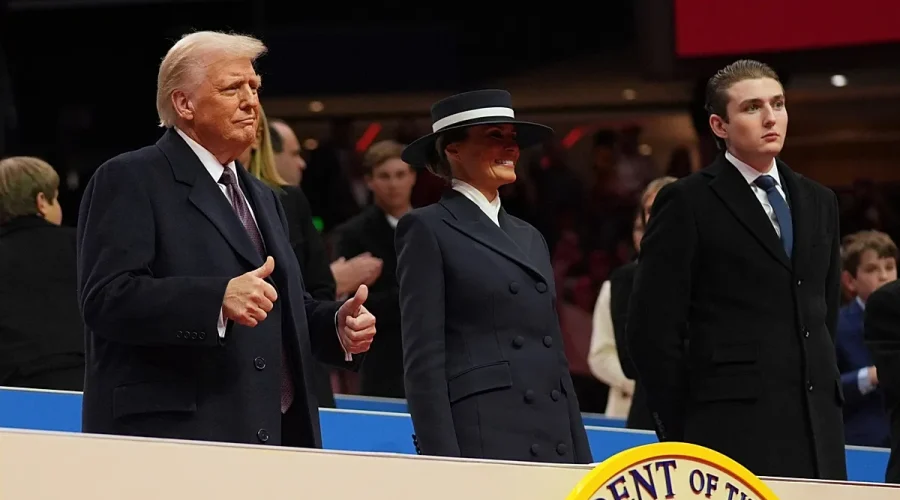
Usagevpn.com – Amid an ongoing war between the United States, Israel, and Iran, the Islamic Republic’s state broadcaster aired a segment that places a $10 million (€8.5 million) price on the head of Barron Trump, the 20-year-old son of President Donald Trump. The programme, distributed through media linked to the Islamic Revolutionary Guard Corps and transmitted on Channel 3 of Iran’s national television network, carries the title “Where and how should we kill Barron Trump?” and presents itself as a surveillance dossier on the young man’s daily routines.
The footage purports to identify the campus where Barron Trump studies, the vehicles assigned to his motorcade, and the exact positioning of his Secret Service detail. Producers of the segment assert that his movements have been “fully monitored,” though no independent verification of the bounty or the surveillance claims was available at the time of broadcast.
Alleged Insider Access and Private Communications
Beyond the surveillance framing, the programme makes a more specific allegation: that a woman had found a means of slipping past the Secret Service perimeter, sat down with Barron Trump in a private meeting, and relayed information back to the show’s producers. The segment further claims that the president’s son conducts private voice and text conversations through an Xbox console, away from his assigned security detail. None of these assertions could be independently confirmed.
The Broader Pattern of Personal Threats
The Barron Trump broadcast is not an isolated incident. It follows a similar IRGC-affiliated video published by the Tasnim news agency in July, captioned “Where and how is Melania Trump accessible?” That earlier piece mapped the former first lady’s movements around New York and pointed to perceived gaps in her protective detail. In late May, the New York Post described an alleged plot aimed at Ivanka Trump, adding another chapter to what has become a sustained campaign of intimidation directed at members of the president’s family.
Threats aimed directly at Donald Trump himself have also featured prominently in Iranian state media. In July, a billboard erected in Tehran’s Islamic Revolution Square displayed an image of the president apparently lifeless inside a coffin, accompanied by the English-language caption “We will kill Trump.” A separate video released around the same period purported to chart the route of the presidential motorcade between airports and his residences in Florida and New York. The US Secret Service acknowledged that it was reviewing the footage.
Two Triggers: Soleimani and Khamenei
Iranian officials have rooted their personal threats against the president in two specific events. The first dates to January 2020, when a US drone strike killed Qassem Soleimani, commander of the IRGC’s Quds Force, at Baghdad International Airport. Trump, then serving his first term, authorised the operation. Iranian leaders vowed retaliation at the time and have renewed those pledges repeatedly in the years since.
The second, more recent trigger is the death of Supreme Leader Ayatollah Ali Khamenei in the US-Israeli strikes of 28 February, which marked the opening salvo of the current war. Several figures in Iranian state-run media have framed the personal threats against Trump explicitly through the Islamic legal doctrine of qisas — retributive justice — arguing that the killing of the Islamic Republic’s leader creates a binding obligation to kill the person deemed responsible.
State Commentators Invoke Retributive Justice
Mohammad-Javad Larijani, a regular commentator on Iranian state television, described qisas as the Islamic Republic’s “inalienable right.” Addressing those he held accountable for Khamenei’s death, he declared:
“We will do whatever is in our power, and there is no international legal barrier to stop us.”
Mohsen Ghanbarian, another frequent voice on the state broadcaster, pressed the point further:
“If we do not carry out qisas on Trump, if we do not punish our leader’s killer, the current leader and the leaders of the Islamic Republic will always have to live in hiding.”
Trump’s Warning of Total Retaliation
The president has responded to the escalating threats with language of near-total military consequence. On 20 January, he stated that any attempt on his life would mean “the whole country of Iran will blow up,” and added that he had issued orders ensuring the United States would “wipe the Islamic Republic off the face of the Earth” should the threats be carried out.
The juxtaposition of a state-broadcast bounty on a 20-year-old university student and a presidential threat to annihilate an entire nation underscores how personal the conflict has become. For Iranian audiences, the qisas framing transforms what might otherwise read as political posturing into a religiously sanctioned duty. For American families watching from abroad, the targeting of Barron, Melania, and Ivanka signals that the war’s reach extends well beyond capitals and battlefields — into the private lives of those closest to the president. Whether the $10 million bounty reflects a genuine operational plan or functions primarily as domestic propaganda remains, for now, unverified.
Related Reading
Frequently Asked Questions
What is Iranian state TV broadcasts video targeting?
Iranian state TV broadcasts video targeting is the main topic of this guide. The article explains the context, practical details, and next steps readers should understand.
Why does Iranian state TV broadcasts video targeting matter?
Iranian state TV broadcasts video targeting matters because readers are looking for a useful answer, not just a short summary. Good content should match search intent and help them decide what to do next.