A Robot Just Outran Usain Bolt: China’s Humanoid Sprinter Clocks 9.39 Seconds
Usagevpn.com – The 100-metre sprint has been humanity’s ultimate test of raw speed since the modern Olympics codified the event, and for fifteen years the benchmark belonged to one man. On Saturday, that benchmark fell — not to another athlete, but to a machine. TienKung, a humanoid robot built by the Beijing Centre for Humanoid Robotics, crossed the finish line in 9.39 seconds during the World Humanoid Robot Games, eclipsing the 9.58-second mark that Usain Bolt set at the Olympiastadion in Berlin back in 2009. No human being has ever run the distance faster than that 2009 performance, and now a two-legged automaton has done it.
The Event Behind the Milestone
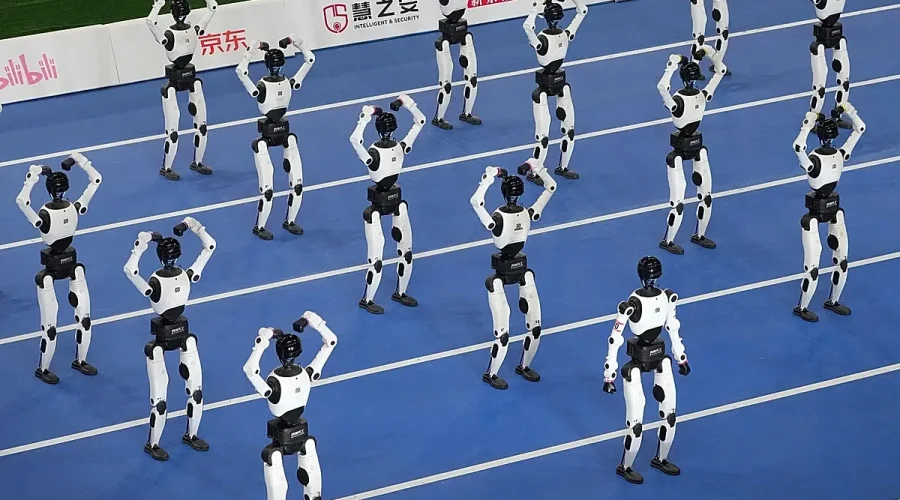
The World Humanoid Robot Games, staged inside Beijing’s “Ice Ribbon” stadium — the same venue that hosted the 2022 Winter Olympics speed-skating events — drew 666 competing teams fielding a combined total of 2,056 robots from sixteen nations. The programme spans disciplines as varied as track athletics, boxing, association football, weightlifting, and gymnastics, giving engineers and designers a full-spectrum proving ground for bipedal and multi-jointed machines.
The contrast with the previous edition of the competition is stark. Last year’s winning time in the equivalent sprint event was 21.50 seconds — more than twice as slow as this year’s result. In a single twelve-month cycle, the field has effectively doubled its velocity, a rate of improvement that would be extraordinary even among elite human athletes.
Organisers Frame the Achievement
The games’ organisers took to the social platform X to underscore the significance of the result, calling it
“a hugely impressive feat,”
and pointing out that the year-on-year acceleration “highlights the pace of advancement both in the market, and specifically in Chinese robotics.”
In a longer statement, they urged spectators not to dismiss the spectacle:
“It shows a pace of technological advancement that almost beggars belief. Only a year ago, at the last WHRG, robots were slow, ponderous machines that struggled to complete a track sprint. This year they are expected to obliterate world records. The pace that the Chinese robotics industry is advancing at, much like the robot in the video shows no sign of deceleration.”
Viral Footage and Public Reaction
Clips from the competition have circulated widely across social media over the past several days. Among the most shared moments are sequences in which humanoids, having completed a sprint, slam into oversized landing mats and topple backward in slow, ungainly collapses. Viewers have found the clips both amusing and instructive: they expose the gap between peak linear velocity and the full biomechanical complexity of human locomotion, including deceleration, balance recovery, and graceful termination of a run.
That gap, however, is narrowing quickly. The fact that a machine can now sustain a top-end speed exceeding Bolt’s record while still struggling with the final metres of deceleration suggests that the remaining engineering challenges are concentrated in control algorithms and joint damping rather than in raw actuator power.
Industrial and Market Context
China has poured substantial state and private capital into the humanoid-robotics sector over the past three years, treating bipedal automation as a strategic pillar alongside semiconductors and electric vehicles. Investor appetite appears to be tracking the technology curve. Morgan Stanley Research, in a report published last year, projected that the global humanoid-robot market will approach five trillion US dollars by 2050, with well over one billion units potentially deployed across manufacturing, logistics, elder-care, and domestic settings.
The same analysis estimated that China alone will operate roughly 302.3 million humanoid robots by mid-century. If those figures hold, the machines will outnumber the population of most European nations and will represent a labour force larger than the entire current global manufacturing workforce.
Why the Sprint Matters Beyond the Track
A 100-metre time, stripped of its athletic romance, is really a stress test of actuator torque, battery density, real-time gait-planning software, and structural fatigue limits. A robot that can accelerate to 10.5 metres per second and sustain that velocity for ten seconds is demonstrating capabilities directly transferable to warehouse picking, construction-site material handling, and emergency-response navigation. The sprint is, in effect, a public benchmark for the entire bipedal-automation stack.
The Beijing Centre for Humanoid Robotics, which produced TienKung, operates under China’s national robotics programme and has been iterating on its platform since roughly 2021. Each annual edition of the World Humanoid Robot Games functions as both a competitive showcase and a de facto standards forum, where designers compare architectures, share failure data, and calibrate expectations for the next generation of machines.
Whether the next edition sees sub-nine-second times, or whether the focus shifts to endurance events and multi-lap distances, the trajectory is now unmistakable. The speed record that once defined a generation of sprinters has become a milestone on a roadmap, and the machines are still accelerating.
Related Reading
Frequently Asked Questions
What is Chinese humanoid robot beats Bolt s 100?
Chinese humanoid robot beats Bolt s 100 is the main topic of this guide. The article explains the context, practical details, and next steps readers should understand.
Why does Chinese humanoid robot beats Bolt s 100 matter?
Chinese humanoid robot beats Bolt s 100 matters because readers are looking for a useful answer, not just a short summary. Good content should match search intent and help them decide what to do next.