Europe Under Siege: Wildfires, Floods, and Storms Test Four Nations Simultaneously
Usagevpn.com – A single week in late August has exposed how fragile the continent’s infrastructure and communities remain when multiple weather extremes converge across borders. From the scorched plains south of Belgrade to the storm-battered farmlands of northern Poland, thousands of residents have been displaced, critical transport links severed, and emergency services stretched to their limits. The pattern is unmistakable: record-breaking heat, prolonged drought, and sudden atmospheric instability are colliding in ways that outpace existing response capacity.
Spain: A Weekend of Opposing Extremes
Spain’s geography turned the weekend into a study in contrasts. In the northeast, Tarragona was battered by torrential downpours that dumped over 145 millimetres of rain in certain localities within hours. Eleven people sustained injuries as streets turned into rivers, and both road and rail networks serving the region were knocked out of service. Meteorologists warned that additional strong thunderstorms would sweep through eastern and northeastern provinces in the following days, while an unusually powerful low-pressure system over the Atlantic was steering heavy rainfall into Galicia, compounding the disruption.
On the opposite side of the country, the picture was one of fire rather than water. In Valencia province, a lightning strike ignited a blaze near the town of Segorbe late on Thursday. By Friday afternoon, shifting winds fed the flames into rapid expansion, prompting authorities to escalate the wildfire emergency to Level 2. Personnel from Spain’s Military Emergency Unit joined local fire brigades in the response. More than 1,000 residents of the nearby town of Gatova were ordered to leave their homes as the fire line advanced. Aerial suppression resources were deployed, and crews eventually contained the perimeter after approximately 630 hectares of vegetation had been consumed.
The episode came just days after temperatures in parts of the region climbed to 44 °C, underscoring how quickly the balance tips from drought-fuelled fire risk to flash-flood danger when atmospheric conditions change abruptly.
Serbia and Bosnia: Fire on the Balkan Frontier
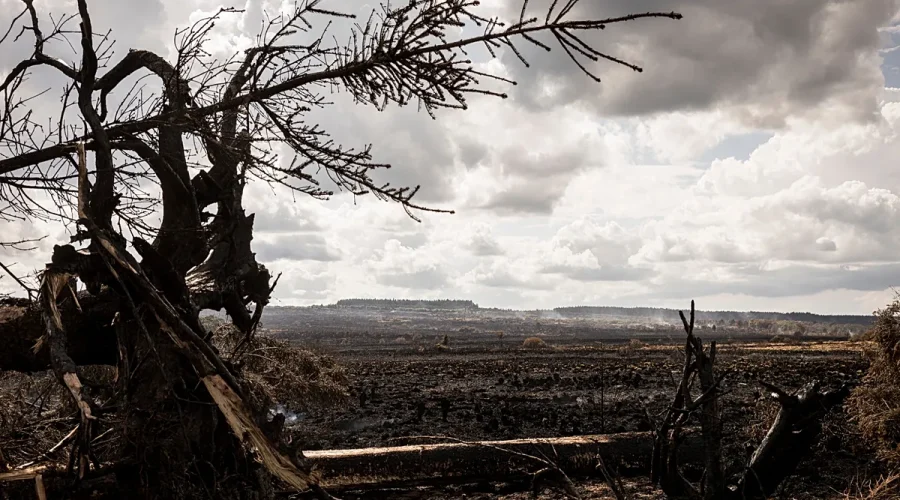
South of the Danube, the Deliblatska Pescara nature reserve — a vast peatland and grassland complex roughly 60 kilometres east of Belgrade — has become the epicentre of Serbia’s worst wildfire season in years. More than 1,600 hectares of vegetation have been consumed. The European Union dispatched helicopters and specialist firefighting teams to assist local crews, while a Russian-built Ilyushin Il-76 water-bomber aircraft has been operating in the area since Thursday. Several Serbian army helicopters also participate in the daily suppression effort.
“The situation is extremely difficult,” Interior Minister Ivica Dacic told journalists, adding that “more than 400 people are deployed there on a daily basis.”
The crisis did not stop at Serbia’s borders. On Saturday, a major fire erupted in the narrow strip of woodland along the Bosnia–Croatia frontier. Bosnian police shut the principal highway linking Trebinje to Dubrovnik, stranding thousands of holidaymakers who had planned to drive south along the Adriatic coast. Villages surrounding the small settlement of Ivanica were evacuated as flames crept toward residential structures; local firefighters confirmed that some livestock was trapped and perished in the blaze.
Croatian crews from Dubrovnik crossed the border to reinforce Bosnian teams. Working with helicopter support, they attempted to hold the fire line, but sustained high temperatures and strong winds drove the blaze further inland. The affected zone now spans more than 16 kilometres in diameter across steep, narrow terrain that limits ground access. Compounding the danger, the Trebinje basin had received virtually no rainfall for months, leaving soils and vegetation exceptionally dry during what has been one of the hottest, driest summers recorded in the region’s recent history.
Poland: Storm Cells Sweep the North
Further north, a different kind of atmospheric violence unfolded. Beginning Friday, successive storm cells tore across Poland, generating over 6,500 individual emergency calls for firefighters. Flooded cellars, downed power lines, and uprooted trees were reported in numerous municipalities. Twelve scout camps were evacuated as a precaution when water levels rose around campsite grounds and electricity supply failed.
Brigadier Karol Kroć of the State Fire Service told the Polish Press Agency that no injuries had been reported as of the latest briefing.
Into Sunday, the Institute of Meteorology and Water Management maintained yellow-level warnings for two small regions in the north, forecasting heavy rainfall of up to 30 litres per square metre, wind gusts reaching 70 kilometres per hour, and the possibility of hail in isolated pockets. Beyond those zones, however, the broader national weather pattern had shifted markedly toward calmer conditions, offering temporary relief to communities still clearing debris from the previous day’s storms.
What the Pattern Signals
Viewed together, the simultaneous crises in four countries illustrate a structural vulnerability: infrastructure designed for historical climate norms is now being tested by events that exceed those norms in frequency and intensity. The Balkan drought-to-fire transition, Spain’s rapid swing between deluge and drought within a single weekend, and Poland’s repeated storm-cell impacts all point to a continent whose emergency planning must now assume multi-hazard, multi-front scenarios as the new operational baseline rather than the exception.
Related Reading
Frequently Asked Questions
What is Extreme weather hits Europe as wildfires?
Extreme weather hits Europe as wildfires is the main topic of this guide. The article explains the context, practical details, and next steps readers should understand.
Why does Extreme weather hits Europe as wildfires matter?
Extreme weather hits Europe as wildfires matters because readers are looking for a useful answer, not just a short summary. Good content should match search intent and help them decide what to do next.