Final Hours Before a 50% Tariff Deadline: Washington and Ottawa Race to Avoid a Trade Cliff
Usagevpn.com – As the calendar flips toward Wednesday midnight, two North American capitals are locked in a frantic diplomatic sprint. The stakes: a sweeping 50% import levy on approximately $20 billion (€17.2 billion) worth of Canadian products, spanning everything from hockey sticks to tongue depressors, unless a deal is sealed before the clock strikes twelve. The two governments have spent the final days in what insiders describe as a last-ditch negotiation to prevent the measures from taking effect.
A Decade-Old Rivalry Meets a New Era of Pressure
The United States and Canada have argued over softwood lumber pricing and dairy market access for decades, yet their relationship has always carried the weight of alliance. The 5,525-mile boundary between the two nations remains the longest undefended border on Earth. Every single day, roughly 330,000 people and $2 billion (€1.72 billion) in merchandise flow across it, while more than 800,000 Canadians reside on the American side of the line. Nearly 72% of all Canadian goods exports were destined for the US market last year, making the two economies deeply intertwined in ways few other bilateral pairings can match.
President Donald Trump’s tariff strategy marks a sharp departure from that tradition. His administration has imposed duties explicitly designed to pull manufacturing capacity back to American soil, and Trump has repeatedly suggested that Canada might one day become “the 51st state.” That rhetoric has landed with particular force in Ottawa and Toronto alike, where public frustration has translated into concrete political action.
Public Backlash and Diplomatic Friction
A petition demanding the removal of US Ambassador Pete Hoekstra — a close Trump ally — has accumulated nearly 218,000 signatures since 21 July. Petitioners accuse the diplomat of normalising annexation talk and of treating Canada as a subordinate rather than a sovereign partner. The campaign underscores how quickly trade policy has become a domestic political issue on both sides of the border.
The Legal Weapon: Section 338 of the 1930 Tariff Act
Trump’s administration reached into a statute most Americans have never heard of to justify the threatened levies. Section 338 of the Tariff Act of 1930 — a provision born in the protectionist fever that deepened the Great Depression — allows a sitting president to impose tariffs of up to 50% on any foreign country deemed to discriminate against US businesses. Crucially, the section requires no prior investigation, carries no sunset clause, and has never before been invoked. Trump cites alleged Canadian discrimination against American automobiles, alcoholic beverages, and cheese, and points to retaliatory measures Canada (alongside China) imposed in response to his earlier tariff rounds.
What Each Side Wants on the Table
The American delegation is pressing Ottawa to expand purchases of US military hardware, including F-35 fighter jets, to integrate into Trump’s proposed “Golden Dome” missile-defence architecture, and to grant broader access to critical minerals — a move that would reduce North American dependence on Chinese supply chains. Canada, for its part, is seeking relief from existing US duties on steel, aluminium, and softwood lumber, which Washington characterises as unfairly subsidised sectors.
Political Arithmetic on Both Sides
Analysts note that Washington faces its own domestic constraints. Imposing steep new tariffs — costs borne initially by US importers and then passed through to consumers — so close to the November midterm elections, when voters already resent elevated living costs, carries real electoral risk.
“I don’t think either side really wants these tariffs to come into effect,” said Ryan Majerus, a former US trade official and partner at King & Spalding. “There’s a pretty strong push on both sides to find an off ramp here.”
On the Canadian side, political scientist Daniel Béland of McGill University warned that Prime Minister Mark Carney “cannot look like it is simply caving.” One-sided concessions, Béland cautioned, risk triggering a fierce domestic backlash and would signal weakness to future rounds of pressure.
The Broader Trade-Pact Dimension
The tariff threat also sharpens US leverage as the US-Mexico-Canada Agreement enters a renegotiation phase. Trade experts argue that a full-scale trade war would poison that process.
“You can’t renegotiate it with a massive trade war going on,” noted Christopher Gundermann of the Center for Strategic and International Studies.
The Final Hours
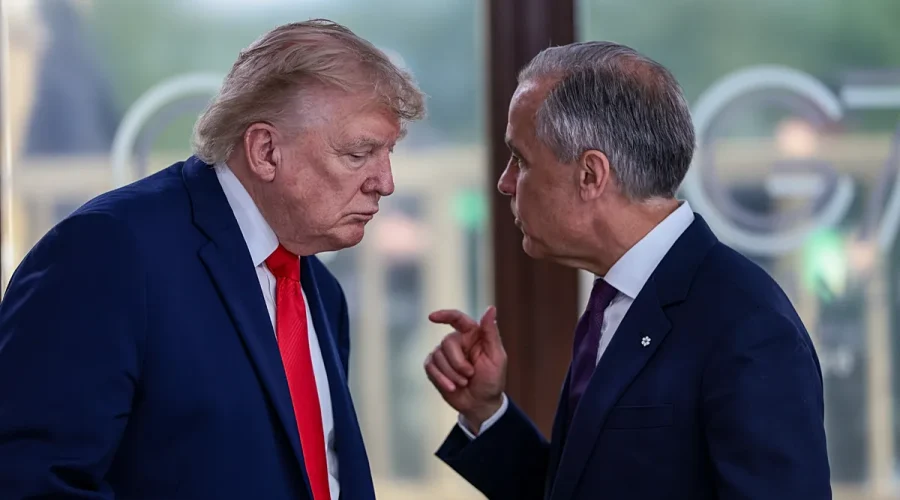
Canadian Prime Minister Mark Carney told reporters on Monday that negotiations are underway, describing them as “very intense and delicate” while declining to disclose specifics. Carney and Trump held a telephone conversation Monday afternoon, underscoring the urgency of the final push. Canada’s trade minister, Dominic LeBlanc, met US Trade Representative Jamieson Greer on the same day and offered only that “the work is continuing.”
Whether a deal materialises before the midnight deadline remains uncertain. What is clear is that the outcome will reshape the economic architecture of North America for years to come — and that both governments are acutely aware that the political cost of failure, on either side of the border, could prove far more expensive than the tariffs themselves.
Related Reading
Frequently Asked Questions
What is Midnight showdown looms as US and Canada?
Midnight showdown looms as US and Canada is the main topic of this guide. The article explains the context, practical details, and next steps readers should understand.
Why does Midnight showdown looms as US and Canada matter?
Midnight showdown looms as US and Canada matters because readers are looking for a useful answer, not just a short summary. Good content should match search intent and help them decide what to do next.