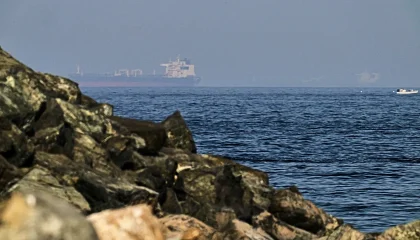
UAE Sounds Missile Alert as Iran Launches Two Ballistic Projectiles Toward Gulf Territory
Usagevpn.com – Residents across the United Arab Emirates received a short-lived mobile phone alert on Tuesday evening instructing them to move indoors and find shelter, after Emirati air-defence systems tracked two ballistic missiles launched from Iranian soil in the direction of the country. Neither projectile struck land. The first came down beyond the nation’s territorial waters, while the second landed inside them, according to the Emirati Ministry of Defence, which confirmed the detection in a statement posted on X.
The alert, issued by the interior ministry, carried a terse instruction to the public:
“Due to the current situation, potential missile threats, immediately seek a safe place in the closest secure building.”
The warning was withdrawn within minutes of being broadcast. For many Emiratis, however, the brief disruption carried weight. It marked the first time in months that the defence ministry publicly confirmed missiles were “directed towards the country,” a phrasing that signals a deliberate targeting rather than a stray trajectory passing overhead.
A Pattern of Escalation Since the Framework Deal Collapsed
The two-missile event does not occur in isolation. It sits within a rapidly deteriorating regional security environment that has been unfolding since late February, when open hostilities erupted between Iran and its adversaries. At that point, the UAE came under direct Iranian fire as part of a broader campaign aimed at Gulf states and their infrastructure. The intensity of those early strikes prompted widespread civilian precautions and temporary disruptions to aviation and shipping across the Persian Gulf.
Hostilities paused in mid-June when a ceasefire took hold and a framework agreement was signed, intended to end the war and restore a degree of predictability to the region’s most volatile flashpoint. Under that arrangement, Tehran halted its missile and drone barrages, and the UAE experienced weeks without incoming projectiles. The lull, however, proved fragile. When the framework deal collapsed and fighting between Washington and Tehran resumed, Iran broadened its targeting to include several neighbouring states. Kuwait, Bahrain, and Jordan have all been struck in the renewed phase of the conflict, underscoring that the Gulf’s smaller neighbours remain within range of Iranian ballistic and cruise-missile systems.
What Came Before: A Run of Alerts and False Alarms
For Emirati residents, the Tuesday evening alert was not the first scare of the summer. In June, a phone warning was triggered by what authorities later described as a false alarm — a system glitch or misread that produced no actual inbound threat. In July, a separate alert was issued for an attack that ultimately failed to cross into UAE airspace or waters. Before those two episodes, the last genuine missile warning had come in early May, during the most intense period of the original exchange of fire.
The recurrence of alerts, even brief ones, has a cumulative psychological effect. Each notification interrupts daily routines, prompts families to gather in interior rooms, and raises questions about whether the next projectile will behave like the last two — falling short of land — or whether a future launch will carry a different payload, a different trajectory, or a different intent.
Strategic and Civilian Implications
The fact that both missiles missed land does not diminish the significance of the event. A ballistic missile launched from Iran toward the UAE covers roughly 500 to 700 kilometres of flight, depending on the specific system employed. The ability to place a warhead within or near Emirati territorial waters on demand means that ports, offshore energy installations, and coastal military facilities remain exposed. The UAE’s air-defence network — which includes layered radar, short- and medium-range interceptors, and integrated command-and-control systems — successfully tracked both objects, but the country’s geographic compactness limits the margin of error available to any incoming projectile.
For the broader Gulf architecture, the renewed targeting of multiple states simultaneously suggests that Iran is treating the region as a single operational theatre rather than a set of bilateral disputes. The UAE, which hosts major American military assets and anchors a web of bilateral defence pacts, occupies a particularly exposed position in that calculus. Its proximity to Iranian launch corridors, combined with the density of critical infrastructure along its coastline, makes it a high-value target even when the stated objective of a strike is elsewhere.
The interior ministry’s decision to issue a public phone alert — even one lifted within minutes — reflects a deliberate choice to keep the civilian population informed and prepared. In a country where expatriate communities make up the majority of residents and where daily life depends on uninterrupted logistics, a transparent warning system reduces panic and channels behaviour toward sensible protective measures. The brief nature of the Tuesday alert, and its prompt cancellation, reinforced that the state’s response is calibrated to the actual threat level rather than to maximum alarm.
As the conflict between Washington and Tehran continues to oscillate between negotiation and exchange of fire, the UAE’s air space and waters will remain a contested zone. The two ballistic missiles of Tuesday evening, harmless in outcome but pointed in intent, serve as a reminder that the ceasefire’s collapse has returned the Gulf to a state of active, if intermittent, military threat — and that the next alert may not be so easily dismissed.
Related Reading
Frequently Asked Questions
What is UAE says Iran targeted its territory?
UAE says Iran targeted its territory is the main topic of this guide. The article explains the context, practical details, and next steps readers should understand.
Why does UAE says Iran targeted its territory matter?
UAE says Iran targeted its territory matters because readers are looking for a useful answer, not just a short summary. Good content should match search intent and help them decide what to do next.