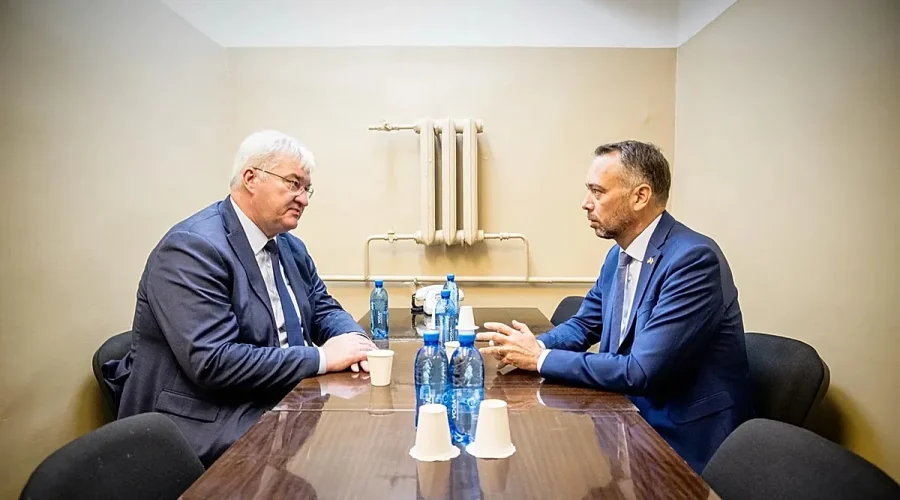
Diplomacy Conducted Underground: Belgian and Ukrainian Ministers Hold Talks in Kyiv Shelter During Active Air Alert
Usagevpn.com – The foreign ministers of Belgium and Ukraine sat across from one another in a narrow, windowless concrete room beneath the Ukrainian Foreign Ministry building on Tuesday, listening to the distant wail of air-raid sirens overhead. The meeting between Andrii Sybiha and Maxime Prevot was not planned as a symbolic gesture of wartime solidarity; it was simply where the conversation could take place once Russian drones began probing the capital’s airspace.
Sybiha documented the unusual setting in a post on X, attaching photographs of the two diplomats seated in the cramped shelter. He framed the episode as an everyday truth of life under bombardment rather than a one-off inconvenience.
“Due to Russian drones attacking our capital, we held our talks underground in the @MFA_Ukraine bomb shelter—a daily reality for millions of Ukrainians, shared by our Belgian guests today.”
Air Alerts as Routine Infrastructure
Kyiv has endured repeated aerial bombardment since Moscow launched its full-scale invasion in February 2022. Four years into the conflict, the sound of sirens has become woven into the city’s daily rhythm. A local tracking platform monitoring air-raid notifications in the capital recorded eight separate alerts on Tuesday alone, with at least one still active when this article was being written. For residents, the drills of descending to basements, subway stations, or purpose-built shelters have become as automatic as locking a front door.
The fact that a sitting foreign minister from a NATO member state was forced into that same routine underscores how the war’s physical reality continues to shape even high-level diplomatic engagements. Prevot’s presence in the shelter, however brief, placed a Western European official inside the lived experience of Ukrainian civilians on a Tuesday afternoon.
Wildfire Solidarity and Front-Line Briefing
Beyond the circumstances of the venue, the two ministers addressed a range of bilateral issues. Sybiha conveyed Ukraine’s solidarity with Belgium, which has been battling severe wildfires sweeping through the country over the preceding week. He stated that Kyiv stood ready to offer practical assistance to its Belgian partner in the firefighting effort.
The conversation also turned to the military situation. Sybiha briefed Prevot on the latest developments along the front lines against Russian forces under President Vladimir Putin. He expressed gratitude for Belgium’s sustained wartime backing, which he characterized as exceeding €4.6 billion in cumulative support since the invasion began.
“We deeply value the more than €1 billion in military aid provided this year bilaterally and through multilateral programs, particularly PURL.”
PURL and the Architecture of Allied Arms Supply
The Prioritised Ukraine Requirements List, or PURL, is a NATO mechanism designed to streamline the procurement of weapons and munitions for Ukraine. Under the scheme, allies and partners commit funding that is then used to purchase equipment—primarily from United States manufacturers—on Ukraine’s behalf. As of June 2026, NATO reported that member states had pledged more than $6 billion toward defence equipment purchases through the programme. The system was created to reduce the administrative friction that had previously slowed deliveries and to ensure that spending was coordinated across multiple donor nations rather than fragmented into bilateral channels.
Belgium’s participation in PURL sits alongside its own direct bilateral contributions. Brussels has funded training programmes for Ukrainian ground troops and has hosted instruction for F-16 fighter-jet pilots and maintenance technicians. These efforts form part of a broader Western European commitment to building Ukrainian air-force capacity over the medium term.
Seven F-16s and a Longer-Term Jet Transition
In June, Belgian Defence Minister Theo Francken told reporters in Brussels that the country intended to deliver seven F-16 fighter jets to Ukraine during 2026. He signalled an even more ambitious trajectory beyond that single tranche.
“I’ll propose to the government to send all our F-16s to Ukraine in the coming years.”
Francken noted that such a full transfer would be contingent on Belgium first receiving replacement F-35 aircraft, a dependency that ties the timeline of Ukrainian air-force reinforcement to the pace of American production and delivery schedules.
Kharkiv Strike: At Least Ten Killed
The diplomatic meeting in Kyiv’s shelter took place against the backdrop of continued Russian missile activity elsewhere in the country. On the same Tuesday, strikes on the village of Pechenihy in Kharkiv region killed at least ten people and wounded eighteen more, local authorities confirmed. Oleh Syniehubov, head of the Kharkiv Regional Military Administration, stated that two Banderol cruise missiles were used in the attack. Ten residential houses, several vehicles, and multiple commercial premises were damaged.
The Kharkiv strike and the Kyiv drone alerts on the same day illustrate the breadth of Russian aerial operations: cruise missiles targeting settlements in the east while drone swarms probe the capital’s air defences. For the diplomats in the shelter below the Foreign Ministry, the siren overhead was not a backdrop to their conversation but an active participant in it—a reminder that the negotiations of the war are conducted under conditions that few of their Western counterparts have ever experienced.
Related Reading
Frequently Asked Questions
What is Belgian and Ukrainian Foreign Ministers meet?
Belgian and Ukrainian Foreign Ministers meet is the main topic of this guide. The article explains the context, practical details, and next steps readers should understand.
Why does Belgian and Ukrainian Foreign Ministers meet matter?
Belgian and Ukrainian Foreign Ministers meet matters because readers are looking for a useful answer, not just a short summary. Good content should match search intent and help them decide what to do next.