Excellent Profit: Solar Hats Save Bavaria’s Hop Farms
Usagevpn.com – Excellent profit was once a given for hop growers across southern Germany; today it is something they must engineer into existence. By 2026, fewer than 950 agricultural enterprises still cultivate hops nationwide — roughly a 40 per cent collapse over two decades driven by falling beer prices, shifting consumer tastes, and increasingly erratic weather. The slow structural death of small family farms has even earned its own German label: höfesterben. Yet in one southeast Bavarian hamlet, a fourth-generation grower has found a way to claw back both his harvest and his income.
The cultural stakes run deeper than economics. Beer is so embedded in southern German identity that school summer holidays are timed around the hop harvest, when towns crown “hop queens” and throw public festivals. Bavaria alone produces 86 per cent of the nation’s hops and roughly one-third of global consumption. The Hallertau region — the largest uninterrupted hop-growing zone on Earth, with cultivation records stretching back to at least 860 AD — still shelters 722 of the country’s surviving hop farms.
Wimmer’s Gamble: Seven Metres of Photovoltaic Shade
In Neuhub, near Osseltshausen, Josef Wimmer has watched decades of shifting seasons erode his family’s livelihood. Hops thrive in cool, moist conditions; rising temperatures suppress the alpha-acid synthesis that gives beer its signature aromatic bitterness, while prolonged drought degrades soil biology and triggers sharp yield collapses. Conventional farming, he decided, would no longer protect what remained.
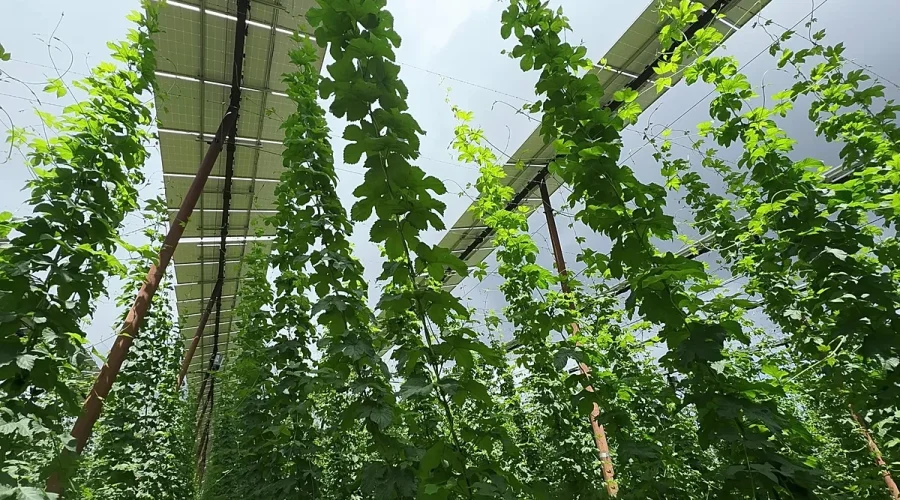
The answer he built is unmistakable from a distance: rows of photovoltaic panels suspended seven metres above the hop rows, forming a vast pale-blue canopy across five hectares. The concept — agri-photovoltaics, or agri-PV — overlays renewable energy generation onto active crop cultivation within a single footprint. By intercepting a portion of direct solar radiation before it strikes the foliage, the array lowers canopy temperatures, curbs evaporative water loss, and recreates microclimatic conditions closer to what the crop historically experienced.
“We wanted to shade the hops because hops are a shade-loving plant,” Wimmer explains. “The years are getting hotter and drier.”
The energy return is equally significant. The installation delivers a peak output of two megawatts — sufficient to run the farm’s processing equipment and feed surplus electricity back into the regional grid through a five-kilometre cable linking the array to a local substation.
From Skepticism to Policy Case Study
The concept germinated roughly ten years ago, after Wimmer installed rooftop solar panels in 2009 and observed their field performance. Scaling that principle to agricultural dimensions was another matter entirely, and local reaction was predictably sceptical.
“There were voices saying ‘Wimmer’s lost it now, that’ll never work!'”
Construction turned the farm into a daily spectacle. Neighbours drove past to inspect scaffolding; after each major storm, questions multiplied about whether wind had torn the canopy apart.
“But everything is still standing, even after the storms,” Wimmer laughs.
Curiosity rippled outward. Growers from neighbouring villages made the trip to study the system firsthand, followed by municipal councillors, district administrators, and eventually ministers travelling from Munich. What began as one farmer’s experiment became a reference point for Bavarian agricultural policy — and a template for others seeking excellent profit in an era of climate volatility.
Bernhard Gruber, a former Airbus engineer who pivoted to solar innovation, supplied the structural and electrical engineering backbone. Together they spent two years navigating planning permissions, grid-connection agreements, and environmental assessments before construction could proceed.
“Long approval procedures are a problem. They put some farmers off going for agri-PV on a larger scale, because the bureaucratic effort is simply too great for many of them,” Gruber notes.
FAQ: Practical Questions on Agri-PV for Hop Cultivation
Can agri-photovoltaic canopies be applied to crops other than hops? Yes. The same shading-and-generation principle suits shade-tolerant vegetables, berries, and certain medicinal herbs. Hops benefit particularly because their natural preference for partial shade aligns with the attenuation profile of a PV array.
What peak output can a five-hectare hop-field installation realistically deliver? Wimmer’s system produces approximately two megawatts at peak, enough to cover on-farm processing loads and export surplus power to the grid. Actual figures vary with panel density, tilt angle, and regional irradiance.
How long does permitting typically take before construction begins? In Wimmer’s case, roughly two years were consumed by planning permissions, grid-connection agreements, and environmental assessments. Gruber cautions that bureaucratic friction remains the single largest barrier preventing wider adoption among smaller growers.
Does the canopy reduce hop yield or quality? Wimmer reports that the microclimatic moderation — lower peak temperatures, reduced evaporative stress — stabilises alpha-acid synthesis and protects soil biology during drought periods, supporting both volume and aromatic quality. The economic upside he describes as excellent profit stems from combining stable crop output with continuous electricity revenue.