Exploring Andorra Beyond the Slopes
Usagevpn.com – Exploring Andorra often surprises travellers who assumed the Pyrenean microstate offered nothing but powder snow and duty-free racks. Yet roughly eight million visitors cross its borders each year against a resident population of about 85,000 — a ratio that eclipses both France’s ~102-million annual arrivals and Spain’s projected 100-million figure for 2026. Strip away the ski season and the retail strips, and what surfaces is a destination layered with medieval governance, contemporary sculpture, thermal heritage, and ridge walks that frame the capital from above.
At just 468 square kilometres, the territory technically holds the title of Europe’s largest microstate, edging out Vatican City, Monaco, Malta, Liechtenstein, and San Marino. Its position in a mountain corridor has long funnelled winter sport visitors into its resorts, but the off-season reveals a far richer cultural and natural landscape.
The Highest Capital in Europe
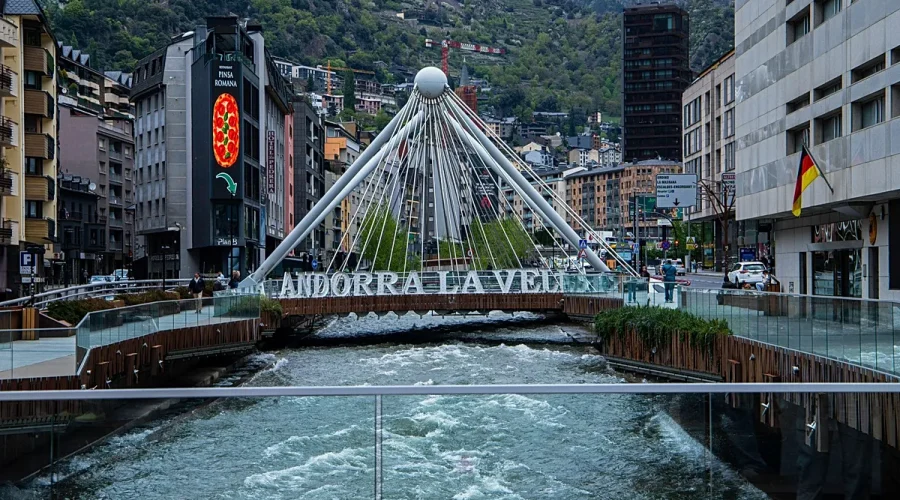
Andorra la Vella sits at an altitude that makes it the continent’s highest national capital. Among its most photographed compositions is Salvador Dalí’s bronze La Noblesse du Temps, set against the Puente de Paris bridge — a backdrop helpfully emblazoned with a large place-name sign for anyone unsure of their location.
Weighing roughly 1,400 kilograms, the sculpture depicts a melting clockface atop a tree trunk. Enric Sabater, a close personal friend of the Catalan artist, gifted it to the government in 1999; it was relocated to its present public position in 2010. Unlike thronged viewpoints elsewhere, this piece rarely demands a queue for a clean photograph.
“The crown above the clock represents the dominion of time over humanity.” — Andorra la Vella tourism board
Above the City: Rec del Solà
For a vantage that frames the entire capital from above, the Rec del Solà trail follows an old irrigation channel through the hills ringing the town. The Visit Andorra website lists the full loop at up to three hours, though a brisk walker can finish it in well under sixty minutes. At the trail’s terminus, a fifteen-minute descent drops you into the Barri Antic, where cobblestone lanes and centuries-old stone façades begin.
Casa de la Vall and Co-Principality
If time permits only one museum visit, make it Casa de la Vall. Built in 1580, this historic residence served as the seat of the General Council until 2011. Exhibits trace the origins of the country’s unique co-principality — a system in which the Bishop of Urgell and the President of France jointly act as heads of state — alongside the evolution of the national flag and coat of arms.
A particular curiosity is the cabinet of seven keys: a locked display case holding one key for each parish, a tangible reminder of how local governance still shapes the microstate’s identity. Directly adjacent stands the new parliament building, while nearby Església de Sant Esteve anchors the quarter as one of the nation’s oldest surviving churches.
Seven Fibreglass Poets
In the plaza beneath the modern parliament, Jaume Plensa’s 7 Poets (installed 2014) presents seven fibreglass figures on individual pedestals. After dark, embedded lighting transforms the group into a quiet, glowing assembly that draws small crowds of onlookers.
“Poets are an integral part of society. They are condemned to failure, because they know they won’t even sell three books, but they are a source of fertility, like a light drizzle that penetrates the earth. In my opinion, this long process, akin to that of a farmer, is highly courageous.” — Jaume Plensa
Taxes, Textiles, and Thermal Water
Famously low VAT rates have made cross-border shopping a weekly ritual for residents of neighbouring France and Spain. The so-called Shopping Mile in the capital stocks major international fashion labels alongside local retailers, catering to visitors who want brand-name goods at reduced tax.
The third pillar of tourism — spas — traces its roots to the natural hot springs at Escaldes-Engordany. Those thermal waters originally powered the textile industry before the first dedicated thermal hotels opened in the mid-nineteenth century, converting industrial steam into leisure infrastructure that still anchors the town’s identity today.
Frequently Asked Questions
Do I need a visa to visit? As an EU-associated territory, the microstate is part of the Schengen Area. Passport holders from most Western nations can enter without a visa for stays up to 90 days.
What currency should I carry? The euro is official. ATMs are plentiful in Andorra la Vella and Escaldes-Engordany, though smaller villages may have limited cash facilities.
Is the Rec del Solà trail suitable for families? Yes. The loop is graded as easy-to-moderate with a gentle gradient along an old water channel. Sturdy footwear is advisable; no technical climbing is required.
When is the best time to explore beyond skiing? Late May through October offers warm days, open trails, and fewer crowds. Winter remains viable for thermal spas and indoor culture, but many mountain paths close under snow.