Belgium’s High Fens Blaze Burns Toward the German Border as Hundreds Are Evacuated
Usagevpn.com – A wildfire of extraordinary scale is consuming the peatland expanse of Belgium’s High Fens nature reserve, sending plumes of dense smoke rolling eastward toward the German frontier. Roughly 30 square kilometres of terrain have been scorched to date, placing this event among the most destructive wildfires the country has faced in recent decades. Around 600 residents from communities bordering the reserve have been ordered to leave their homes as shifting winds continue to drive the flames in a westerly-to-easterly direction, narrowing the distance between the active fire front and the international boundary.
A Firefighting Operation in Extreme Terrain
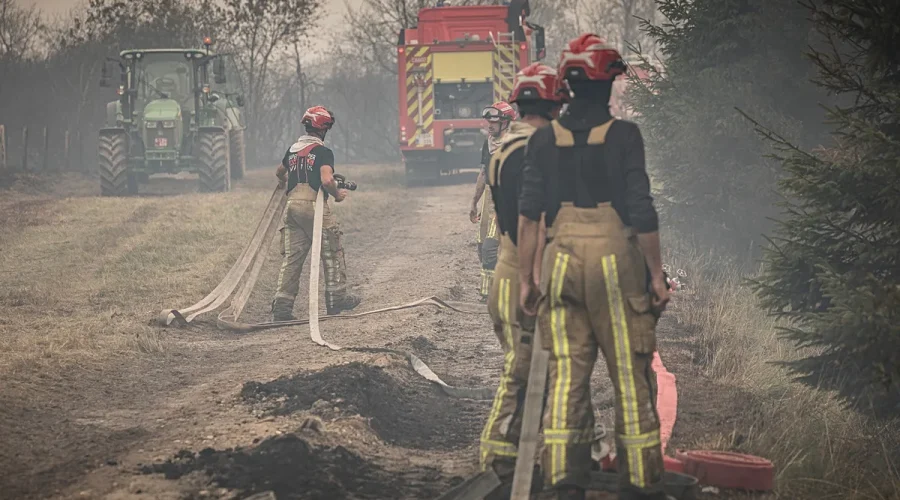
The High Fens — a vast, boggy peatland straddling the Belgian-German border in the Ardennes highlands — presents firefighters with conditions that make conventional suppression tactics extraordinarily difficult. The ground is soft, waterlogged in places yet parched in others, and the organic peat substrate can smoulder metres below the surface long after visible flames have been knocked down. Crews advancing through thick smoke have been observed spraying water directly onto burning and smouldering patches while simultaneously felling trees to create firebreaks and slow the advance of the blaze. Tankers and heavy fire engines have been brought into the operation to sustain water supply in terrain where municipal hydrants are absent and access roads are limited.
The combination of peat smouldering and active crown fire means that even after a section appears visually contained, residual heat can reignite the fuel bed within hours, particularly under dry, windy conditions. Firefighters therefore work in rotating shifts, maintaining a continuous presence around the perimeter to prevent the fire from re-establishing momentum.
Scale and Historical Context
At approximately 30 square kilometres of burned area, this event dwarfs most Belgian wildfire incidents on record. The country’s temperate maritime climate historically produced only small, quickly extinguished brush fires, but a succession of hotter, drier summers in recent years has increased the frequency and severity of larger blazes. The High Fens, with its thick accumulation of centuries-old peat, represent a particularly combustible landscape once surface moisture drops below critical thresholds. The August timing of this fire aligns with the period of lowest humidity and highest solar radiation in the region, compounding the risk.
The eastward trajectory of the fire, driven by prevailing wind shifts, has raised the prospect of a cross-border incident. If the blaze reaches the German side of the reserve, coordination between Belgian and German emergency services would become essential, adding logistical complexity to an already demanding operation.
Evacuations and Local Impact
Approximately 600 people have been evacuated from settlements adjacent to the reserve. The order to leave was issued as a precautionary measure given the unpredictability of wind direction and the potential for spot fires to leap the active front. Local authorities have set up reception points where displaced residents can register, receive basic supplies, and await updates on when it is safe to return. Schools and small businesses in the affected corridor have suspended operations.
The smoke itself has degraded air quality across a wide radius, prompting health advisories for residents in downwind areas who may experience respiratory irritation. Visibility on nearby roads has dropped sharply at times, complicating both civilian travel and emergency-vehicle access to the fire line.
International Aerial Support
Belgium has received firefighting assistance from abroad, including water-bombing aircraft and helicopters, to supplement the ground-based effort. Aerial drops allow crews to attack the fire from above in areas where the terrain is too broken or too smoky for ground teams to operate safely. The helicopters also serve a transport role, ferrying personnel and equipment into staging areas that are inaccessible by road.
Such international cooperation is not unusual in European wildfire response; neighbouring countries routinely share aerial assets when a single nation’s fleet is insufficient for the scale of the event. The deployment of foreign aircraft underscores the seriousness with which authorities regard the threat posed by this blaze.
What Comes Next
As long as the peat continues to smoulder and winds remain variable, the fire is unlikely to be declared fully contained in the short term. Meteorological forecasts for the coming days will be closely monitored by incident commanders, who will adjust containment lines and evacuation perimeters accordingly. The priority remains preventing the fire from breaching the German border and protecting the remaining unburned sections of the reserve, which hold significant biodiversity value as one of Europe’s largest intact peatland ecosystems.
For now, crews continue their round-the-clock work in the smoke, cutting, spraying, and holding the line against a fire that has already consumed an area the size of several small towns.
Related Reading
Frequently Asked Questions
What is Belgium races to tame huge wildfire?
Belgium races to tame huge wildfire is the main topic of this guide. The article explains the context, practical details, and next steps readers should understand.
Why does Belgium races to tame huge wildfire matter?
Belgium races to tame huge wildfire matters because readers are looking for a useful answer, not just a short summary. Good content should match search intent and help them decide what to do next.