Malmedy’s 30th Giant Omelette Turns a Four-Metre Pan into Belgium’s Most Unusual Community Kitchen
Usagevpn.com – On a warm August afternoon in the Belgian Ardennes, the smell of rendered bacon fat and scorched egg whites drifted across the cobblestone streets of Malmedy, drawing hundreds of onlookers toward a single, absurdly oversized cooking vessel. What unfolded over the course of the afternoon was not a restaurant service, not a food-truck pop-up, and not a cooking competition. It was, by every measurable standard, the largest communal omelette ever attempted in the town’s history — and the thirtieth time the residents of this small, German-speaking enclave in eastern Belgium have gathered to do exactly that.
A Four-Metre Pan, an Open Fire, and Seven Thousand Two Hundred Eggs
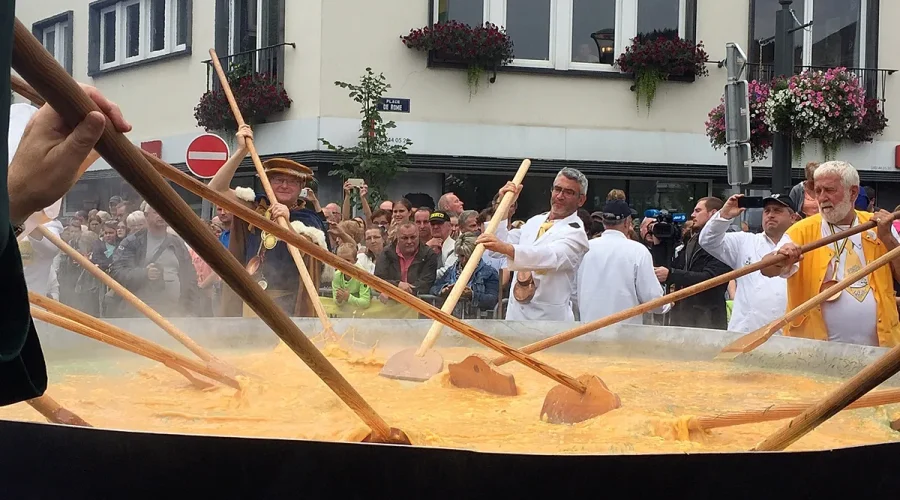
The vessel at the centre of the operation stretched roughly four metres across, perched over a roaring open flame that turned the surrounding air into a wall of heat. Volunteers, many of them regular townspeople who had signed up weeks in advance, worked in rotating shifts to crack, whisk, and pour the egg mixture into the pan in successive waves. Organisers confirmed that the total egg count for the 2026 edition reached 7,200 — a figure that translates to roughly 480 dozen eggs, or enough raw protein to feed a small village for several days if served in conventional portions.
The sequence of cooking followed a strict choreography. First, strips of bacon hit the searing metal, releasing a sharp, savoury smoke that announced the event to anyone within earshot. Once the fat had rendered and the meat had crisped, the first ladles of beaten egg, folded through with herbs and seasoning, cascaded into the pan. Long-handled tools — some nearly two metres in length — were used to fold and stir the mass, ensuring even cooking across the vast surface area. As portions set, teams moved in with bread loaves, slicing thick rounds to accompany each serving.
Portions were distributed freely to residents, visiting families, and the steady stream of tourists who had made the trip specifically for the spectacle. No ticket was required; no reservation was needed. The implicit social contract was simple: show up, wait your turn, and accept a plate of what amounted to a very large, very communal breakfast.
Three Decades of a Local Tradition
The tradition traces its origins to 1996, when a handful of Malmedy residents decided that the town’s summer calendar deserved an event as large and unapologetic as the landscape surrounding it. What began as a modest neighbourhood gathering has since grown into a fixed annual fixture, now in its thirtieth edition. The Ardennes region, where Malmedy sits near the borders of France and Luxembourg, has a long cultural history of communal food events — village feasts, harvest suppers, and seasonal cook-offs that reinforce local identity. The Giant Omelette occupies a distinctive niche within that tradition: it is neither a competition nor a charity fundraiser, but a purely celebratory act of collective cooking.
For a town of roughly 12,000 inhabitants, the logistical undertaking is considerable. Sourcing, transporting, and storing more than seven thousand eggs requires coordination among local farms, suppliers, and municipal authorities. The open-fire setup demands permits, safety marshals, and fire-watch protocols. Yet the organisers have maintained the event’s informal, neighbourhood-party character across three decades, resisting the temptation to commercialise or spectacle-ify the occasion beyond its original intent.
Why the Scale Matters
The number 7,200 is not merely a headline figure. It represents a deliberate escalation from earlier editions, reflecting both the growing appetite of visitors and the volunteers’ willingness to push the boundaries of what a single pan can absorb in one sitting. Culinary historians note that omelettes of this magnitude are rare outside of festival contexts; the physics of heat distribution across a four-metre diameter mean that cooking times, folding intervals, and seasoning ratios must be adjusted far beyond any home-kitchen logic. The result, by all accounts, is a dish that tastes of smoky bacon, fresh herbs, and the particular char that only an open flame can produce.
For the residents of Malmedy, the event also functions as a seasonal marker — a reminder that summer is winding down and that the community has, once again, fed itself collectively. In a region where German-language culture persists alongside the broader Belgian and French linguistic landscape, such gatherings carry an additional layer of local identity: they are, in effect, a culinary assertion of place.
The Aftermath and the Next Edition
By evening, the pan had been scrubbed, the fire banked, and the last of the bread loaves distributed. Volunteers packed down their stations, and the streets of Malmedy returned to their ordinary quiet. The next edition is already anticipated — the thirty-first, in 2027 — and organisers have indicated that the egg count will be revisited, though no figure has been confirmed. Until then, the town’s collective memory holds the afternoon’s smoke, the clatter of long-handled tools, and the simple, improbable fact that seven thousand two hundred eggs became, for one evening, a shared meal.
Related Reading
Frequently Asked Questions
What is 7 200 eggs cracked for giant?
7 200 eggs cracked for giant is the main topic of this guide. The article explains the context, practical details, and next steps readers should understand.
Why does 7 200 eggs cracked for giant matter?
7 200 eggs cracked for giant matters because readers are looking for a useful answer, not just a short summary. Good content should match search intent and help them decide what to do next.