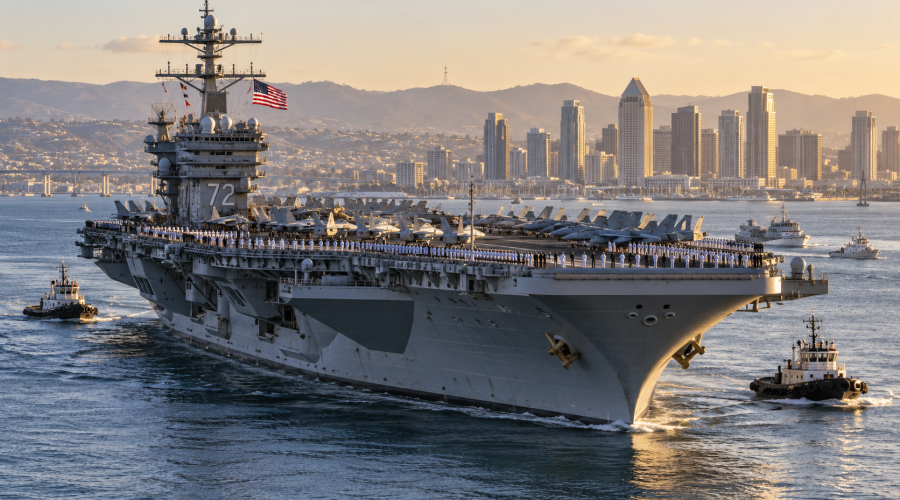
USS Abraham Lincoln Returns to San Diego After 265 Days at Sea
Usagevpn.com – The USS Abraham Lincoln arrived back in San Diego on Thursday, ending an unusually long and demanding deployment that kept the US aircraft carrier at sea for 265 consecutive days. The voyage set a record for the vessel and concluded after the carrier supported US military operations during the war against Iran.
Its return closes a deployment that placed thousands of sailors under sustained operational pressure for much of the past year. The Abraham Lincoln and its strike group, involving roughly 6,000 personnel, had originally departed California in November 2025 for an assignment in the South China Sea. Events in the Middle East then changed the ship’s course, sending it toward the region before US-Israeli attacks on Iran began in February 2026.
A Deployment Reshaped by Conflict
Aircraft carriers are designed to serve as mobile air bases, allowing the United States to position aircraft, crews and support capabilities far from home ports. That flexibility also means deployments can shift rapidly when military priorities change. For the Abraham Lincoln, the rerouting from the Pacific to the Middle East transformed what had begun as one mission into a far longer period away from California.
Spending 265 days continuously at sea is a notable burden for both the ship and those aboard it. Extended deployments can affect everyday life in ways that are less visible than flight operations or military planning: time away from families, reduced opportunities for rest, constrained supplies and the challenge of maintaining morale in a highly structured environment.
The carrier’s deployment drew national attention as concerns emerged about stress, mental health and access to basic products. Reports highlighted shortages involving food and hygiene supplies, raising questions about the conditions experienced by sailors during the prolonged mission.
The Navy initially played down the concerns, but later recognised that there had been problems aboard the ship. Among them were reduced meal choices, linked to limited chances to replenish supplies while the carrier remained deployed.
Mental Health Concerns Raised During Voyage
The Navy also told lawmakers that eight sailors attempted suicide during the deployment. Mental health is a significant concern across armed forces, particularly during long separations from home and periods of intense operational activity. The number prompted scrutiny of conditions on the Abraham Lincoln, although experts noted that it was comparatively low for a strike group of approximately 6,000 people operating over 10 months.
That assessment does not erase the seriousness of each incident. For military commands, any attempted suicide requires attention to the welfare of the individual sailor as well as the wider conditions affecting crews. Long deployments place added importance on access to support, leadership and practical resources that can help personnel manage stress.
The discussion surrounding the Abraham Lincoln also illustrated the tension between the demands of a major military mission and the human consequences for the people carrying it out. Operational success, logistics and crew wellbeing are closely connected: food supplies, hygiene products, rest and mental-health support can all influence a ship’s ability to sustain its mission over time.
Hegseth Presents Unit Award
US Defence Secretary Pete Hegseth visited the carrier on Wednesday, shortly before its return to San Diego. During the visit, he presented the crew with the Presidential Unit Citation, described as the highest military award given to a unit.
The recognition marked the ship’s role in the conflict and offered public acknowledgement of the crew’s service during the deployment. Hegseth also pushed back against characterisations that the carrier’s difficulties had come to define its mission.
“A symbol of dysfunction or a symbol of low morale or a symbol of a failed mission.”
His remarks addressed criticism that followed reports from the deployment. The carrier became a focal point for broader questions over whether sailors had received sufficient support while operating for so long without returning to port.
For the crew, the homecoming brings an end to a deployment that lasted far beyond the duration many sailors and families would have anticipated when the ship left California in late 2025. Returning to San Diego allows personnel to reconnect with relatives and gives the Navy an opportunity to assess the ship, its equipment and the needs of those who served aboard it.
What the Return Means
The Abraham Lincoln’s arrival does not end the wider debate over the conditions during its time at sea. The acknowledged supply limitations and the mental-health concerns remain important issues for naval leadership and lawmakers examining how future deployments are supported.
At the same time, the ship’s return highlights the central role aircraft carriers play when conflicts alter US military priorities. A vessel assigned to one region can be redirected across the world, but such flexibility depends on crews who may spend months living and working under difficult conditions.
The 265-day deployment will stand as a defining chapter in the recent history of the USS Abraham Lincoln. It combined a record period at sea, a rapidly changing military assignment and close public attention to the wellbeing of the sailors who carried out the mission.
Related Reading
Frequently Asked Questions
What is US aircraft carrier Abraham Lincoln returns?
US aircraft carrier Abraham Lincoln returns is the main topic of this guide. The article explains the context, practical details, and next steps readers should understand.
Why does US aircraft carrier Abraham Lincoln returns matter?
US aircraft carrier Abraham Lincoln returns matters because readers are looking for a useful answer, not just a short summary. Good content should match search intent and help them decide what to do next.