Housing Takes Centre Stage as Spain’s Election Campaign Begins
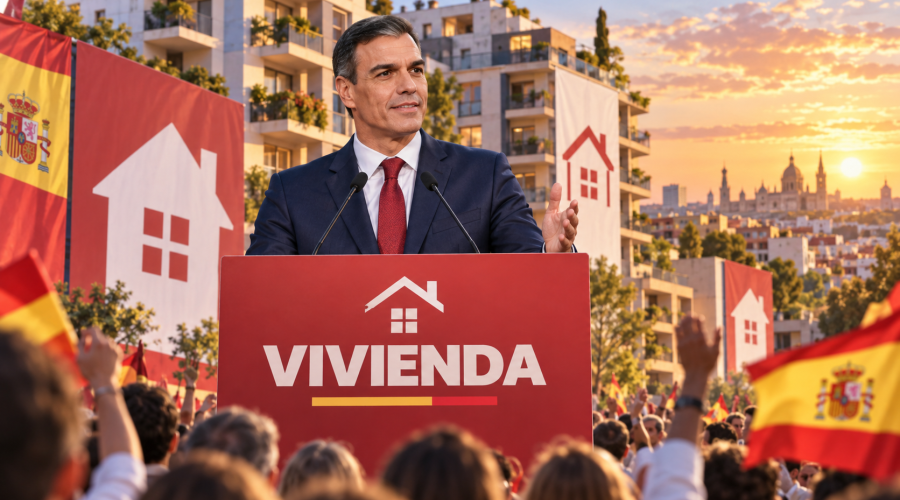
Usagevpn.com – Spain’s political parties have begun campaigning for the 29 November general election, with Prime Minister Pedro Sánchez placing housing pressures at the heart of his opening appeal to voters. Sánchez addressed a crowd of more than 5,000 people in Dos Hermanas, near Seville, choosing a location with strong symbolic value for the Spanish Socialist Workers’ Party (PSOE).
Dos Hermanas is the largest municipality in Andalusia still governed by the Socialists after the latest regional elections. It also holds a particular place in Sánchez’s political story: in 2017, he started his successful effort to regain the PSOE’s general secretariat there. His national campaigns in both 2019 and 2023 likewise opened in the town, which Alejandro Moyano, the PSOE’s deputy secretary for Organisation in Andalusia, has called the party’s “lucky city”.
A difficult electoral recovery
The setting offered a reminder of the scale of the challenge facing the Socialists. The party is seeking to rebuild support after a succession of setbacks: the 2022 Andalusian election, the 2023 municipal and general contests, the 2024 European election and the Andalusian vote held earlier this year.
Sánchez used his launch speech to frame the campaign around social concerns, especially the struggle many people face in securing and keeping a home. He paid tribute to Maricarmen Abascal, the 87-year-old woman who has become an emblematic figure in housing demonstrations across Spain.
“The social cause bears the name of an 87-year-old woman.”
The prime minister also repeated Abascal’s message about the hardship she has endured and her wish that others should not experience the same thing.
“What I have suffered, I don’t want anyone else to go through.”
By elevating her story, Sánchez sought to connect an individual experience of housing insecurity with a broader electoral argument about affordability, stability and public policy. Housing has become a prominent issue for voters as the campaign gets under way, giving the governing party a theme through which it can argue for its social agenda.
Sánchez targets the opposition
The PSOE leader also launched a forceful attack on his political rivals, accusing them of relying for eight years on what he described as fear-based messaging. Drawing on the tale of The Boy Who Cried Wolf, Sánchez turned the fable against his opponents.
“They are the wolf.”
He presented the People’s Party as facing a choice he summarised with the Spanish expression “susto o muerte”, meaning “fright or death”. In Sánchez’s formulation, the party insults when it is out of power and imposes cuts when it governs.
The remarks set the tone for a campaign expected to be highly confrontational. For Sánchez, the central contrast is between a government he portrays as defending social protections and an opposition he says would weaken them. The message is intended to mobilise voters who may have been discouraged by the Socialists’ recent defeats while also focusing attention on everyday economic concerns.
Feijóo promises change
Alberto Núñez Feijóo, president of the People’s Party (PP) and leader of the opposition, opened his own pre-election campaign in Madrid on Saturday. He told supporters that he would devote himself fully to those attending the event and to the millions of Spaniards who want political change.
Feijóo responded sharply to Sánchez, contrasting his own record with the prime minister’s political style. He said his background was not rooted “in the saunas or the sewers”, but in management and administration. He pointed to experience in presenting and balancing budgets, protecting public services and taking responsibility in prosperous periods as well as difficult ones.
The PP leader’s argument is designed to make competence and change the defining themes of his campaign. While Sánchez is stressing housing and social protection, Feijóo is presenting himself as a manager capable of restoring confidence in government and handling public resources responsibly.
An Expanded Electorate
The early election called for 29 November will involve a notably larger group of Spaniards living outside the country. A total of 2,769,645 voters with Spanish passports who reside abroad are eligible to take part. That is an increase of 444,335 people compared with the 2023 election, representing growth of more than 19%.
The expansion reflects the effect of the so-called “Grandchildren’s Law”, which has widened access to Spanish nationality for descendants abroad. The larger overseas electorate means that campaigns will need to consider voters whose lives are based beyond Spain’s borders but who retain a direct stake in the country’s political direction.
Spain’s electoral register has increased by 1.26 million people since 2023. At the same time, 1.6 million young people have reached voting age and are eligible to vote for the first time. These changes add another layer of uncertainty to the contest, as parties try to persuade both a growing expatriate electorate and new generations of voters.
With housing, public services, management and political change already emerging as defining lines of argument, the campaign is set to test whether Sánchez can revive Socialist support or whether Feijóo can translate demands for change into a winning majority. The outcome on 29 November will depend not only on established party loyalties, but also on how these expanding groups of voters respond to the competing visions now being offered.
Related Reading
Frequently Asked Questions
What is Spanish PM Sánchez launches campaign?
Spanish PM Sánchez launches campaign is the main topic of this guide. The article explains the context, practical details, and next steps readers should understand.
Why does Spanish PM Sánchez launches campaign matter?
Spanish PM Sánchez launches campaign matters because readers are looking for a useful answer, not just a short summary. Good content should match search intent and help them decide what to do next.