Beneath the Ski Slopes: How Switzerland’s Winter Infrastructure Could Combat Rising Wildfire Threats
Usagevpn.com – Under the blazing August sun above Adelboden, the landscape appears almost devoid of its usual winter character. Skiers are nowhere to be found, and snow is scarce at these mid-altitude elevations. Yet this Swiss mountain community may soon deploy its cold-weather machinery for an entirely different purpose: battling the growing threat of forest fires across Europe’s warming climate.
Switzerland’s alpine glaciers have been retreating at an alarming pace in recent years, part of a broader pattern of environmental transformation driven by human-caused climate change. Snowfall patterns have grown increasingly unpredictable over multiple decades, creating significant challenges for mountain resorts that depend on reliable winter conditions.
The Hidden Network Beneath the Slopes
The Adelboden-Lenk region presents a particular vulnerability. With approximately 200 kilometers of ski runs stretching between 1,000 and 2,300 meters above sea level, the resort has adapted to changing conditions by producing roughly seventy percent of its snow artificially. The visible snow cannons and lances represent only a fraction of the resort’s snowmaking capability.
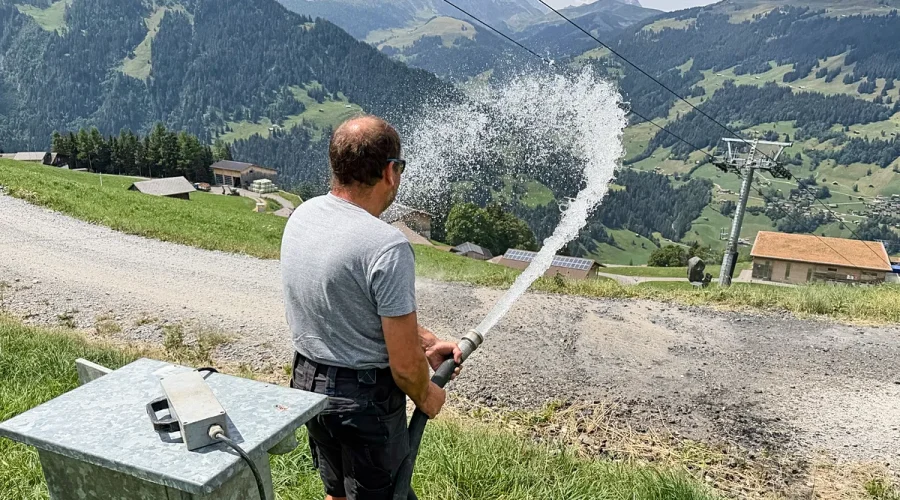
Far beneath the surface lies an extensive network of underground water pipes spanning dozens of kilometers. This subterranean infrastructure, designed to supply water to snow production equipment during winter months, may soon serve a critical role in summer firefighting efforts. The system connects 210 snow cannons and fifty snow lances throughout the Adelboden-Lenk area.
Reservoirs scattered throughout the region collect rainfall and melting snow during warmer months. This stored water powers snow production throughout the ski season, but it also represents a valuable resource when emergency services need to combat spreading flames.
Firefighting Potential in Mountain Communities
Jürg Klopfenstein, who oversees snowmaking operations at the resort, explained the dual-purpose potential of their infrastructure. “We can help firefighters with our infrastructure,” he noted. “Not primarily with our snow cannons, which can mainly be used to water the fields or aim them at surrounding infrastructure. But firefighters can use our infrastructure, and helicopters can refill their tanks using our water reservoirs.”
In the event of a wildfire, this water network could create wet buffer zones that slow flame progression. These moisture barriers would buy crucial time for ground crews and aerial firefighting units to arrive and establish containment lines. The strategy represents a proactive approach to wildfire management in regions where traditional water sources may be limited.
Switzerland has avoided catastrophic fires this year compared to neighboring countries, yet drought conditions persist. Authorities have classified wildfire risk as high across nearly the entire nation, including the Bern region where Adelboden sits. The concern extends beyond summer months, as spring and early summer dryness can create tinderbox conditions.
Expert Perspectives on Long-Term Viability
Stefan Buchs, the resort’s operations manager, acknowledged that Switzerland’s wildfire risk differs from southern European patterns. “Different types of vegetation and different levels of soil humidity mean the large and frequent forest fires seen in southern Europe can’t be extrapolated directly into a similar risk in the Alps,” he explained. Nevertheless, he emphasized that “widespread wildfires are a likely scenario.”
The Bernese Oberland region attracts diverse summer visitors beyond winter sports enthusiasts. Mountain bikers, hikers, runners, and paragliders all contribute to increased human presence in forested areas during warmer months, potentially raising ignition risks.
Local officials recognize the urgency of preparation. Adelboden Mayor Willy Schranz stated plainly that “we must be prepared, because I am sure it won’t be the last summer like this one.” Firefighters in the region have already identified humidity levels as a critical concern, noting that conditions can become extremely dry well before peak summer temperatures arrive.
However, climate experts caution against viewing infrastructure adaptations as permanent solutions. Nathan Solothurnmann, a climate specialist with Greenpeace, warned that while Adelboden’s planned watering system “might for sure help for a while,” the broader environmental challenges remain severe. “All those types of adaptations, they just help for a while,” he observed.
Solothurnmann also highlighted a geographic limitation: “In most parts of Switzerland, there are no pipes buried underground that we can use when a forest is burning.” This distinction means that resorts like Adelboden-Lenk possess unique advantages that may not be replicable across all Swiss mountain communities.
As Europe continues experiencing increasingly intense heatwaves, the intersection of winter infrastructure and summer emergency response offers a compelling model for climate adaptation. Whether this approach proves sufficient against escalating wildfire threats remains to be seen, but the potential benefits for mountain communities appear substantial.
Related Reading
Frequently Asked Questions
What is Snow cannons and reservoirs?
Snow cannons and reservoirs is the main topic of this guide. The article explains the context, practical details, and next steps readers should understand.
Why does Snow cannons and reservoirs matter?
Snow cannons and reservoirs matters because readers are looking for a useful answer, not just a short summary. Good content should match search intent and help them decide what to do next.