Sánchez Defends Spain’s Migration Strategy Amid EU Dispute
Usagevpn.com – Spanish Prime Minister Pedro Sánchez has pushed back against criticism of Spain’s migration policies from several European leaders, arguing that the political debate does not reflect the available evidence on irregular arrivals and migration management.
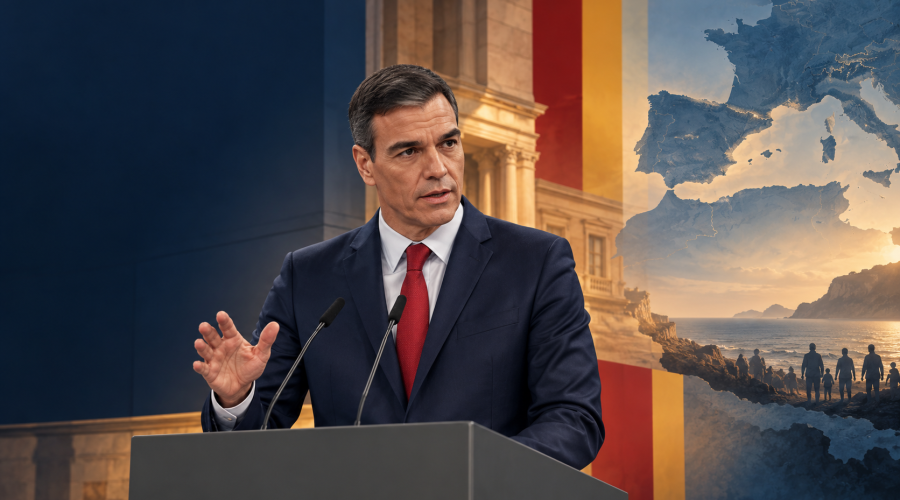
Speaking in Brussels during a European Council summit on Friday, Sánchez defended his government’s approach, which combines action against irregular migration, management of legal migration channels and cooperation with countries of origin and transit.
“If you look at the facts, at the figures – which is kind of always what happens with the far right – it’s like night and day.”
He said the claims made about Spain’s policies were disconnected from the situation on the ground.
“What is being said has nothing to do with reality (…) one thing is the blah, blah, blah and another is reality.”
Criticism over regularisation plan
Sánchez was responding to concerns raised by Czech Prime Minister Andrej Babiš, Danish Prime Minister Mette Frederiksen and Austrian Chancellor Christian Stocker. Their objections have focused in particular on Spain’s extraordinary plan to regularise the status of migrants, a measure affecting 600,000 undocumented people.
Stocker described the initiative as a “bad signal” and warned that national decisions on migration could have repercussions beyond one country’s borders. Frederiksen has urged the European Commission to assess the consequences of Spain’s measures for the wider European Union.
Babiš was more forceful in his criticism, accusing some European leaders of being prepared to “replace the population” in order to retain power. He also said the Czech Republic could strengthen border checks to stop migrants arriving from other EU member states.
Sánchez drew a distinction between the Danish leader’s position and the Czech prime minister’s language. He said disagreements with Frederiksen were part of a legitimate policy debate, while comparing Babiš’s remarks to messaging used by Spain’s far-right Vox party.
“With the Danish prime minister we have disagreements, but indeed, it has nothing to do with what the prime minister of the Czech Republic said, which, by the way, sounds very much like what the far-right Vox says in Spain.”
Spain points to enforcement and cooperation
The Spanish leader insisted that his government has been acting responsibly on migration. He cited interceptions in the Atlantic, returns and refusals of entry at airports as examples of enforcement measures already in place.
Spain has also sought to work with countries through which migrants travel and countries from which they depart. Sánchez said that partnership with those states is a central element of a strategy intended to reduce dangerous and irregular journeys before they reach Spanish territory.
“The migration and asylum pact that we secured under the Spanish presidency is working.”
He described Spain as “a model pupil” in efforts to address irregular immigration and rejected the argument that the country is becoming a key gateway for migrants moving onward through the European Union.
“The reality, the data show that Spain is pursuing a very responsible policy in the fight against irregular migration, in managing regular migration flows and in cooperation with transit and origin countries.”
The dispute highlights one of the most difficult questions in European migration policy: whether actions taken by one member state can alter migration incentives or pressures elsewhere in the bloc. Countries calling for stronger coordination argue that national regularisation measures can have effects beyond their own borders. Spain, meanwhile, maintains that its policies should be judged by outcomes rather than political rhetoric.
Migration pact remains at centre of EU debate
European Commission President Ursula von der Leyen also called for continued implementation of the EU migration and asylum pact, while acknowledging that member states remain divided on how best to manage arrivals.
She said irregular crossings at the EU’s external borders had declined by more than 56% during the previous two years. Her stated priorities were completing the pact’s implementation, improving the management and protection of external borders, and ensuring the bloc is better prepared for possible crises at its frontiers.
Von der Leyen said the Commission would propose strengthening Frontex, the EU border agency, so it can offer greater support to member states when necessary. She stressed that the European approach must balance national responsibility with solidarity among countries facing different levels of migration pressure.
“To succeed, it is necessary to continue acting together.”
That appeal comes as Denmark, Poland and Italy sought changes to the summit’s conclusions. Their proposal included an indirect reference to Spain’s regularisation initiative and called for member states to avoid measures that might encourage illegal migration.
Spain and France opposed that wording. A later draft called more generally for stronger coordination by the European Commission when national migration decisions could affect other member states. The broader, sharper language was eventually dropped in favour of a shorter and less forceful formulation.
A wider political divide
Sánchez used the debate to argue that Europe needs competing political visions, including the perspective offered by Spain’s progressive government. For him, the disagreement is not only about border management but also about the language and assumptions shaping the continent’s migration debate.
The practical challenge remains substantial. EU governments must apply the migration and asylum pact while managing external borders, sharing responsibility among member states and maintaining cooperation with countries outside the bloc. The argument over Spain’s regularisation plan shows that even when leaders broadly agree on the need for coordination, they remain far apart on the policies they believe will deliver it.
Related Reading
Frequently Asked Questions
What is Sanchez rejects criticism of Spain s migration?
Sanchez rejects criticism of Spain s migration is the main topic of this guide. The article explains the context, practical details, and next steps readers should understand.
Why does Sanchez rejects criticism of Spain s migration matter?
Sanchez rejects criticism of Spain s migration matters because readers are looking for a useful answer, not just a short summary. Good content should match search intent and help them decide what to do next.