Wildfire-Scarred Hillside Becomes Canvas as Activists Challenge New PM on Fossil Fuels
Usagevpn.com – Five consecutive heatwaves have battered Britain through the summer of 2026, pushing temperatures to record highs and leaving nearly three-quarters of the country under drought conditions. More than 27 million residents now live under water-use restrictions, and Greenpeace estimates that roughly 2,700 excess deaths were linked to the May and June heat spikes alone. Against that backdrop, a coalition of climate campaigners chose a scorched hillside in north Wales to deliver what they describe as an unambiguous warning to the nation’s newest head of government.
A 1,120-Square-Metre Message Written in Fire-Blackened Earth
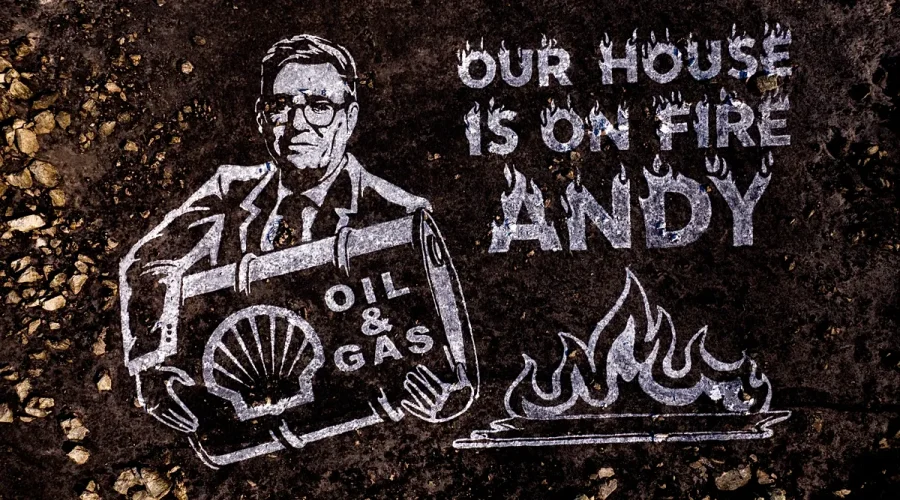
At Sychnant Pass within Eryri National Park, Conwy, members of Greenpeace joined forces with the art collective known as A Letter From Lucy to paint a vast mural directly onto ground already charred by wildfire. The piece spans 1,120 square metres and was executed using eco-friendly, plastic-free pigment of the type normally reserved for sports-field markings. Its central text reads: “Our house is on fire, Andy.” Beside the words sits an illustration depicting Prime Minister Andy Burnham tipping a barrel labelled “oil and gas” into a blaze.
The phrasing is a deliberate callback to Greta Thunberg’s 2019 address to world leaders, in which the then-teenage Swedish activist declared that “our house is on fire.” By adapting that line to name the sitting PM, the artists aimed to personalise a warning that had, until now, been aimed at governments collectively.
Timing: The Final Day of the Rosebank Consultation
The unveiling was not accidental in its timing. It fell on the last day of a public consultation over Rosebank, the largest undeveloped oil field in the United Kingdom. A parallel consultation covering the Jackdaw gas field had closed just seven days earlier. Both projects sit at the final regulatory stage: developers have resubmitted revised environmental assessments following a Scottish court ruling in January 2025 that struck down the original consents because they had failed to account for downstream emissions generated when the extracted fuel is ultimately burned. Ministers now face a decision on whether to grant fresh approvals.
Rosebank was originally sanctioned in 2023; Jackdaw received its initial consent in 2022. The January 2025 judicial intervention forced both developers back to the drawing board, and this summer’s consultations represent the last procedural hurdle before a final ministerial call.
“A Change of Emphasis,” Not a Reversal
Despite Labour’s manifesto pledge not to issue new North Sea licences, Deputy Labour Leader Lucy Powell has characterised Burnham’s posture as a “more pragmatic” orientation toward existing and pending hydrocarbon projects. In her framing, the shift constitutes a “change of emphasis” rather than a wholesale policy reversal. Powell explained that the government remains bound by its election commitment against new licences, yet Burnham wishes to “work with the industry” so that oil and gas revenues can continue feeding the energy transition “over the long term.”
For critics, that distinction is thin. The North Sea has supplied roughly a fifth of Britain’s energy needs over recent decades, and any extension of its operational life carries implications for carbon budgets, coastal communities, and the pace at which renewables must scale. Whether a government can simultaneously honour a no-new-licences pledge while courting expanded extraction from already-approved fields is precisely the question the activists believe Burnham has dodged in his first weeks in office.
Greenpeace: Nothing Pragmatic About Watching Communities Burn
Maja Darlington, a Greenpeace campaigner, dismissed the government’s self-description as pragmatic. Her remarks, issued alongside the artwork’s unveiling, drew a sharp line between rhetoric and lived experience.
“There is nothing pragmatic about watching communities be battered by climate chaos while the Prime Minister flirts with expanding the very industry driving it. This summer has been an endless showreel of fossil-fuelled disasters playing out across the country.”
Darlington pointed to the human toll already accumulating: firefighters working through unprecedented heat, bus drivers enduring inhumane cabin temperatures, nurses collapsing mid-shift. She argued that the climate crisis is falling hardest on working people who have the least capacity to shield themselves from its effects.
The Numbers Behind the “Carbon Bomb” Label
Campaigners have branded Rosebank a “carbon bomb.” Greenpeace-cited estimates place the project’s lifetime emissions at 254 million tonnes of CO₂ — a figure equivalent to nearly 70 per cent of the UK’s entire annual emissions recorded in 2024. Oxfam research, also referenced by Greenpeace, projects that if both Rosebank and Jackdaw proceed, their combined lifetime output would contribute to an estimated 65,495 excess heat deaths globally, a number the charity likens to wiping out the entire population of Clacton-on-Sea.
Those projections sit alongside the immediate reality of a British summer already tracking toward the warmest on record. The juxtaposition — record-breaking heat at home, a court-ordered re-examination of two major extraction projects, and a government signalling willingness to keep hydrocarbons in the energy mix — is what the Sychnant Pass mural was designed to make visible in a single, unavoidable image.
“Does the Prime Minister really want to stand with the oil companies making billions, rather than the millions already paying the price? Our message is simple: be brave — say no.”
Related Reading
Frequently Asked Questions
What is Our house is on fire Andy?
Our house is on fire Andy is the main topic of this guide. The article explains the context, practical details, and next steps readers should understand.
Why does Our house is on fire Andy matter?
Our house is on fire Andy matters because readers are looking for a useful answer, not just a short summary. Good content should match search intent and help them decide what to do next.