Alps Rockfall Record Shattered as 2026 Heatwave Turns Summer Into a Danger Zone
Usagevpn.com – Two Czech climbers were killed by a falling rock slab on Mont Blanc in July, and a third mountaineer perished under similar conditions in August. Their deaths are the latest grim markers of a season that has broken every historical benchmark for rockfall activity in the French Alps. Since January, observers have logged 450 separate rockfall events within the Mont Blanc massif alone — a figure that dwarfs the previous annual high of 300 set back in 2022 and that experts describe as genuinely unprecedented.
Why Summer Stopped Being Safe
For generations, alpine guides and mountain-rescue services treated the warm months as the lowest-risk window for high-altitude travel. Snowpack was stable, avalanche danger had largely passed, and the main hazards were weather-related rather than geological. That calculus has been overturned. Sustained temperatures pushing past 30 to 35 degrees Celsius — levels once confined to lowland cities — are now a recurring feature of high valleys and exposed ridgelines during July and August. The thermal stress is not merely uncomfortable for hikers; it is actively reshaping the mountain itself.
Ludovic Ravanel, a geomorphologist who directs research at the CNRS through the Edytem laboratory, has been tracking the consequences. He points to a dramatic spike in rock-face destabilisations and full-scale collapses that have no parallel in the instrumental record.
“Here temperatures have easily climbed above 30–35 degrees, and that obviously has impacts on the glaciers and on the permafrost. That is why this year we are recording unprecedented figures, for example in terms of the number of rock-face destabilisations and collapses.”
The Permafrost Engine
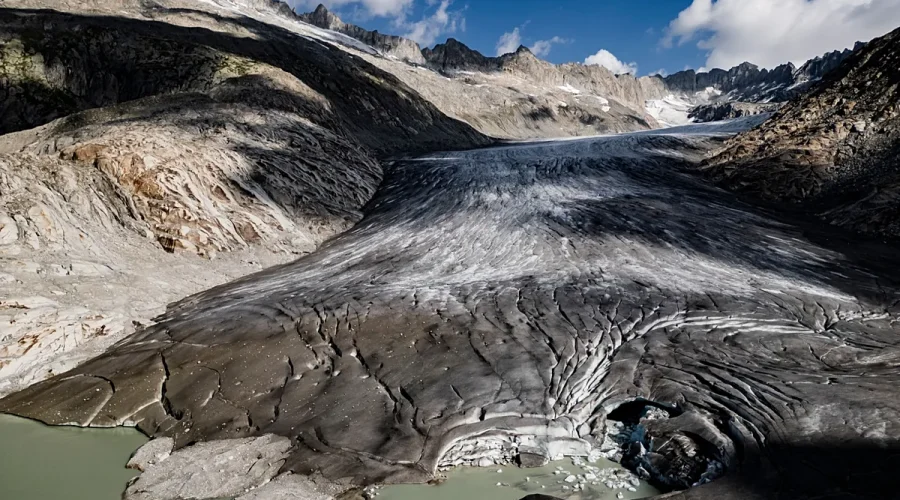
Beneath the visible surface of the Alps lies a vast network of frozen ground — permafrost — that has acted as a natural cement for steep rock walls for millennia. As ambient temperatures climb, that frozen matrix thaws, losing its binding strength. Simultaneously, glaciers that once pressed against valley walls exert a stabilising load on adjacent slopes. As those ice bodies thin and retreat, the pressure they applied is withdrawn, leaving rock faces structurally relieved and far more prone to fracture.
Ravanel explains that the combination of permafrost degradation and glacial retreat is now the primary driver of rock collapses and rock avalanches. The mountain is, in effect, losing two of its most important structural supports at the same time.
Two Centuries of Scars in Photographs
The evidence linking climate warming to slope failure is not merely statistical. Ravanel’s team has assembled a photographic archive spanning roughly two hundred years of alpine imagery. By overlaying and comparing these historical views, researchers can identify discrete “scars” — zones where rock faces have broken away — and measure the volume of material lost at each site.
“These photographs cover nearly 200 years of 200 years of climate warming. By comparing them with one another, we are able to identify the scars, that is to say the areas where rock faces have been destabilised. We can quantify them in terms of volume. And we have shown that 80 or 85% of these scars have formed over the past two or three decades. So there is a very clear relationship between climate warming and the destabilisation of rock faces.”
The concentration of damage in the most recent decades is, in the researchers’ assessment, incompatible with natural geological variability alone. It points squarely to the accelerated warming trend of the late twentieth and early twenty-first centuries.
What This Means for Mountaineers and Local Communities
For the thousands of climbers, hikers, and ski-tourists who still head for the high Alps each summer, the message is unambiguous: the risk profile of the season has shifted. Rockfalls that were once rare, episodic events are becoming frequent and prolonged, capable of striking routes at any hour of the day, not just during morning freeze-thaw cycles.
As of late August, neither French mountain authorities nor rescue organisations have moved to close high-altitude access or impose formal restrictions on climbing routes in the Mont Blanc massif. However, both experts and local officials are urging anyone above roughly 2,500 metres to exercise heightened vigilance — to check recent rockfall bulletins before setting out, to avoid lingering beneath obvious overhangs, and to accept that the window of relative safety that once defined the summer months no longer exists.
The coming autumn months, when freeze-thaw cycles intensify and residual summer heat continues to work through deep rock structures, may yet produce additional events. The 450 recorded so far in 2026 are, by current projections, unlikely to be the final tally. For a mountain range that has drawn human ambition upward for centuries, the geological clock is now ticking faster than anyone planned for.
Related Reading
Frequently Asked Questions
What is Heatwave in France?
Heatwave in France is the main topic of this guide. The article explains the context, practical details, and next steps readers should understand.
Why does Heatwave in France matter?
Heatwave in France matters because readers are looking for a useful answer, not just a short summary. Good content should match search intent and help them decide what to do next.