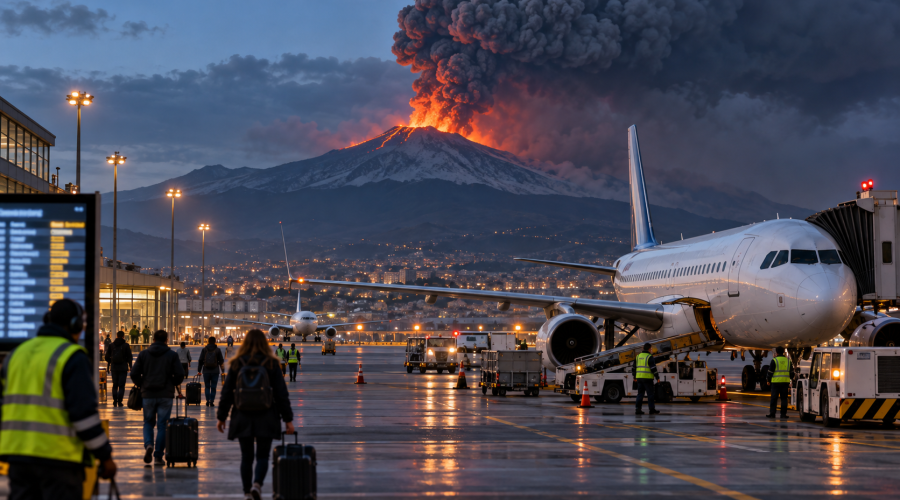
Etna ash cloud shuts Catania airport as stranded travellers face mounting disruption
Usagevpn.com – Volcanic ash from Mount Etna has again halted air traffic at Catania-Fontanarossa airport, cutting Sicily’s main eastern gateway off from scheduled arrivals and departures on Sunday 27 September.
Sac, the company responsible for the airport, closed the affected airspace after a substantial ash emission combined with unfavourable winds. Flight operations were first paused until midday, but the suspension was later prolonged until 23:59 on Sunday.
Passengers have been advised not to travel to the terminal before confirming their flight status directly with their airline. With aircraft unable to land or depart normally, travellers have been left seeking rebookings, road connections and other ways to continue their journeys.
Pressure spreads across Sicily’s airports
The shutdown has not been confined to Catania. Saturday’s interruption created immediate strain across the regional transport system as flights were redirected to other Sicilian airports, including Comiso, Palermo and Trapani.
Those airports suddenly had to accommodate diverted aircraft as well as their own scheduled services, adding congestion to terminals, ground operations and onward travel arrangements. For many passengers, the disruption has meant uncertainty over departure times, alternative airports and the availability of replacement tickets.
Etna’s activity can have consequences well beyond the area surrounding the volcano. Ash in the atmosphere may make normal flight paths unsafe, while wind direction can determine whether Catania’s airspace remains usable. The result is that an eruption can quickly become a region-wide aviation problem, affecting crews, airport workers, airlines and travellers across the island.
The latest stoppage has also renewed concerns over how Sicily manages a recurring risk. Mount Etna is one of Europe’s most active volcanoes, and its eruptions are not an abstract emergency for the communities and transport networks around it. When airport operations stop, the impact reaches holidaymakers, residents returning home, workers on business trips and families with limited flexibility to alter travel plans.
Fears of sharp fare increases
As passengers look for alternatives, consumer and civic groups have raised alarms over the possibility of air-ticket speculation. Acli Terra has highlighted unusually steep prices for connections to and from Sicily during the disruption, including a Verona-to-Palermo fare that rose to roughly €1,180.
The association has argued that a natural emergency should not create an additional financial burden for households. It has called for scrutiny of sudden price increases, warning that travellers can become especially vulnerable when flights are cancelled and available seats on other routes are scarce.
For people trying to leave or reach the island quickly, the closure of one airport can sharply reduce practical options. A diverted flight may arrive far from its intended destination, while a replacement booking can involve longer transfers and higher costs. Even where seats remain available, travellers may need to weigh the expense of a new ticket against uncertain information about when normal operations will resume.
The wider concern is not limited to a single day’s cancelled flights. Repeated disruption can affect confidence in the reliability of Sicily’s connections with the rest of Italy and Europe. Groups calling for greater oversight say the response to events linked to Etna must protect both passengers and the island’s broader transport reputation.
Unions call for a standing emergency plan
Transport unions have focused on the operational burden placed on staff during the shutdown. Filt Cgil, Fit Cisl and Uiltrasporti Sicilia have described the situation as “total chaos” and criticised the lack of a contingency arrangement tailored to an Etna eruption.
“Total chaos”
The unions maintain that volcanic disruption should no longer be treated as an exceptional event without preparation. In their view, Etna-related airport closures have become a structural challenge that requires clear and lasting procedures rather than improvised responses each time ash affects aviation.
Airline personnel and ground workers are among those facing the immediate consequences, dealing with frustrated passengers in a high-pressure environment while schedules, gates and aircraft movements change rapidly. The unions say workers need clearer operational instructions and stronger safeguards when the airport is forced to suspend activity.
They are again urging the Sicilian Region to establish a permanent protocol. Such a framework would set out dependable working arrangements during eruptions, define operational flows and provide adequate protection for staff. The central demand is to replace what the unions view as a cycle of recurring emergency management with a stable response plan.
For now, the immediate priority remains the restoration of safe flight operations at Catania-Fontanarossa. Until conditions permit the airspace to reopen, passengers are being asked to rely on airline updates before setting out for the airport. The episode underscores how quickly Etna’s activity can turn a local volcanic event into a major test for Sicily’s transport network, prices and emergency preparedness.
Related Reading
Frequently Asked Questions
What is Etna erupts again?
Etna erupts again is the main topic of this guide. The article explains the context, practical details, and next steps readers should understand.
Why does Etna erupts again matter?
Etna erupts again matters because readers are looking for a useful answer, not just a short summary. Good content should match search intent and help them decide what to do next.