When Scientists Took the Lectern: How a Climate Briefing Mimicked the Pandemic’s Most Powerful Moment
Usagevpn.com – There is a specific memory etched into the collective consciousness of European households from 2020 to 2022: the nightly television address, the lectern, the sober faces of ministers and chief medical officers delivering death tolls and behavioural instructions to a nation that, for once, listened. Group chats erupted with debate over whether the latest guidance meant another week of isolation or a cautious return to normalcy. The format worked because it collapsed the distance between expert knowledge and ordinary citizens into a single, unmediated channel.
Science communicator Simon Oldridge watched those broadcasts and asked a question that would eventually produce a 50-minute film screened to audiences across the United Kingdom. What would happen, he reasoned, if the same format were pointed not at a virus but at the slow-moving catastrophe of climate change? What if leading researchers stood before the public — or before the people who shape policy and capital — and laid out, in plain language, exactly how warming is reshaping weather patterns, food systems, healthcare infrastructure, and national security? The answer became the National Emergency Briefing, or NEB.
Borrowing the Architecture of Authority
Oldridge recruited his brother, climate science communicator Nick Oldridge, and together they brought in collaborators from the advertising world — former creative directors accustomed to the cutthroat pace of commercial production. Their contribution was aesthetic and strategic: the briefing had to carry the visual and tonal weight of a state address. Nick Oldridge explains the reasoning plainly.
“We turned up in sharp suits, which we never wear, and everything was designed to appeal to people in industry, people who are in the world of business as usual and think ‘we’re indestructible, nothing can really harm us.'” — Nick Oldridge
The logic was that the audience — senior politicians, heads of major corporations, government chief scientists — would only lean in if the presentation mimicked the gravity of an official communiqué. The format was stripped of entertainment trappings and rebuilt around authority, directness, and urgency.
Westminster Central Hall, Nearly 1,300 Seats
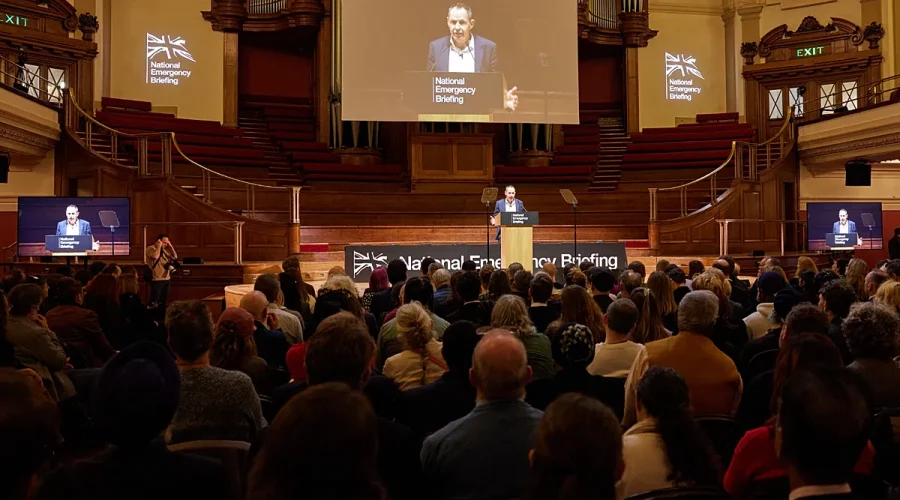
The event was invite-only and, by all accounts, generated a frenzy of requests. Oldridge recalls emails arriving from senior government figures asking whether they could attend. The venue chosen was Westminster Central Hall, the historic assembly space situated directly opposite the Houses of Parliament — the physical seat of British legislative power. Almost 1,300 attendees filled the room.
Each scientist was allotted ten minutes at the lectern. Slides accompanied verbal delivery of data on current and projected climate impacts. No journalists sat between the speakers and the audience; the information moved directly from researcher to decision-maker, what Nick Oldridge describes as arriving “without the filter of the media.”
The silence in the hall, Oldridge says, was unlike anything the organisers had anticipated. Attendees accustomed to multitasking and scepticism sat still for the full duration. Afterward, representatives from established non-governmental organisations emerged and reported being “profoundly moved.” Several people wept. The atmosphere, as Oldridge characterises it, carried the quality of a long-held secret finally spoken aloud in a shared space.
“Something happened in that room. Even hardened NGO people came out and said ‘I was profoundly moved’. Lots of people cried. There was a profound feeling of that pain being inspired and uplifted, as if a secret had finally been shared. As if they’re finally watching something get witnessed by everybody together. There was a huge, palpable sense of relief in that room.” — Nick Oldridge
From Live Event to Public Film
The presentations were recorded. The footage was then shown to a deliberately broad cross-section of the public, including a small number of well-known figures such as comedian and actress Jennifer Saunders. Their reactions were captured on camera — another technique borrowed from the advertising collaborators, intended to give viewers a human entry point into otherwise dense material. The finished product is a 50-minute film titled the People’s Emergency Briefing.
The NEB team’s stated goal is distribution to every person over sixteen across the full spectrum of society, regardless of political affiliation or prior engagement with climate science. The film’s structure follows the original briefing: scientists present findings in accessible language, avoid euphemism, and close each segment with a concrete explanation of actions available immediately to reduce the trajectory toward the worst-case outcomes.
Why the Format Matters
The pandemic demonstrated, perhaps more clearly than any prior public-health crisis, that a single authoritative voice delivered through a trusted channel can shift national behaviour within hours. The NEB project is an explicit attempt to replicate that mechanism for a threat that does not announce itself with a single dramatic inflection point but accumulates silently across decades. By placing scientists in the role of briefing officers and audiences in the role of citizens receiving instructions, the project collapses the usual layers of editorial interpretation, political spin, and institutional distance that dilute climate communication.
Whether a filmed briefing can sustain the urgency of a live, in-person event remains an open question. What is not in dispute is the premise: that the information already exists, that it is delivered by credible experts, and that the primary barrier to action is not ignorance but the absence of a moment in which the full weight of the evidence is presented to a room full of people who can act on it. The NEB team’s wager is that creating that moment — even in recorded form — is enough to move the needle.
Related Reading
Frequently Asked Questions
What is A secret had been shared?
A secret had been shared is the main topic of this guide. The article explains the context, practical details, and next steps readers should understand.
Why does A secret had been shared matter?
A secret had been shared matters because readers are looking for a useful answer, not just a short summary. Good content should match search intent and help them decide what to do next.