A New Budget Route Opens the Door to Galicia’s Pilgrimage Capital
Usagevpn.com – For centuries, the Camino de Santiago has drawn walkers, cyclists, and spiritual seekers along ancient paths toward the cathedral city of Santiago de Compostela. In 2027, that journey takes on added significance: the year is designated a Holy Year, meaning the Catholic Church grants a special indulgence to pilgrims who complete the route. With thousands of additional walkers expected to arrive at the city’s gates, a new low-cost carrier is preparing to ease the final leg of their trip home. Fly2Galicia, a budget airline purpose-built to serve the region, will begin scheduled departures from Santiago–Rosalía de Castro Airport on 1 December 2026, connecting the pilgrimage capital to eight European cities.
Routes and Pricing
The inaugural network splits between domestic and international legs. Within Spain, the carrier will link Santiago to Alicante, Granada, and Zaragoza. Across borders, flights will reach Brussels, Prague, Munich, Venice, and Milan. Tickets opened for sale ahead of the launch, with fares structured to undercut legacy carriers on the same corridors. A one-way seat from Milan to Santiago starts at €41; departures from Brussels, Prague, or Venice begin at €51; and the Munich route is priced from €71. For a pilgrim finishing a multi-week walk with a modest budget, those figures represent a meaningful reduction compared with full-service options that have historically served the airport.
Who Actually Flies the Planes
A practical detail worth noting: Fly2Galicia will not place its own aircraft into service on these initial routes. Instead, the flights will be operated by a separate European airline whose identity has not yet been publicly confirmed. This arrangement—common among start-up carriers in their earliest months—allows the brand to establish route authority, build passenger familiarity, and refine scheduling while a partner operator handles the actual flying. The unnamed partner will presumably transition operations to Fly2Galicia’s own fleet once certification and crewing are complete.
A Broader Wave of New Service
The Fly2Galicia announcement lands amid a wider expansion of air connectivity into Galicia. Wizz Air, the Hungarian ultra-low-cost carrier, confirmed earlier this year that it will open flights from Rome and Warsaw into Santiago beginning this December. Separately, the airline plans to establish a permanent operational base at the airport in February, accompanied by new domestic links to Málaga, Tenerife, Gran Canaria, Fuerteventura, and Zaragoza. Together, these additions transform an airport that has long relied on a thin schedule of seasonal and legacy-carrier flights into a node with year-round, multi-carrier service.
Why Santiago de Compostela Deserves the Attention
The city’s appeal extends well beyond its role as a pilgrimage terminus. Its Old Town holds UNESCO World Heritage status and has been called
“one of the world’s most beautiful urban areas”
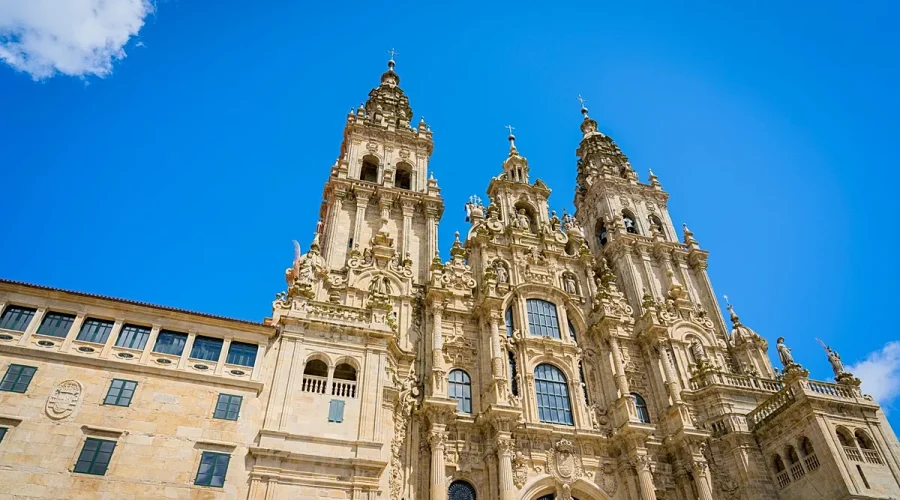
by heritage observers, owing to a layered architectural palette that spans Romanesque arches, Gothic spires, Baroque facades, and Neoclassical civic buildings. The Cathedral of Saint James, destination of every Camino route, anchors a medieval core where narrow lanes still follow medieval alignments.
Food and drink form a second pillar of the visitor experience. The Mercado de Abastos, a bustling wholesale food market, offers the day’s catch of Galician seafood alongside regional cheeses, cured meats, and produce. Pairing a plate of octopus or fresh oysters with a glass of Albariño—the crisp, mineral-driven white wine for which the Rías Baixas and Valdeorras appellations are celebrated—has become a near-ritual for visitors.
Beyond the Capital
Galicia’s attractions radiate outward from Santiago. The coastal cities of A Coruña and Vigo offer their own maritime heritage, modern waterfronts, and distinct culinary traditions. Further south, the Rías Baixas—a string of deep, fjord-like inlets studded with small islands—draws beachgoers, kayakers, and birdwatchers through much of the year. For a pilgrim with a few spare days after completing the Camino, these destinations are now reachable by short domestic hops once the new routes are fully operational.
What the Expansion Means for Travelers
The combined effect of Fly2Galicia’s launch and Wizz Air’s entry is to dismantle what had been a structural cost barrier for independent travelers. Previously, reaching or leaving Santiago often required routing through Madrid or Barcelona at premium fares, or accepting limited seasonal schedules. With multiple carriers now competing for the same passenger, prices should continue to soften, and schedule reliability should improve. For the estimated surge of Holy Year pilgrims in 2027, the additional capacity arrives at precisely the moment demand peaks—offering a practical, affordable exit route for those whose spiritual journey ends at the cathedral steps.
Related Reading
Frequently Asked Questions
What is This new budget airline is launching?
This new budget airline is launching is the main topic of this guide. The article explains the context, practical details, and next steps readers should understand.
Why does This new budget airline is launching matter?
This new budget airline is launching matters because readers are looking for a useful answer, not just a short summary. Good content should match search intent and help them decide what to do next.