Tulsi Gabbard Resigns as Trump’s Director of National Intelligence
Tulsi Gabbard resigns as Trump s director – On Friday, Tulsi Gabbard, the U.S. director of national intelligence, declared her departure from the role, citing the deteriorating health of her spouse in a statement posted on the social media platform X. In a letter to President Donald Trump, she explained that her resignation would take effect on 30 June, enabling her to focus on her husband’s care after he was diagnosed with an uncommon type of bone cancer. The move marks the fourth significant cabinet resignation during Trump’s second term in office, joining former Attorney General Pam Bondi, Labour Secretary Lori Chavez-DeRemer, and Homeland Security Secretary Kristi Noem.
A Political Journey from Democrat to Republican
Gabbard, who once aligned with the Democratic Party, became a prominent presidential candidate in 2020, advocating a progressive, anti-interventionist agenda. Her campaign, however, ended before the primaries concluded, and she eventually endorsed Joe Biden, who went on to win the election. In 2022, she left the Democratic Party, criticizing it as an institution controlled by an “elitist cabal of warmongers” and “woke” ideologues. This shift paved the way for her to endorse Trump ahead of the 2024 presidential race and formally join the Republican Party that same year.
“I am resigning to be with my husband as he battles this rare form of bone cancer,” Gabbard wrote in her letter to Trump. Her decision to step down underscores the personal toll of her political career, which has been marked by rapid transitions and evolving ideological commitments.
The president responded to her resignation, praising her work and naming Aaron Lukas, her deputy, as the acting director. Trump’s acknowledgment of her service highlights the complex relationship between the two, which has fluctuated over the years.
The Iran Strike Controversy
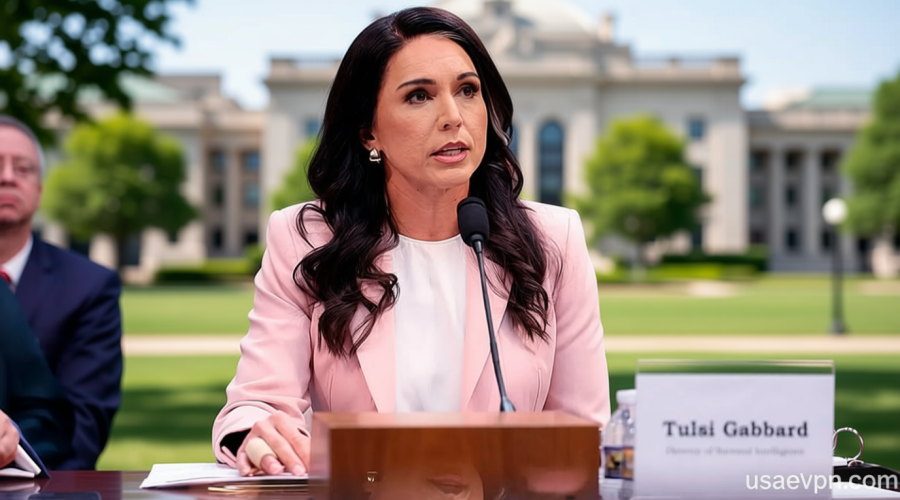
Speculation about Gabbard’s potential departure from Trump’s administration had been growing in recent months, especially after the president’s decision to launch strikes against Iran. Her political stance, which had long centered on opposing foreign wars, placed her in a difficult position when the U.S. and Israel carried out attacks on Iran on 28 February. At a congressional hearing in March, she carefully avoided directly endorsing the strike, instead emphasizing the broader strategic implications of the action.
“The strikes last June have effectively dismantled Iran’s nuclear programme, and there has been no subsequent attempt to rebuild it,” she testified earlier this week. This statement sparked debate, as it seemed to challenge assertions by Trump’s allies that Iran posed an imminent threat to U.S. interests.
During the hearing, lawmakers pressed her for her opinion on Iran’s threat level, but she consistently attributed the decision to the president, stating, “It was Trump’s call, not mine.” Her measured approach contrasted with the more assertive rhetoric of some of her colleagues in the administration.
A Legacy of Reform and Partisanship
Despite her initial promise to eliminate the politicization of intelligence within the government, Gabbard’s tenure saw her increasingly align with Trump’s partisan agenda. She actively supported claims that the 2020 election was stolen, contributing to the narrative that challenged the results of the vote. Additionally, she played a role in undermining investigations into Trump’s connections with Russia, a move that drew criticism from both sides of the aisle.
“I will be leaving this position to focus on my family, but I remain committed to the principles of national security,” Gabbard stated in her resignation message. Her actions during her time in office reflected a balance between her personal values and the political demands of the Trump administration.
Gabbard also oversaw a notable reduction in the intelligence workforce, a decision that raised questions about the efficiency and scope of the agency. Her leadership style, characterized by a blend of idealism and pragmatism, left a lasting impact on the department’s operations.
From American Samoa to Congress
Gabbard’s background adds a unique dimension to her political career. Born in the U.S. territory of American Samoa, she was raised in Hawaii and became the first person from her home island to be elected to Congress. At just 21 years old, she was elected to Hawaii’s House of Representatives, though she left after a single term to serve in the National Guard during the Iraq War. Her early experiences in politics and military service shaped her views on foreign policy and national security.
Gabbard’s tenure in Congress was marked by her vocal opposition to the Democratic Party’s leadership, which she often criticized for being out of touch with the concerns of ordinary citizens. She was a key supporter of Bernie Sanders in the 2016 Democratic presidential primary, establishing herself as a prominent figure in progressive politics. However, her evolution from a progressive candidate to an independent and later a Republican reflects the shifting priorities of her political identity.
Her resignation from the Director of National Intelligence role brings an end to a chapter that saw her navigate the tensions between her ideological roots and the realities of serving in a Trump administration. As she steps down, questions remain about the future of the intelligence community under new leadership and the implications of her departure for U.S. foreign policy. Gabbard’s career, spanning from the Pacific Islands to the nation’s highest intelligence office, underscores the dynamic nature of American politics and the personal sacrifices required in public service.
The timing of her resignation also coincides with a period of uncertainty in the administration. Her decision to leave the role adds to the list of departures that have occurred during Trump’s second term, signaling potential shifts in the executive branch’s strategic direction. As the nation looks to the future, Gabbard’s journey from a progressive voice to a partisan ally offers a case study in the evolving landscape of political loyalty and institutional influence.