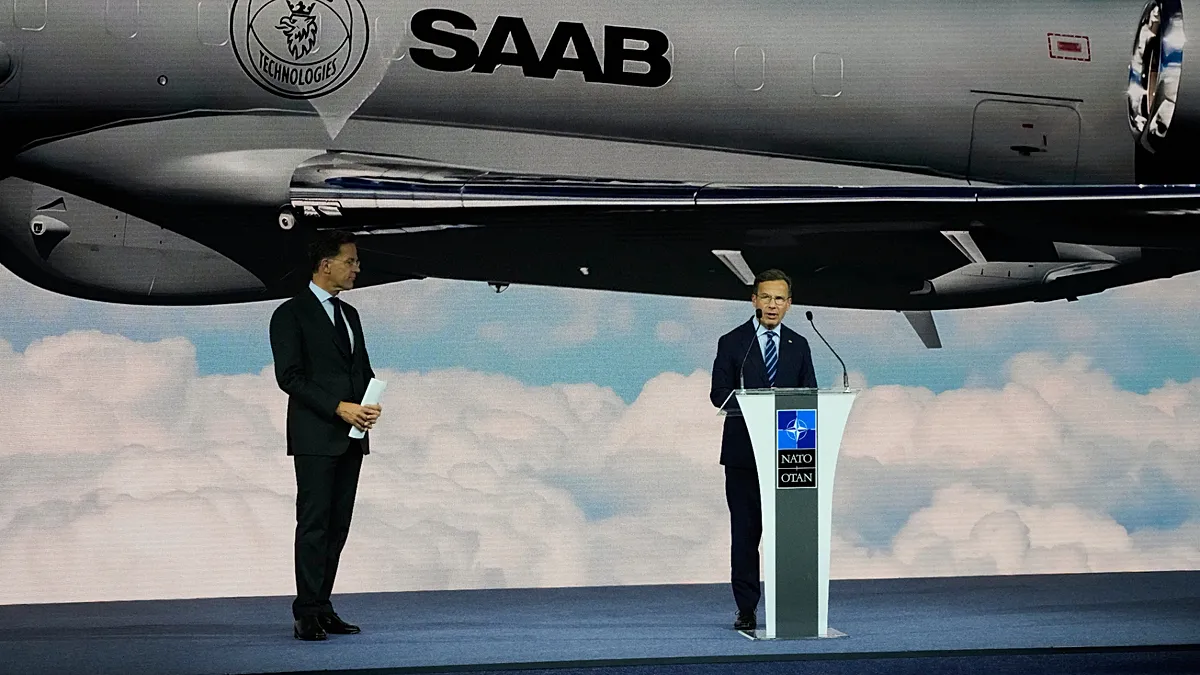
What is GlobalEye, the Swedish aircraft set to become NATO’s new ‘eyes in the sky’?
What is GlobalEye the Swedish aircraft – NATO is set to modernize its aging U.S.-developed surveillance aircraft fleet with a new model from Sweden, the GlobalEye. At the NATO Summit Defence Industry Forum in Ankara, the alliance and the Swedish government confirmed that the military partnership has selected the aircraft as a replacement for its current Boeing E-3A systems. This decision follows a series of discussions aimed at enhancing the alliance’s capabilities in real-time threat detection and command coordination.
The Strategic Shift in NATO Surveillance
The GlobalEye, developed by Swedish defence company Saab, is an Airborne Early Warning and Control (AEW&C) system designed to provide extended surveillance across air, sea, and land domains. Unlike traditional military assets, which are often managed by individual member states, NATO’s existing AEW&C fleet is operated directly by the alliance. This new acquisition marks a significant move toward a more unified approach to aerial reconnaissance.
“In a serious security situation, the ability to detect threats early and control operations in the air, at sea and on the ground is becoming increasingly important,” said Pål Jonson, Sweden’s Defence Minister, during the summit. “GlobalEye provides precisely the kind of advanced situational awareness that modern defences need to combat everything from drones, missiles and other types of threats,” he added.
NATO’s current AEW&C capabilities rely on 14 Boeing E-3A aircraft, which have been in service since 1982. These planes, while effective, are now considered outdated compared to newer technologies. The alliance’s decision to pivot to the GlobalEye is part of its broader strategy to address evolving security challenges, such as the proliferation of unmanned aerial vehicles (UAVs) and hypersonic missiles.
The Evolution of AEW&C Systems
AEW&C systems are specialized aircraft equipped with advanced radar and sensor technology to monitor vast areas and identify potential threats. These platforms operate at high altitudes, enabling them to detect targets that may evade ground-based radar systems. Their role extends beyond mere observation, as they also facilitate real-time command and control during military operations.
GlobalEye, built on the Global 6500 business jet platform from Canadian manufacturer Bombardier, combines long-range active and passive sensors to enhance its detection range. The aircraft is capable of identifying and tracking objects over 550 kilometers away, with its radar system designed to reach even farther under certain conditions. This extended reach, coupled with a flight duration exceeding 11 hours, positions GlobalEye as a versatile asset for continuous surveillance missions.
The Collapse of a Previous Initiative
The selection of GlobalEye follows NATO’s earlier attempt to replace its E-3A fleet with the Boeing E-7A Wedgetail. This project, announced in 2023, faced setbacks in 2025 when the U.S. Air Force withdrew the aircraft from its budget, opting instead for space-based surveillance systems. The failure of the E-7A initiative highlighted the need for a more adaptable solution, leading NATO to reconsider its options and ultimately choose Saab’s offering.
Saab emphasizes that the GlobalEye is the only AEW&C system available that can deliver seamless integration of air, sea, and land monitoring from a single platform. This capability is critical in today’s complex threat environment, where adversaries can strike from multiple domains simultaneously. The Swedish government’s endorsement of the system underscores its confidence in its technological superiority and operational efficiency.
Operational Capabilities and Comparative Performance
The new aircraft’s range and endurance offer notable improvements over the Boeing E-3A. While a single E-3A can cover an area roughly equivalent to Poland, three coordinated GlobalEye units could potentially monitor the entirety of Central Europe continuously. Saab has not yet released specific coverage figures for the new model, but the potential for expanded operational reach is a key selling point.
GlobalEye’s ability to remain airborne for over 11 hours, compared to the E-3A’s 10-hour limit, allows for prolonged missions without the need for frequent refueling. This extended endurance is complemented by its low maintenance costs, making it a cost-effective solution for NATO’s long-term needs. The aircraft’s performance is also bolstered by its advanced sensor suite, which enables precise tracking of both high- and low-flying targets.
Global Support and Next Steps
The proposed purchase of up to 10 GlobalEye aircraft has received backing from 11 NATO member states. These countries include Belgium, Canada, Denmark, Germany, Latvia, Lithuania, Luxembourg, the Netherlands, Norway, Romania, and Sweden. The alliance is now preparing to initiate formal negotiations with Saab through the NATO Support and Procurement Agency.
Saab’s CEO, Micael Johansson, shared insights with Swedish media, stating that the company could begin delivering the aircraft by 2030 if a deal is finalized soon. The timeline reflects the strategic importance of the project, as NATO seeks to bolster its capabilities in response to emerging security threats. The successful implementation of GlobalEye could mark a turning point in the alliance’s reliance on airborne surveillance technology.
With its superior range, endurance, and integration of cutting-edge sensors, the GlobalEye is positioned to redefine NATO’s approach to aerial reconnaissance. As the alliance transitions from its aging Boeing fleet to this new Swedish model, the aircraft’s ability to provide real-time data and coordinate multi-domain operations will be crucial in maintaining NATO’s strategic edge. The negotiations are expected to be a pivotal step in ensuring the future of airborne surveillance within the alliance.