Ukraine’s Independence Day May Double as a Diplomatic Inflection Point
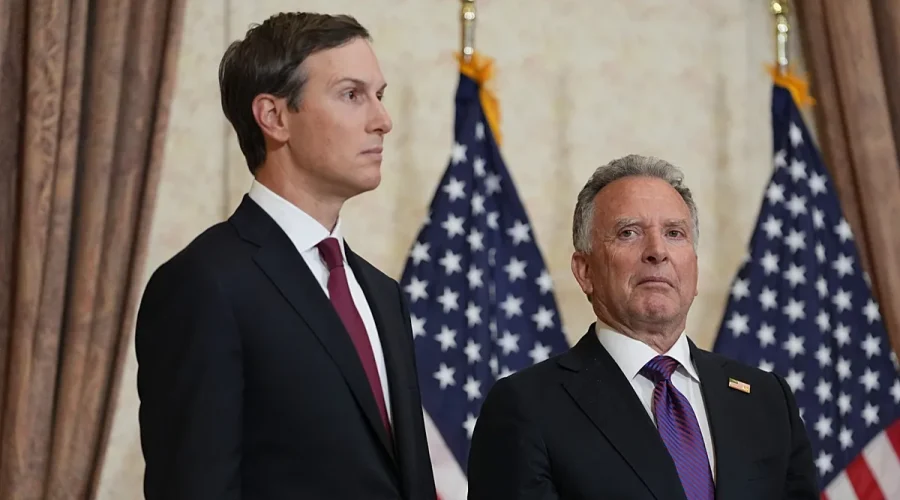
Usagevpn.com – Kyiv will mark 35 years of sovereignty on Monday, and the ceremony could be overshadowed by a question that has simmered for weeks: will two of President Donald Trump’s principal peace negotiators finally set foot on Ukrainian soil? Steve Witkoff and Jared Kushner, the envoys tasked with steering Washington’s effort to halt Russia’s full-scale invasion, have not yet visited the country they are trying to help negotiate out of war. A trip timed to coincide with Independence Day would mark their first direct encounter with a nation under active military assault — a symbolic weight that goes well beyond routine diplomatic protocol.
Neither the White House nor the Ukrainian government has confirmed the itinerary. Moscow, too, remains silent. Yet the signals have been accumulating. In late July, Trump publicly stated that he intended to dispatch both men to the Ukrainian capital within a matter of weeks. Kremlin-aligned outlets picked up the thread earlier this month, suggesting a window around the current date. Additional reporting indicated the pair might split their schedule between Kyiv and Moscow, a pairing that would underscore the administration’s attempt to position itself as the sole arbiter between the two belligerents.
A Day of Solidarity and Strategic Signaling
The Independence Day observance will draw a constellation of international figures to Kyiv regardless of whether the American envoys appear. European Council President António Costa is expected in the capital, joining other guests in what is framed as a show of solidarity with a country that has endured more than three years of sustained bombardment and territorial occupation. The Coalition of the Willing — the informal grouping of states committed to Ukraine’s defence and reconstruction — is also scheduled to convene in Kyiv on Monday, with several heads of state attending in person. Finnish President Alexander Stubb and Luxembourg Prime Minister Luc Frieden are among those confirmed to be present.
Costa’s attendance carries a second, more pointed dimension. As the EU scrambles to define its own role in whatever diplomatic architecture emerges from the US-led process, the question of who speaks for European interests has become a live political debate. Costa has surfaced in internal discussions as a candidate voice for Brussels should substantive talks with Moscow resume. The European Commission and member states want assurance that Europe will not be sidelined in negotiations that could reshape the continent’s security order.
Moscow’s answer to that ambition has been blunt. The Kremlin has consistently insisted that any negotiations must run exclusively through Washington, rejecting a direct European seat at the table. In parallel, Russian rhetoric aimed at Brussels and other Western capitals has grown sharper, reinforcing the impression that Moscow views EU involvement as an obstacle rather than a stabilising factor.
The Negotiating Landscape: Thin on Substance
For all the diplomatic machinery now in motion, the actual substance of Ukraine-Russia talks remains remarkably sparse. No substantive negotiations are currently underway. Moscow has dismissed every option tabled within the US-led framework, including proposals for a ceasefire. Russian positions continue to centre on sweeping territorial concessions from Kyiv and, in the most extreme formulations, the capitulation of the Ukrainian state itself. The Kremlin has displayed no appetite for compromise or for a broader settlement that would preserve Ukraine’s sovereignty and territorial integrity.
The one tangible output of direct Ukrainian-Russian contact to date has been prisoner-of-war exchanges — a narrow but meaningful channel that keeps a thread of communication alive even while the larger questions remain locked.
What a Kyiv Visit Would Mean
Witkoff and Kushner have been the face of the Trump administration’s mediation effort since taking on their roles. Witkoff alone has made eight trips to Moscow and has sat down with Vladimir Putin on multiple occasions. Kushner has participated in parallel tracks of engagement. Yet neither man has crossed into Ukraine since assuming these duties. That absence has been noted by Kyiv’s allies and by Ukrainian officials, who see a visit as both a gesture of recognition and a practical step: understanding the conditions on the ground, meeting the leadership that must ultimately accept any deal, and signalling to domestic audiences that the country is not being negotiated over in its absence.
If the trip materialises around Monday, it will land amid a crowded diplomatic calendar and a deeply uncertain negotiating environment. The administration will be weighing whether a viable path back to talks with Moscow still exists, or whether the Kremlin’s maximalist posture has foreclosed the window entirely. A first-hand look at wartime Ukraine — its leadership, its wounded cities, its population enduring daily air-raid alerts — could sharpen or soften Washington’s calculus in ways that no briefing room in the White House can replicate.
For now, the question remains open. Independence Day will proceed with or without the American envoys in the room. But the timing, if confirmed, would transform the day from a commemoration into a statement: that the two men charged with ending the war are finally willing to see what they are trying to end.
Related Reading
Frequently Asked Questions
What is Will Witkoff and Kushner make their?
Will Witkoff and Kushner make their is the main topic of this guide. The article explains the context, practical details, and next steps readers should understand.
Why does Will Witkoff and Kushner make their matter?
Will Witkoff and Kushner make their matters because readers are looking for a useful answer, not just a short summary. Good content should match search intent and help them decide what to do next.