From Supplying to Building: Ukraine’s Push to Manufacture Its Own Long-Range Strike Capability Gains a Critical Milestone
Usagevpn.com – The architecture of Western military aid to Ukraine is undergoing a quiet but consequential transformation. Where once the flow ran one way — finished systems shipped from allied factories to Ukrainian depots — the conversation is increasingly about blueprints, licensing agreements, and local assembly lines. That shift received a tangible boost this week when Britain committed to handing over technical documentation covering the domestically produced components embedded in the Franco-British SCALP cruise missile, clearing the path for Kyiv to begin assembling the weapon on Ukrainian soil.
The decision follows months of back-and-forth negotiations between Kyiv and Paris on the terms of licensing and local production. Luke Pollard, who holds the UK portfolio for Defence Readiness and Industry, framed the announcement as a measure designed to harden Ukraine’s defensive posture against sustained aerial bombardment.
What SCALP / Storm Shadow Is and How Ukraine Has Deployed It
The weapon in question is an air-launched cruise missile carrying a range exceeding 250 kilometres, engineered for precision strikes against fixed, pre-planned targets rather than mobile ones. France designates it SCALP; Britain calls the same airframe Storm Shadow. Ukraine has already employed the missile in operational campaigns against Russian military installations, command-and-control posts, and defence-industry sites located both in occupied Ukrainian territory and deeper inside Russian borders.
The UK was the first nation to deliver long-range cruise missiles of this class to Ukraine, doing so in 2023. Three years on, the technology-transfer step represents a further escalation in the nature of Western support: governments are moving beyond the logistics of shipping completed weapons toward enabling Ukraine to produce sophisticated systems domestically, reducing dependence on continuous external resupply.
Coalition of the Willing Convenes in Kyiv Amid Escalating Russian Missile Campaign
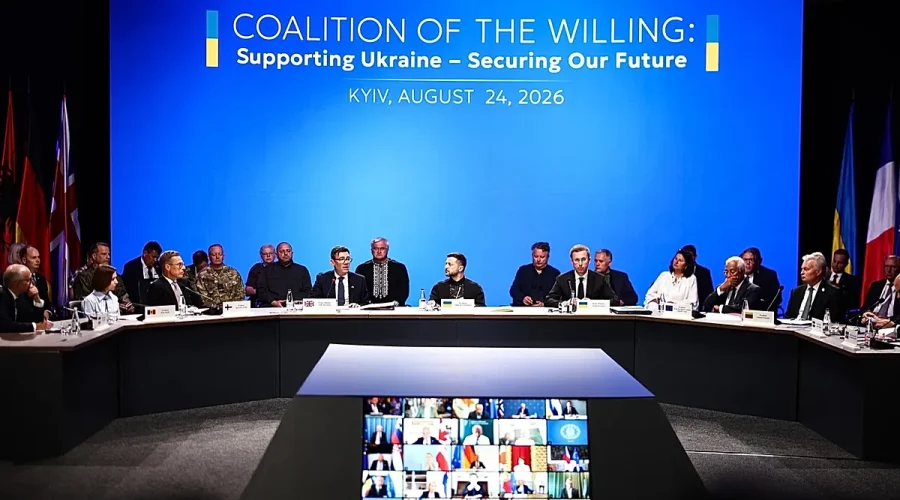
The SCALP announcement landed against the backdrop of a Coalition of the Willing gathering in the Ukrainian capital, where the immediate threat of intensifying Russian missile barrages dominated the agenda. In a joint declaration issued at the meeting, the assembled allies condemned what they described as:
“systematic and escalating strikes against Ukraine’s cities, critical infrastructure and civilians”
The declaration further pledged to reinforce Ukraine’s air-defence architecture
“as a matter of urgent priority”
Leaders present at the Kyiv session also committed to sharing relevant technologies, with particular reference to the Anti-Ballistic Missile Coalition, as Ukraine braces for another winter of sustained Russian attacks on urban centres and energy infrastructure. The seasonal dimension matters: Russian practice has consistently intensified bombardment of power-generation and distribution assets during colder months, when demand peaks and repair windows narrow.
The Patriot Question: Washington’s Shifting Signals on PAC-3 Production
Ukraine’s most acute military shortfall remains layered defence against ballistic missiles, a domain in which it remains critically dependent on US-built Patriot systems and their PAC-3 interceptor missiles. Kyiv has pressed Washington on two fronts simultaneously: additional interceptor rounds, and permission to manufacture those rounds domestically so that supply becomes less vulnerable to the vagaries of allied political cycles.
Trump’s July Licence Promise and Its Subsequent Retraction
At the NATO summit held in early July, President Donald Trump indicated that Washington would grant Ukraine a licence to produce PAC-3 interceptors on its own territory. Yet roughly three weeks later, he walked back the specificity of that statement, saying no final decision had been taken and characterising the prospective technology transfer as a “significant step” — language that, in diplomatic parlance, signals the matter remains unresolved.
Matthew Whitaker, the US ambassador to NATO, subsequently told reporters that a long-term production agreement was unlikely to be concluded before winter and stressed that PAC-3 technology continues to be tightly controlled under American export-control rules. Those mixed signals arrive at a particularly precarious moment: Ukraine’s Patriot interceptor stockpile is running thin amid an intensifying Russian ballistic-missile campaign, and analysts expect renewed concentrated strikes on the country’s energy grid once winter sets in.
The broader implication is structural. If Ukraine cannot secure either additional interceptor deliveries or a domestic production line before the cold months, its layered air-defence architecture will face a gap precisely when Russian strike tempo is projected to peak. The SCALP technology transfer, while significant for the cruise-missile leg of Ukraine’s strike and defence portfolio, does not by itself close the ballistic-missile defence shortfall that the Kyiv meeting identified as the most urgent priority on the table.
Related Reading
Frequently Asked Questions
What is UK to share SCALP missile blueprints?
UK to share SCALP missile blueprints is the main topic of this guide. The article explains the context, practical details, and next steps readers should understand.
Why does UK to share SCALP missile blueprints matter?
UK to share SCALP missile blueprints matters because readers are looking for a useful answer, not just a short summary. Good content should match search intent and help them decide what to do next.