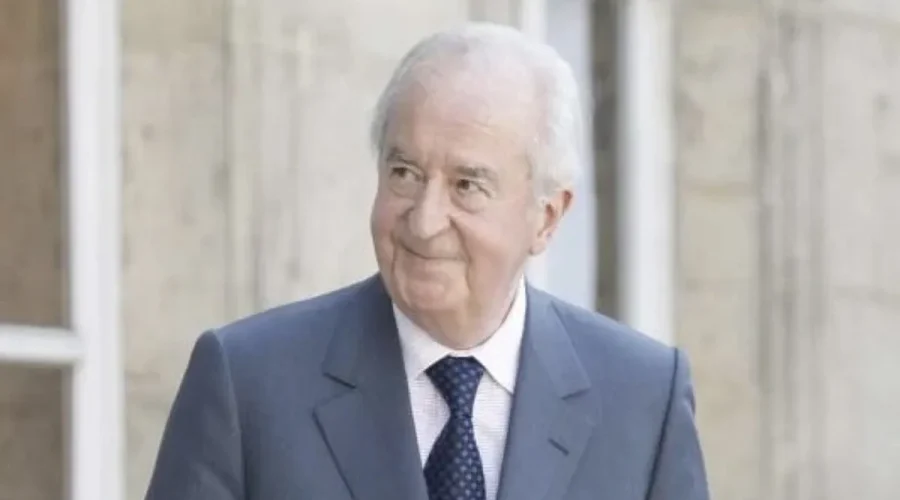
Edouard Balladur, Architect of France’s Second Cohabitation, Dies at 97
Usagevpn.com – The death of Edouard Balladur in Paris on Monday, at the age of 97, marks the closing of a chapter in French political history that stretched across five decades of public service. His family confirmed the passing to the AFP news agency and announced that a private Catholic mass would be held in his honour, though no further logistical details were disclosed at the time of the announcement.
Balladur’s most prominent office came during what French political scientists term the “second cohabitation” — a period in which a president of one political colour governed alongside a prime minister drawn from the opposing camp. From March 1993 through May 1995, he led a centre-right cabinet while Socialist President François Mitterrand retained the constitutional authority of the Élysée. That arrangement, rare in the Fifth Republic’s history, demanded a leader capable of navigating institutional friction while still delivering legislative programmes. Balladur’s tenure, though brief, left a mark on French economic and social policy debates that persists in parliamentary discourse to this day.
Macron and Lecornu Offer Formal Tributes
President Emmanuel Macron moved quickly to pay homage to the late statesman, posting a message on social media shortly after the news broke. In his remarks, the sitting head of state framed Balladur not merely as a partisan figure but as an embodiment of republican duty.
“A demanding, level-headed, and devoted public servant” who had “dedicated his life to the Fifth Republic,” Macron wrote. “I honor his memory and extend my thoughts to his family and loved ones.”
Sebastien Lecornu, France’s current prime minister, offered his own assessment, emphasising Balladur’s reformist instincts and his influence on younger generations of politicians.
“A statesman with a reformist spirit,” Lecornu described him, adding that Balladur “will remain a role model for many men and women in his political circle.”
Le Pen Sets Aside Partisan Divides
Marine Le Pen, leader of the Rassemblement National, took to the platform X to convey condolences to Balladur’s family and former colleagues. Her message was notable for its explicit attempt to transcend the ideological gulf that separated her party from Balladur’s centre-right tradition.
“Setting aside the political disagreements we had with the man who served as Prime Minister from 1993 to 1995, today we should pay tribute to a statesman who left his mark on French public life, who consistently upheld his convictions and his vision of service to the Republic, and who always demonstrated respect for democratic debate,” Le Pen wrote.
From Istanbul to the Élysée’s Orbit
Balladur’s origins were as unusual as his political trajectory. Born in 1929 in Turkey into a family of Armenian descent, he was five years old when his household relocated to Marseille. The port city shaped his early years before he moved north to Paris, where he enrolled at two of France’s most selective institutions: Sciences Po and the École Nationale d’Administration. Graduates of those schools have filled a disproportionate share of French ministerial and presidential offices since the postwar era, and Balladur’s passage through them placed him squarely within the administrative elite that has governed the Republic since 1958.
His first major political attachment was to Georges Pompidou, who himself would go on to serve as both prime minister and president. Balladur became a close adviser during Pompidou’s years in power, absorbing the mechanics of executive governance at a level that few outsiders ever achieve. That proximity to the centre of statecraft positioned him for his own bid at the highest office.
The 1995 Presidential Bid
In the spring of 1995, Balladur stepped down from the premiership to contest the presidential election as the candidate of the centre-right RPR party. The race that year featured a crowded field, and Balladur finished behind both Lionel Jospin, the Socialist prime minister, and Jacques Chirac, the Gaullist rival. Chirac advanced to the second round and ultimately claimed the presidency, a result that reshaped French politics for the next twelve years. Balladur’s elimination in the first round ended his personal ambitions for the Élysée, though he remained active in parliamentary and advisory roles for years afterward.
The passing of Balladur removes one of the last living figures who personally navigated the second cohabitation — a period that tested the Fifth Republic’s separation of powers between the presidency and the government. For scholars of French constitutional practice, his career offers a rare, continuous thread from the Pompidou era through the Mitterrand cohabitation and into the post-1995 political landscape. His family’s decision to keep the funeral private suggests a wish to let the public mourning take place in words rather than spectacle, a choice that itself echoes the restrained, institutional temperament his colleagues have described.
Related Reading
Frequently Asked Questions
What is Tributes pour in for former French?
Tributes pour in for former French is the main topic of this guide. The article explains the context, practical details, and next steps readers should understand.
Why does Tributes pour in for former French matter?
Tributes pour in for former French matters because readers are looking for a useful answer, not just a short summary. Good content should match search intent and help them decide what to do next.