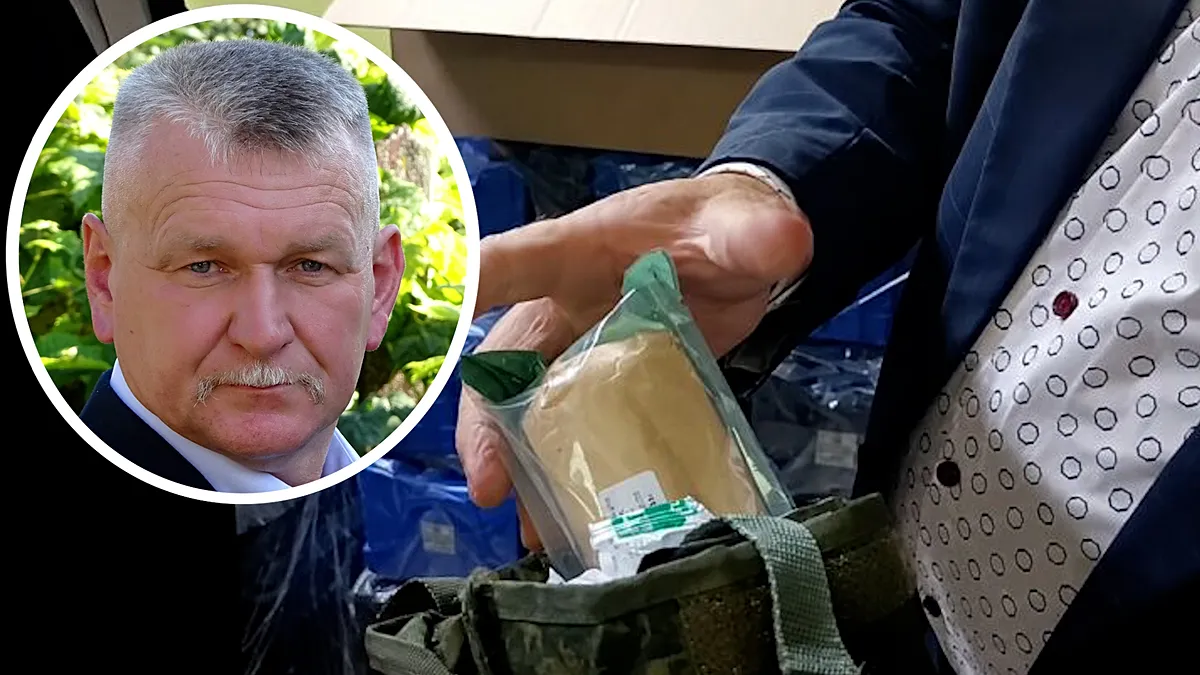
Former Polish Deputy Minister Caught on Camera Delivering Medical Supplies to Russian Troops
A Controversial Act of Humanitarian Aid or Political Statement?
Shocking footage – For more than four years, the Russian Federation has been engaged in a comprehensive military campaign against Ukraine. Within this context, offering assistance to soldiers from the aggressor nation has become an increasingly contentious issue, viewed by many as both morally questionable and politically provocative. Recent revelations concerning Krzysztof Tołwiński have intensified public debate in Poland. The former deputy state treasury minister, who served under Jarosław Kaczyński’s administration and was a member of parliament during its sixth legislative term, released a video documenting his humanitarian gesture toward Russian servicemen.
In the widely circulated footage, Tołwiński explained that he personally financed the purchase and delivery of medical supplies to Russian troops positioned at the front lines. The recording took place on Belarusian soil, adding another layer of complexity to the situation given Belarus’s close alliance with Moscow. The politician emphasized that the transaction was transparent, pointing to documentation as proof of his expenditure.
“We have bought – here is the invoice – 20 battlefield medical first-aid kits which, through our colleague, the party working with us, the Liberal Democratic Party of Belarus (LDPB), we will pass on to soldiers of the Russian Federation, the lads in the trenches, as humanitarian aid, medical assistance,” Tołwiński stated in the video.
Political Context and International Reactions
During the handover ceremony, Tołwiński presented the medical kits to Oleg Gajdukiewicz, the leader of the LDPB. Notably, Gajdukiewicz appears on both European Union and United States sanctions lists, underscoring the political significance of this connection. While making the delivery, the Polish politician characterized the Russian military operations as a struggle “for a new order, for peace, against Nazism.” This framing aligns with Kremlin narratives and has drawn particular attention from critics.
Beyond the physical delivery of supplies, Tołwiński used the opportunity to address Polish citizens directly. He called for continued support for Russians during the ongoing conflict, grounding his appeal in two key concepts: the need to “normalise relations” between nations and the principle of “Slavic solidarity.” These arguments reflect a broader ideological position that Tołwiński has maintained throughout his political career.
A History of Pro-Kremlin Positions
This incident was hardly the first time Tołwiński expressed views sympathetic to Moscow. For several years, he has been a regular presence in both Belarusian and Russian media outlets. His commentary has frequently criticized Polish governmental support for Ukraine, earning him a reputation as a pro-Russian voice within Polish politics. Experts in the field have consistently noted his alignment with the Kremlin’s perspective on regional affairs.
In 2023, Tołwiński assumed leadership of an organization he established called Front. Although officially presented as an agrarian party, the group has faced criticism from various commentators for its pro-Russian orientation and its connections with Belarusian political circles. This organizational role has provided him with a platform to further articulate his positions on international relations.
Legal and Diplomatic Developments
The timeline of Tołwiński’s political activities extends into recent months. In May 2026, he formally requested permission to organize a gathering at the cemetery of Soviet soldiers in Warsaw. This location holds particular significance for Russia’s historical policy, and the event coincided with Victory Day, a holiday of major importance in Russian culture. The gathering attracted representatives from the Russian Embassy in Poland alongside Polish supporters of the Kremlin.
Legal matters have also intersected with Tołwiński’s public profile. In 2026, the District Court in Białystok delivered a verdict finding him guilty of insulting Ukrainians and inciting hatred on national grounds. The case proceeded on the basis of a subsidiary indictment. Following the announcement of the ruling, Tołwiński characterized the court’s decision as a form of “distinction,” suggesting that it validated his stance and strengthened his position within public discourse.
Humanitarian Aid vs. Military Support: A Question of Interpretation
The legal framework surrounding humanitarian assistance provides important context for understanding this controversy. International law generally permits the provision of aid to civilians and wounded soldiers. However, a distinction exists between general humanitarian support and individual first-aid kits designed for direct battlefield use. The latter category is often considered part of military equipment rather than pure humanitarian assistance.
Politicians from multiple parties, along with commentators and ordinary citizens, have raised concerns about the implications of Tołwiński’s actions. Many argue that providing assistance to an army engaged in armed aggression against Ukraine may conflict with Poland’s national interest. This perspective emphasizes that Poland’s official policy supports Kyiv in response to the Russian invasion, making such gestures potentially contradictory to state interests.
Media sources report that the National Prosecutor’s Office is currently reviewing information related to the former deputy minister’s case. While formal proceedings have not yet been confirmed, the investigation suggests that authorities are taking the matter seriously. The outcome of this review could have significant implications for Tołwiński’s political future and for the broader understanding of how humanitarian gestures are interpreted in times of conflict.
As the situation develops, the debate continues over whether Tołwiński’s actions represent genuine humanitarian concern or a calculated political statement. The footage serves as a lasting record of a moment when personal conviction intersected with international relations in a way that challenged conventional expectations within Polish society.