Weekly Talks Pledge Marks New Phase in Cyprus Reunification Effort
Usagevpn.com – The two men who govern the fractured halves of Cyprus have agreed to meet face to face every week, a commitment reached at the close of Wednesday’s talks in the island’s UN-monitored buffer zone. The arrangement, brokered in part by United Nations Secretary-General António Guterres, represents the most concrete step toward restarting reunification negotiations since the last major diplomatic round collapsed nearly a decade ago.
A Half-Century of Partition
Cyprus has been physically and politically divided since August 1974, when Turkish forces invaded the northern third of the island following a coup engineered in Athens that sought to merge the Greek-speaking south with mainland Greece. Before that invasion, Turkish Cypriots constituted roughly one-fifth of the population on the former Ottoman and British colony, where decades of inter-ethnic friction and sporadic violence had already strained relations between the two communities. The military intervention froze the island into two separate administrations, and no comprehensive settlement has been reached since.
Today the southern entity, the Republic of Cyprus, is an internationally recognised state and a full member of the European Union. The northern entity, the Turkish Republic of Northern Cyprus, declared independence in 1983 but enjoys diplomatic recognition only from Ankara. Between them runs a green-line buffer zone patrolled by UN peacekeepers, through which a limited number of crossing points allow residents to move between the two sides.
Guterres Takes Personal Ownership
The current diplomatic push traces directly to Guterres’s decision to assume personal responsibility for re-energising the Cyprus track. In July he travelled to the island — the first visit by a sitting UN secretary-general since 2010 — and held separate meetings with Nikos Christodoulides, president of the Republic of Cyprus, and Tufan Erhürman, the pro-unification leader of the Turkish-occupied north. Guterres framed his intervention as a necessary corrective to years of diplomatic drift, insisting that the process could not simply be left to expire by default.
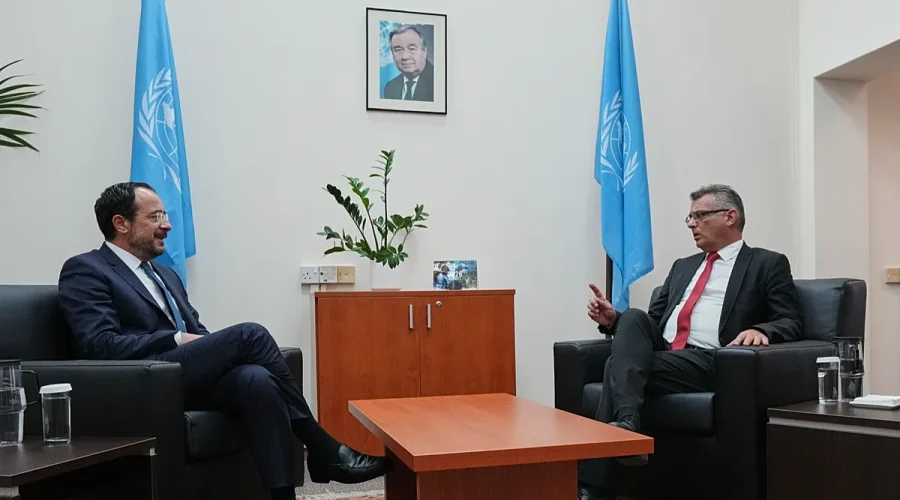
Wednesday’s sit-down in the buffer zone was the first in-person encounter between Christodoulides and Erhürman since Guterres’s July trip. Observers described the gathering as a critical confidence-building step, laying the groundwork for what the UN envisions as a structured, preparatory phase ahead of any full-scale negotiation.
The Weekly Commitment
A short statement released by the United Nations after the session characterised the discussions as “constructive” and confirmed the leaders’ new scheduling arrangement:
“The leaders agreed to intensify their meetings and to meet once a week and more frequently, as circumstances may require.”
Cypriot government spokesperson Konstantinos Letymbiotis told reporters earlier on Wednesday that the agenda for these recurring sessions would focus on the substantive elements of the Cyprus question rather than procedural formalities. He added that opening additional crossing points across the buffer zone to ease daily movement between the two communities was being weighed as a confidence-boosting measure.
The Guarantor Powers and the Summit Question
Guterres has indicated he intends to convene a broader round of talks that would bring together the island’s two leaders alongside the three guarantor powers of the 1960 independence treaty: Greece, Turkey, and the United Kingdom. Those three states retain formal security guarantees over Cyprus and have historically played decisive roles in shaping — or blocking — settlement frameworks.
At the same time, the secretary-general has been explicit that he does not want another cycle of summits that produce nothing but communiqués. Last month he stressed the need for “adequate preparation” to build mutual confidence before any high-level gathering, and he declined to announce a date for the proposed summit. His term as secretary-general ends at the close of this year, adding a layer of institutional urgency to the timeline.
Why Now, and What Comes Next
The last major round of peace negotiations took place in Montreaux, Switzerland, in July 2017, and ended without agreement. Since then, the process has languished, with periodic statements of intent from both sides failing to translate into substantive movement. The weekly meeting structure now agreed upon is designed to prevent that pattern from repeating: by institutionalising regular contact, the leaders reduce the diplomatic gaps during which positions harden and momentum evaporates.
For the roughly 1.2 million people living on the island, the practical stakes are tangible. A durable settlement would reshape trade flows, property rights, energy exploration in the eastern Mediterranean, and the daily lives of families still separated by the green line. Until then, the buffer zone remains a physical reminder that a single island can house two governments, two currencies, and two competing narratives of sovereignty — and that the question of how to bridge them remains, after fifty years, unanswered.
Related Reading
Frequently Asked Questions
What is Rival leaders of divided Cyprus agree?
Rival leaders of divided Cyprus agree is the main topic of this guide. The article explains the context, practical details, and next steps readers should understand.
Why does Rival leaders of divided Cyprus agree matter?
Rival leaders of divided Cyprus agree matters because readers are looking for a useful answer, not just a short summary. Good content should match search intent and help them decide what to do next.