Mélenchon’s Presidential Gambles Gain Traction as France’s Left Fractures
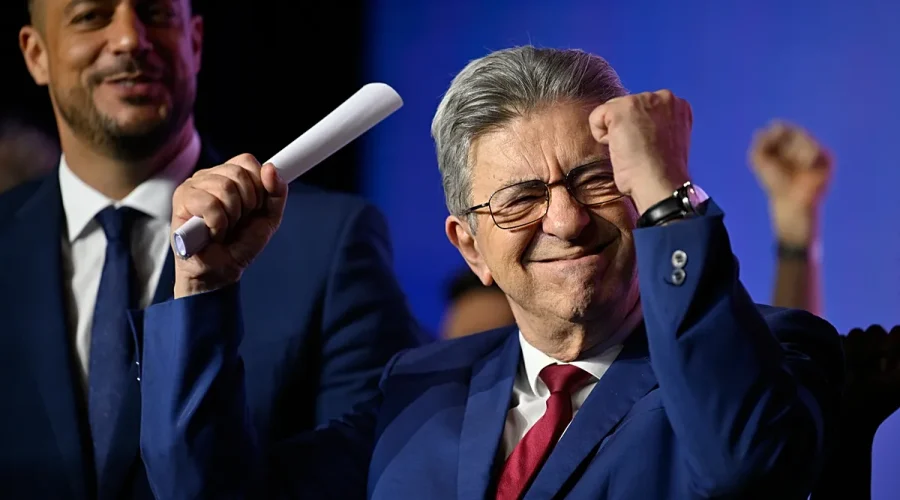
Usagevpn.com – With barely eight months remaining before France’s next presidential vote, Jean-Luc Mélenchon has moved from the margins of the race into a position where he could shape its outcome. A fresh Toluna-Harris Interactive survey commissioned by broadcasters M6 and RTL places the La France Insoumise (LFI) leader in the second-round run-off under three of five candidate configurations tested. Under France’s two-round system, only the top two finishers from the first ballot advance to a decisive head-to-head contest, making the question of who reaches that final stage the central strategic calculation of the campaign.
Shifting Numbers, Narrow Margins
The LFI candidate now commands just over 16 percent of the vote, a marked climb from the 12 percent recorded in the institute’s prior survey conducted in April. That upward trajectory places him within striking distance of Édouard Philippe, the former prime minister who has long occupied the role of principal challenger for second place behind Marine Le Pen and her Rassemblement National (RN) formation. In the most adverse configuration examined — one in which former president François Hollande enters the race — the poll still shows Mélenchon trailing Philippe by only two percentage points.
The scenario most advantageous to the LFI leader involves a heavily divided centre and centre-right field. When multiple candidates contest the same electoral space, Mélenchon’s consolidated left-wing base allows him to leapfrog them. In a scenario featuring Raphaël Glucksmann, Gabriel Attal, Bruno Retailleau of Les Républicains (LR), and Philippe, the survey returns Mélenchon at 16 percent, Philippe at 14 percent, and Glucksmann at 10 percent.
A Platform Built on Crisis
The political calendar has aligned in ways that suit Mélenchon’s messaging. Speaking to several thousand party activists at the close of LFI’s summer conference in Châteauneuf-sur-Isère, a small town near Valence in southeastern France, he used the occasion to declare his presidential ambitions without reservation.
“Victory is possible,” he told the assembled delegates.
Over nearly 45 minutes, the LFI leader attempted to demonstrate that his candidacy offered more than protest politics. He anchored his address in two pillars: economic restructuring and environmental transformation. Coming in the wake of a summer defined by record heatwaves, devastating wildfires, and prolonged drought across southern France, he called for what he termed an “ecological state” and demanded a “clear and unequivocal break” with incumbent policy directions.
“Climate change is ushering in a completely new era for human civilisation,” he argued, pressing for fundamental reorganisation of how French society lives, produces, and trades.
The speech also carried a sharp rebuke of Emmanuel Macron’s decade in power. Mélenchon characterised the president’s eventual departure as something now “awaited on all sides as a liberation.” Turning to the immediate legislative agenda, he pledged to pursue a motion of censure against Prime Minister Sébastien Lecornu’s government should its draft 2027 budget survive parliamentary scrutiny, warning that the document would “worsen all the ills” afflicting the French economy.
The Left’s Internal Reckoning
Mélenchon’s ascent coincides with a visible split among other left-wing formations seeking to chart an alternative course. Raphaël Glucksmann, co-president of the Place Publique movement, formally announced his own presidential bid on the same Sunday as the LFI conference. He positions himself as a social-democratic, pro-European counterweight to what he calls the Mélenchonist current, urging the Socialist Party to abandon any renewal of its alliance with La France Insoumise.
The two formations had previously joined forces under the Nupes left-wing coalition assembled ahead of the 2022 parliamentary elections, and again under the New Popular Front (NFP) following Macron’s dissolution of parliament in June 2024. Glucksmann, polling at roughly 10 percent in the latest survey, has explicitly called for the left to turn the page on “Mélenchonism.”
For the Greens, the calculus proves more tangled. Party leader Marine Tondelier favours keeping dialogue channels open with LFI, while other figures within the party lean toward closer coordination with Glucksmann, the Socialist Party, and Place Publique. Green MP Jérémie Iordanoff has floated the creation of a joint electoral structure uniting these forces. Meanwhile, Yannick Jadot — the Greens’ presidential candidate in 2022 — announced on Monday that he is entering Glucksmann’s camp, arguing that Mélenchon’s political programme is fundamentally incompatible with Green values.
The Run-Off Problem
The fragmentation that currently benefits Mélenchon in the first round carries a familiar danger: multiple left-wing candidates risk splitting the vote and handing the second round to Le Pen. Mélenchon dismissed the concern on Sunday, reducing his strategy to a single declarative sentence.
“What matters is not the number of candidates, but the number of voters.”
Yet the poll data exposes a structural vulnerability. In a direct head-to-head contest with Le Pen, the RN leader would capture approximately 68 percent of the vote against roughly 32 percent for the LFI candidate. Le Pen also outperforms every other candidate tested in the survey’s run-off simulations. The gap between first-round competitiveness and second-round viability remains the defining question of Mélenchon’s campaign: whether his base can translate protest energy into the disciplined, cross-class coalition that a French presidential run-off demands.
As the autumn campaign season opens, the strategic arithmetic will sharpen. Every additional candidate entering or exiting the race, every alliance formed or dissolved among left-wing parties, and every economic shock that reshapes voter priorities will determine whether Mélenchon’s gamble culminates in an Élysée bid or another round of electoral frustration. The polls suggest the former is now genuinely on the table — but the second round, where France’s presidential system ultimately decides, remains a far more formidable obstacle.
Related Reading
Frequently Asked Questions
What is French election 2027?
French election 2027 is the main topic of this guide. The article explains the context, practical details, and next steps readers should understand.
Why does French election 2027 matter?
French election 2027 matters because readers are looking for a useful answer, not just a short summary. Good content should match search intent and help them decide what to do next.