Paris Commits Fresh Interceptor Missiles to Kyiv After Deadly Russian Drone Barrage on Zelenskyy’s Hometown
Usagevpn.com – Emmanuel Macron confirmed on Saturday that France will ship a new batch of interceptor missiles to Ukraine, a decision framed explicitly as a response to a devastating Russian drone assault on the city of Kryvyi Rih in the country’s central Dnipropetrovsk region. The announcement lands at a moment when Kyiv’s air-defence network is stretched to its limits, juggling nightly salvos of cruise missiles, ballistic weapons, and swarms of cheap Shahed-type drones across a front that spans nearly a thousand kilometres.
The Attack on Kryvyi Rih
Ukrainian authorities described two successive waves of drone strikes that hit the city on Friday, including a direct impact on a shopping centre. At least 16 people were killed and roughly 130 more were wounded; among the injured were 23 children. The location carries particular symbolic weight: Kryvyi Rih is the birthplace of President Volodymyr Zelenskyy, and the daylight timing of what Macron termed a “double strike” underscored how little warning civilians now receive before ordnance arrives.
The incident drew swift condemnation across European capitals. Kaja Kallas, the European Union’s high representative for foreign affairs, labelled the bombardment “terror by design,” a phrase that echoed through Brussels and national parliaments within hours.
Macron’s Response and the Interceptor Commitment
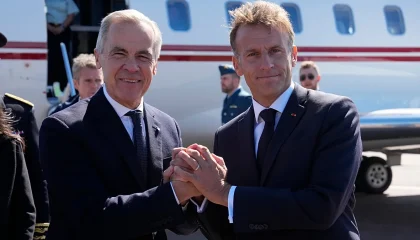
In a statement posted on X, Macron said he had telephoned Zelenskyy in the aftermath of the strikes and conveyed his “horror” and “deep concern” over the toll on civilians.
“It is crucial to provide Ukraine with all the necessary means to defend its airspace and thwart this aggression,” Macron wrote, adding that he had informed Zelenskyy of Paris’ “increased support, including the deployment of interceptors.”
The French president went further, tying the missile delivery to a broader strategic posture:
“We must also continue to increase the pressure on Russia as long as it chooses to refuse to halt the fighting and make peace.”
The language signals that Paris views interceptor supply not as a one-off gesture but as part of a sustained escalation ladder aimed at raising Moscow’s cost of continuing the war.
Zelenskyy’s Two-Hour Call and Licensing Talks
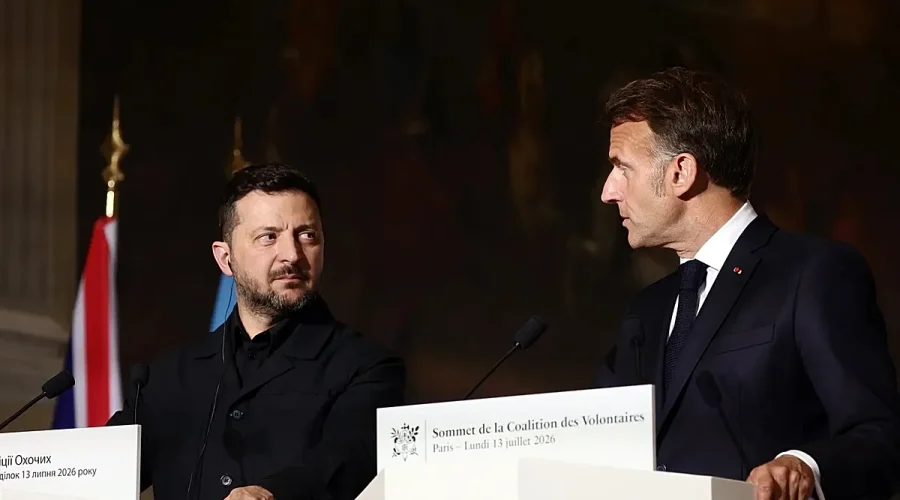
Zelenskyy, in his own post, said the conversation between the two leaders lasted close to two hours. The agenda reportedly covered Ukraine’s immediate air-defence shortfalls, the financing of continued operations, and the state of bilateral communications with Washington.
“We agreed to accelerate the delivery of the latest French equipment and missiles. Thank you for confirming your readiness to provide licenses for the production of missiles,” Zelenskyy wrote.
The licensing element is notable. Rather than relying solely on finished systems shipped from French arsenals, Kyiv appears to be moving toward domestic or allied-territory assembly of interceptor components, a step that would reduce lead times and insulate supply lines from disruption.
Why Interceptors Remain the Bottleneck
For months, Ukrainian commanders have pressed Western partners for additional surface-to-air missiles capable of engaging both high-altitude cruise missiles and low-flying drones. Every interceptor fired consumes a finite stockpile; replenishment cycles measured in months leave gaps that Russian planners exploit. France’s new commitment, layered on earlier deliveries of SAMP/T and other systems, narrows those gaps but does not close them. The licensing arrangement Zelenskyy referenced suggests both sides recognise that long-term sustainability requires production capacity closer to the front, not just periodic shipments from European depots.
Kyiv’s Own Long-Range Campaign
While defending its own skies, Ukraine has simultaneously intensified what it calls “long-range sanctions” — deep-strike operations aimed at degrading Russia’s economic and logistical base. In the 24 hours preceding Macron’s announcement, Zelenskyy confirmed hits on the Novokuybyshevsk oil refinery, a logistics hub in the Samara region, and several targets in the Black Sea. Energy infrastructure — refineries, fuel depots, export terminals — has become the primary axis of this strategy, designed to erode the revenue streams that finance Moscow’s war effort.
The interplay between the two fronts is direct: every Russian drone or missile that reaches Ukrainian cities represents a failure of air defence, while every Ukrainian strike on a refinery or depot represents a success in economic attrition. France’s interceptor pledge and licensing offer are, in effect, an investment in the first half of that equation — buying Ukraine the time and capability to keep defending its population while its own long-range campaign continues to chip away at Russia’s industrial base.
For European publics watching from a distance, the Kryvyi Rih strikes serve as a reminder that the war’s civilian toll is not confined to the eastern front. A shopping centre in a mid-sized industrial city, hit in broad daylight, is the kind of event that reshapes political calculations in Paris, Berlin, and Brussels within a single news cycle. Macron’s Saturday announcement reads less as routine diplomacy and more as a calibrated political response to precisely that kind of event.
Related Reading
Frequently Asked Questions
What is France to give new interceptor missiles?
France to give new interceptor missiles is the main topic of this guide. The article explains the context, practical details, and next steps readers should understand.
Why does France to give new interceptor missiles matter?
France to give new interceptor missiles matters because readers are looking for a useful answer, not just a short summary. Good content should match search intent and help them decide what to do next.