When a children’s book villain became a neighbourhood nightmare
Usagevpn.com – Social media has a long history of turning harmless cultural references into shared anxieties, but few recent episodes have matched the speed and intensity with which a beloved children’s-book character transformed into a source of genuine dread among young users. Across the United Kingdom and parts of Ireland, teenagers and young adults have been posting shaky, grainy clips of what appears to be a life-sized, hollow-eyed figure in a tall, tilted hat lurking outside homes, peering through windows, and standing motionless in driveways. The figure, unmistakably modelled on Dr. Seuss’s Cat in the Hat, has prompted police departments to issue public clarifications confirming that no such creature exists in their jurisdictions — that every frame was produced by artificial intelligence.
The spark: a deleted clip and a dark caption
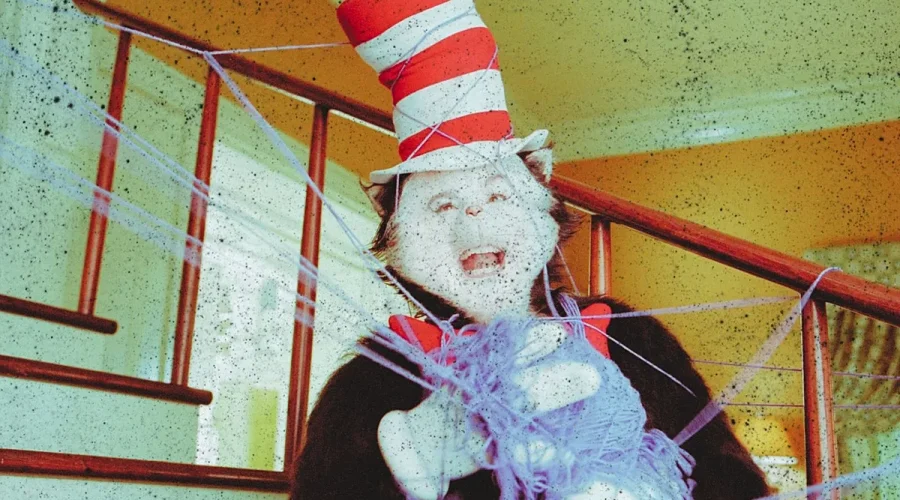
The chain of events traces back to late June 2026, when a TikTok account posted a short clip drawn from the 2003 live-action film adaptation of The Cat in the Hat, starring Mike Myers in the title role. In the footage, the character dances to an unsettling, slowed-down soundtrack. The uploader attached a caption that read:
“How mfs be dancing at prom just to overdose 2 weeks later.”
The clip accumulated more than 4.4 million views in roughly seven days before the account removed it. By then, however, the format had already caught hold. Other creators began repurposing innocuous scenes from the same movie — or from the original 1957 book illustrations — and re-editing them with distorted audio, jump-scare cuts, and whispered dialogue to produce short horror vignettes. The Cat in the Hat, once a symbol of playful mischief for generations of readers, had been recast as something sinister.
The costume auction and the deepening lore
The trend gained an additional layer of unease when the original screen-used costume from the 2003 production was listed for sale on the prop-auction platform Propstore. Photographs of the garment — a pale, elongated suit with a lopsided top hat and a mask whose eyes appeared sunken and vacant — circulated widely. For viewers already primed by the edited clips, the image of the empty suit hanging on a rack felt less like a collectible and more like evidence. Fan-made lore expanded rapidly: whispered backstories about where the Cat “lives,” why it watches, and what it wants. Each new video added another detail, and the mythology grew denser with every upload.
“Sightings” in Limerick, Wexford, and beyond
By mid-summer, the format had migrated from pure editing into something that mimicked real-world documentation. Videos surfaced purporting to show the figure spotted on residential streets in the Irish counties of Limerick and Wexford, as well as in various English and Scottish towns. Many were shot in a found-footage style: handheld, low-resolution, with the camera panning nervily toward a doorway or a garden gate where the tall silhouette stood perfectly still. Ring-doorbell footage became a recurring motif, the Cat apparently waiting on a porch as though expecting a delivery.
The comment sections under these clips revealed a spectrum of reactions ranging from playful to genuinely unsettled. One user wrote:
“Just heard someone shout ‘I’m gonna get you’ outside my house, then I hear footsteps amd [sic] see no one, it’s actually starting to get creepy, its 11pm and I don’t normally believe any stuff like this but it now feels too real.”
Another, leaning into the joke, simply replied:
“Green eggs and SCRAM bro.”
Police step in to confirm: it is all AI
The volume of posts claiming real-world encounters eventually attracted official attention. Police forces in both the UK and Ireland published statements — some on social media, some via press releases — confirming that no physical Cat in the Hat had been sighted and that the circulating videos were generated by AI tools capable of inserting a character into existing footage of ordinary locations.
A spokesperson for Wexford Garda took to Instagram to address the local concern directly:
“In an unusual turn of events we are hearing a lot about an illusive Dr Seuss character doing the rounds online, apparently causing havoc in neighbourhoods and towns across the country. Fortunately, we can rule out the issue, which is essentially an AI prompt that places the character into images/videos of familiar places. To be clear, the Cat in the Hat was not in your driveway while you were out and he is not currently hiding out in Curracloe.”
The dry humour of that final line — naming a specific coastal suburb of Wexford — underscored how far the joke had travelled from its editing-bench origins into the territory of local public-safety communication.
A familiar pattern: clowns, creepypasta, and the creep of the collective
Collective online fear is hardly new. In 2016, a wave of clown-sighting reports swept North America and Europe, spawning pranks, user-generated videos, and a brief but intense period of neighbourhood anxiety that blurred the boundary between staged content and lived experience. Before that, the internet had already produced an entire genre of collaborative horror storytelling known as creepypasta — shared legends like Slender Man, We’re All Going to the World’s Fair, and, more recently, the Backrooms — that grew and mutated as thousands of contributors added layers. When those stories remain inside a bounded online community, they function as creative play and social bonding. The friction begins when they spill into younger audiences who may struggle to separate fiction from observation, or when they are paired with photorealistic AI imagery that mimics genuine surveillance footage.
What the Cat episode says about AI and younger users
The rapid maturation of generative-AI video tools means that a convincing clip of an impossible figure standing in a real street can now be produced in minutes by a teenager with a smartphone. That capability amplifies an existing challenge: how to protect younger users from content that exploits their developing ability to distinguish the fabricated from the factual. Social-media platforms face renewed pressure to label synthetic media clearly, to moderate trends that cross from playful into genuinely distressing, and to give parents and educators practical ways to discuss what their children are watching.
For now, the immediate threat has been neutralised. No anthropomorphic feline in a top hat is patrolling any British or Irish suburb. The only remaining risk is logistical: whoever purchases that 2003 screen-used costume from the Propstore auction will be the sole custodian of the most unsettling object in the entire saga — and, depending on how they choose to display it, possibly the last person on Earth who should be left alone in a dimly lit room at eleven o’clock.
Related Reading
Frequently Asked Questions
What is The Cat in the Hat is terrorising?
The Cat in the Hat is terrorising is the main topic of this guide. The article explains the context, practical details, and next steps readers should understand.
Why does The Cat in the Hat is terrorising matter?
The Cat in the Hat is terrorising matters because readers are looking for a useful answer, not just a short summary. Good content should match search intent and help them decide what to do next.