Malta’s Artists Step Beyond the Baroque, Toward Seoul
Usagevpn.com – In late September, a pavilion representing Malta will open its doors at the Gwangju Biennale in South Korea, running through 15 November. Titled BEJN / In-Between, the project is an artistic statement about liminality itself — about the spaces between cultures, between past and present, between one identity and another. At its helm sits Julien Vinet, a French-born artist who has called Malta home for roughly a decade, serving as the pavilion’s artistic director. Working alongside him are sound artist Michael Quinton, architect-artist Norbert Francis Attard, and the poetry-and-visual-arts collective Ponks, co-run by Vinet and his creative partner Sam Alekksandra. Three linked installations will form the backbone of the project, drawing explicit parallels between Maltese and Korean cultural histories.
The choice of theme is hardly accidental. Malta, a compact archipelago in the central Mediterranean, has absorbed successive layers of foreign influence over millennia. Its table carries African, Mediterranean, and British culinary traditions. Its spoken tongue is the sole Semitic language transcribed in the Latin alphabet. Its harbours once hosted Phoenician vessels; its skyline is studded with Catholic churches bearing the crest of the United Kingdom. Yet for decades, the island’s visual-art conversation remained locked in a single historical register.
“Baroque this, baroque that – for many people in Malta, real art is only baroque.”
That observation, offered by a guide in Valletta’s Muza Gallery, captures a long-standing cultural fixation. Caravaggio’s monumental canvas, The Beheading of Saint John the Baptist, hangs in St John’s Cathedral and has long served as the default answer to any question about Maltese art. For years, the island offered artists very few galleries and even fewer institutional pathways to exhibit work outside that baroque frame.
A New Infrastructure Takes Shape
The landscape is shifting. The Malta Biennale has arrived as a new institutional anchor, and MICAS — the country’s first national museum dedicated exclusively to contemporary art — has added a public-facing platform for current practice. Private spaces have followed. Valletta Contemporary, founded by Attard, occupies a converted 400-year-old warehouse in the city’s lower east end. Across two floors, it now hosts exhibitions by Maltese and international artists, filling a gap many local creators described as years in the making.
At the time of a recent visit, the gallery was presenting Still Time, a 50-year retrospective of photographer Joseph P. Smith, curated by Lisa Gwen Chetcuti. Chetcuti noted the structural constraints that shape gallery practice on the island.
“In Malta, we have very few private galleries, and they operate differently than they do in London or New York. They often don’t own the work, meaning they aren’t taking on inventory they need to sell — and artists don’t necessarily want them to, either. In a small country, they don’t want to put all their eggs in one basket. This exhibition was all done through public funding.”
Attard’s ambitions reach beyond Valletta. He maintains a residency at his home and studio on the sister island of Gozo, hosting visiting artists and facilitating collaborative projects. He is now converting that Gozo property into a public archive complete with a café and garden.
“I’m the kind of person who can stop being an artist during my lifetime as a conscious decision. That doesn’t mean I stop being creative. There are a lot of ways one can create.”
The Studio at Twilight
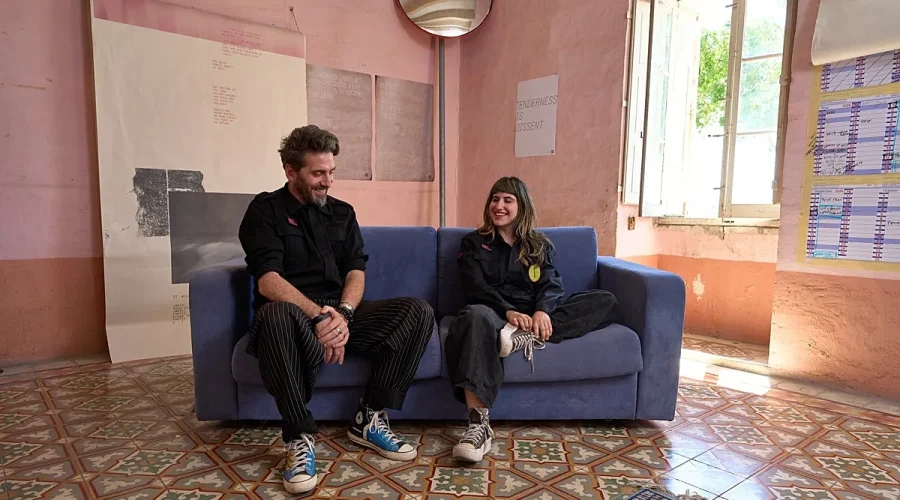
Back in the Three Cities, Vinet and Alekksandra share a modest studio whose faded pink walls are papered with posters announcing their pop-up poetry events. Vinet, who spent eight years in Japan before arriving in Malta, speaks with particular conviction about the quality of light that falls across the limestone architecture at dusk. He describes the sun laying itself “like a crown” atop the buildings, rivers of red and orange flooding the windows as another day dissolves into night. He calls the phenomenon “obsolete beauty” — a term he applies to moments of quiet, overlooked significance that most people walk past without registering.
Alekksandra, a Maltese journalist who has turned to poetry, found in the island a point of reference from which to develop her own artistic language. For Vinet, the country’s relative smallness and its position at cultural crossroads have granted him the latitude to pursue both sides of his temperament: the punk impulse and the perfectionist’s discipline. Both artists are drawn to liminal subjects — things caught in the in-between — and perhaps it is no coincidence that they discovered creative freedom in a nation defined by its own in-betweenness.
Their next chapter, however, will unfold not in Valletta but in Gwangju. BEJN / In-Between positions Malta’s contemporary voice within a global biennial circuit, connecting the island’s layered past to Korea’s own complex negotiations of tradition and modernity. For a scene that spent generations looking backward at Caravaggio’s saints and martyrs, the pivot toward Seoul marks something genuinely new: not a rejection of the baroque, but a widening of the frame beyond it.
Related Reading
Frequently Asked Questions
What is From Caravaggio to Korea?
From Caravaggio to Korea is the main topic of this guide. The article explains the context, practical details, and next steps readers should understand.
Why does From Caravaggio to Korea matter?
From Caravaggio to Korea matters because readers are looking for a useful answer, not just a short summary. Good content should match search intent and help them decide what to do next.