A Living Masterpiece: Brussels Grand-Place Blooms with Japanese Artistry
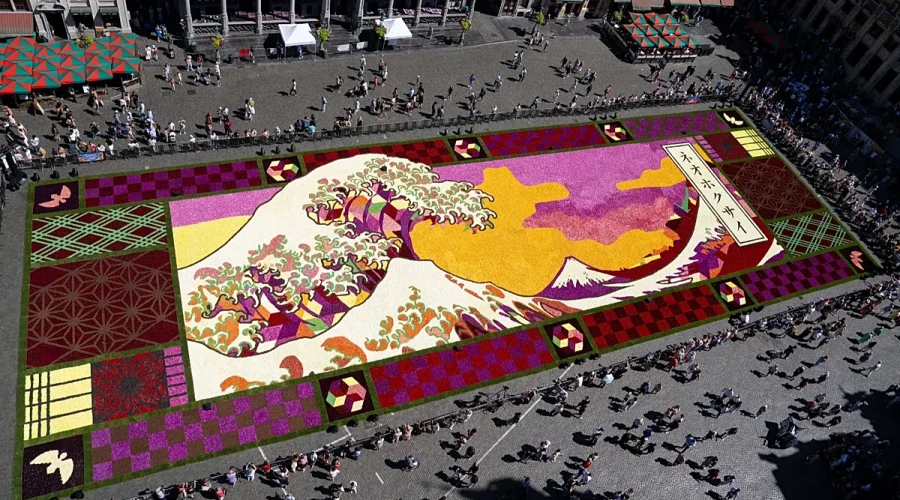
Usagevpn.com – The historic cobblestones of Brussels’ Grand-Place have once again become a canvas for nature’s beauty, as the Belgian capital hosts its 24th annual Flower Carpet celebration. This year’s spectacular installation draws inspiration from Japanese aesthetics, creating a stunning fusion of European tradition and Eastern artistry. The centerpiece of this year’s display is a magnificent reinterpretation of Katsushika Hokusai’s legendary woodblock print, “The Great Wave off Kanagawa,” brought to life through thousands of carefully placed flowers.
Japanese artist Hiro Sugiyama served as the creative force behind this year’s composition, dedicating eight months to developing his vision. The ambitious project required meticulous planning and coordination, as Sugiyama worked to translate the iconic Japanese artwork into a floral medium that would resonate with Brussels visitors. The artist’s approach involved not only selecting appropriate flowers but also determining how to capture the dynamic movement of Hokusai’s original masterpiece through color and texture.
The scale of the undertaking is remarkable. More than 700,000 flowers form the foundation of this living artwork, with dahlias serving as the primary medium. This choice is particularly fitting, as dahlias hold a special place in Belgian horticultural history. The carpet measures 70 meters in length and 24 meters in width, creating an expansive visual experience that visitors can appreciate from multiple vantage points. Beyond dahlias, the installation incorporates begonias, grass, and bark to add depth and dimension to the overall composition.
“To be honest, at the beginning, I was pretty nervous about [the limited colours palette], but once I came here and saw the design and the flowers laid out, I was very excited and realised that I didn’t need to worry about it at all, because it looks beautiful already,” Sugiyama said.
One of the most interesting aspects of Sugiyama’s creative process was working within constraints. While the artist initially envisioned a more colorful composition, time limitations required him to work with a palette of just 16 colors. This restriction, rather than limiting the artwork’s impact, ultimately contributed to its cohesive beauty. Sugiyama noted that the carpet represents a bridge between contemporary Japanese culture and Belgian appreciation for art and nature.
The timing of this year’s installation carries special significance beyond its artistic merit. The Belgian-Japanese collaboration celebrates the 160th anniversary of diplomatic relations between the two nations, marking a substantial milestone in international friendship. This connection extends back to 2016, when the first Flower Carpet collaboration between Belgium and Japan took place, establishing a tradition that continues to strengthen cultural bonds.
The creation process itself is a testament to careful organization and community involvement. Once organizers select a theme, they calculate the required number of flowers and determine the appropriate color scheme. Several days before the final assembly, a full-size version of the design is drawn onto a large cotton canvas positioned directly on the city square. This preparatory work ensures that every flower finds its precise location in the final composition.
“Culture events show people that we can work together, we can do interesting things together and that’s one of the things we do here also with our Japanese friends,” Poncin said.
On Thursday, the community came together to bring the vision to life. More than one hundred volunteers spent approximately six hours arranging the flowers according to Sugiyama’s specifications. The Japanese Ambassador to Belgium, Takeshi Osuga, joined the effort personally, explaining that many Japanese sponsors had contributed to the event and he wanted to participate directly in the flower-laying process.
The Flower Carpet tradition in Brussels has deep roots, with the first display dating back to 1971. The event occurs biennially, allowing sufficient time for both preparation and restoration of the historic Grand-Place. The location itself adds meaning to the installation, as the Grand-Place stands as one of Europe’s most magnificent public squares, recognized for its architectural splendor and cultural importance.
For visitors planning to experience this year’s installation, the 2026 Flower Carpet runs from August 13 through August 16. While online tickets have sold out, attendees can purchase admission at the venue during opening hours at the Town Hall entrance. The design offers two distinct viewing experiences: visitors may walk around the perimeter to observe the intricate details up close, or they can ascend to the Town Hall balcony for a comprehensive aerial perspective of the entire composition.
Richard Poncint, a member of the Brussels Flower Carpet Organisation, emphasized that the installation represents more than mere decoration. He described it as a symbol of cultural unity, demonstrating how art can bring diverse communities together. The event serves as a reminder that shared appreciation for beauty transcends geographical and cultural boundaries, creating opportunities for meaningful connection between people from different backgrounds.
As the flowers begin to fade after their brief but brilliant display, the memory of this year’s Japanese-inspired masterpiece will remain in the minds of Brussels residents and visitors alike. The Grand-Place, with its centuries of history, continues to evolve as a living museum where art, nature, and culture converge in ever-changing forms.
Related Reading
Frequently Asked Questions
What is Brussels central square transformed into giant?
Brussels central square transformed into giant is the main topic of this guide. The article explains the context, practical details, and next steps readers should understand.
Why does Brussels central square transformed into giant matter?
Brussels central square transformed into giant matters because readers are looking for a useful answer, not just a short summary. Good content should match search intent and help them decide what to do next.