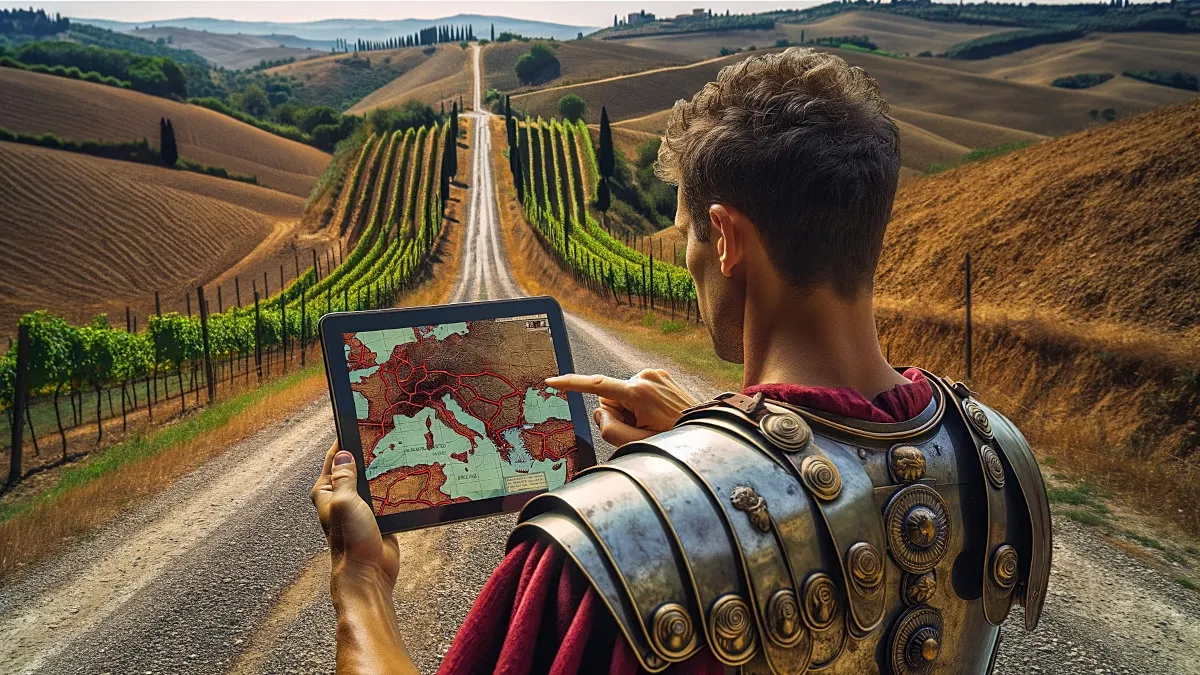
Ancient Rome s Google Maps is here – A Dutch engineer has reconstructed, using academic sources and historical maps, the road map that connected the Roman Empire. The result, accessible from any browser, including on a mobile phone, lets users plot routes between ancient cities and find out how many days the journey would have taken on foot or on horseback. The tool is called OmnesViae ( Omnesviae.org (source in Spanish) ) and is based primarily on the Tabula Peutingeriana, a medieval copy of a Roman map that depicted the cursus publicus, the Empire's official road network.
As the western part of that document has been lost, the data for that area comes from the Antonine Itinerary, another record from the Roman period. Behind the project is René Voorburg (source in Spanish) , who drew on the work of historian Richard Talbert on the Tabula (source in Spanish) and on location data from the Pleiades Project. The code and database are open-access and can be consulted on Codeberg.
The site is designed to be used on a computer, but it also works well in a phone browser. You simply enter a starting point and a destination for the system to calculate the quickest route according to the distances given in ancient sources, and highlight it in yellow on a modern map. It also provides detailed information on intermediate stops, which is particularly useful because many Roman roads followed rivers or passed close to settlements that still exist today, albeit under different names.
When Madrid and Milan are entered as the destination, the website identifies them as Miaccum and Mediolanvm, and sets Conplutum, today’s Alcalá de Henares, as the first significant stop. Among the final stages are Avgvsta Tavrinorvm (Turin) and Placentia (Piacenza). According to the planner’s calculations, the journey would have taken 43 days to cover 1,500 Roman miles.
To put the difference with the present day into context: the same itinerary by road can now be done in 14 days (340 hours) on foot, 16 hours by car (source in Spanish). OmnesViae is not the only initiative seeking to reconstruct the communications map of the Roman world. In recent years, other projects with similar approaches have appeared, some focusing on calculating travel costs and times depending on the time of year, and others aimed at documenting the physical course of the roads more precisely using digital mapping techniques.
Voorburg keeps his tool up to date and has completely rewritten the original version, which was active between 2011 and 2024, now incorporating artificial intelligence support for the site’s translations and illustrations.