Trump Becomes First Sitting President on a US Coin
Usagevpn.com – The US Mint has released a one-dollar coin bearing the portrait of President Donald Trump, making him the first sitting president to appear on American legal tender. Trump becomes first sitting US president to be struck into everyday currency when the Mint confirmed on Thursday that the new golden dollar entered circulation. Collectors can obtain sealed rolls and bags exclusively through the Mint’s retail channels, while everyday shoppers may encounter the coin in pocket change at grocery stores, gas stations, and vending machines.
Design, Composition, and Collector Pricing
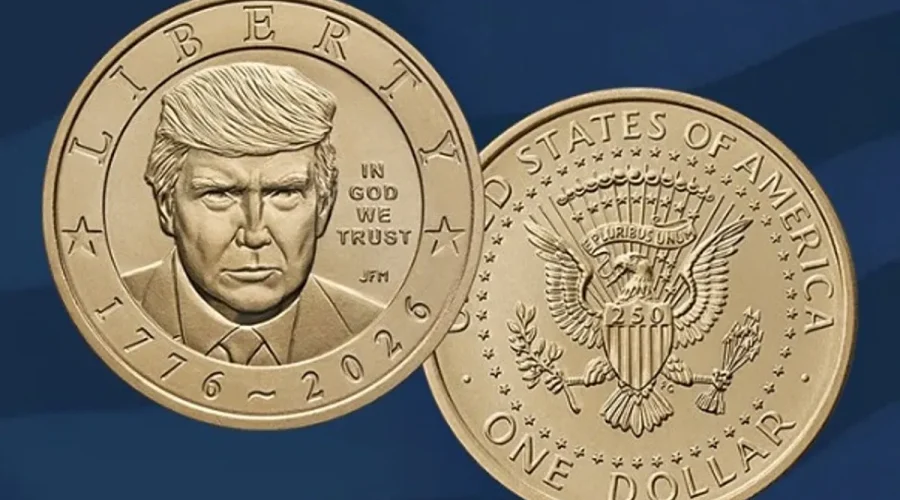
Chief Engraver Joseph Menna crafted the obverse from an official White House photograph, depicting Trump in a near-frontal pose flanked by the inscriptions “LIBERTY” and “IN GOD WE TRUST.” A dual date spanning 1776 to 2026 anchors the design to the nation’s 250th-anniversary programming. The reverse carries the Presidential Seal—a motif originally sculpted by former chief engraver Frank Gasparro—with the numeral 250 added to the eagle’s shield to mark the sesquicentennial.
Despite its golden appearance, the coin contains no gold. Its alloy is 88.5 percent copper with smaller proportions of zinc, manganese, and nickel. Every piece was struck at the Philadelphia Mint and carries no mint mark, a departure from standard numismatic practice that collectors will note.
Collector pricing is straightforward: a 25-coin roll retails at $61 and a 100-coin bag at $154.50. Both products are distributed solely through the Mint’s own channels; no third-party dealer will stock them.
Legal Basis and the Abbreviated Review Process
US law generally bars the depiction of living persons on American coinage. The administration’s legal footing rests on the Circulating Collectible Coin Redesign Act of 2020, a statute signed into law by Trump during his first term. That legislation permits one-dollar coins bearing anniversary-themed designs throughout 2026, providing the narrow statutory window through which this particular issue could be minted and released. In effect, Trump becomes first sitting US president on a circulating coin only because of a law he himself signed years earlier.
The design review was, by the Mint’s own standards, abbreviated. The US Commission of Fine Arts recommended a profile portrait and an alternative eagle motif for the reverse; neither suggestion was adopted. The Citizens Coinage Advisory Committee, which ordinarily reviews Mint designs before public release, declined to consider the Trump coin at all. The final design therefore moved forward without the full breadth of external review that accompanies most new issues.
A Single Imperfect Precedent
One historical parallel exists, though it falls short of true equivalence. In 1926, President Calvin Coolidge appeared alongside George Washington on a half dollar commemorating 150 years of American independence. That made Coolidge the first living president on US coinage. The critical distinction: the 1926 issue was a commemorative coin struck for collectors, never intended for daily commercial use. The Trump dollar, by contrast, is a circulating piece meant to pass through millions of hands in ordinary commerce.
Every purchase made with the coin carries, in a small physical sense, the image of the current administration embedded in a routine transaction.
The decision to place a sitting president on a coin that will change hands millions of times touches questions of political symbolism woven into everyday commerce. For supporters, the image is a point of pride; for critics, it raises questions about the separation between executive authority and the symbols of the republic that appear on currency. Dollar coins, though widely accepted, circulate far more sparsely than paper bills, and many consumers simply do not keep them in active rotation—meaning the coin’s real-world visibility may remain limited.
Among the millions of coins entering circulation, the Mint struck exactly 250,000 pieces on 4 July bearing a special “July 4th” privy mark. These are dispersed randomly through rolls and bags, adding a chase element for dedicated collectors. Finding one in everyday change, however, may demand considerable patience.
Frequently Asked Questions
Where can I buy the Trump dollar coin? Only through the US Mint’s own retail channels. A 25-coin roll costs $61 and a 100-coin bag costs $154.50. No third-party dealer or online marketplace will carry them.
Is the coin made of gold? No. The alloy is 88.5 percent copper with trace amounts of zinc, manganese, and nickel. The golden hue comes from the surface finish, not precious-metal content.
Can I find this coin in regular change? Yes, though dollar coins circulate far less frequently than paper currency. Many shoppers simply do not keep them in active use, so encounters in pocket change will be uncommon.
What makes the July 4th variant special? Exactly 250,000 coins struck on 4 July carry a hidden “July 4th” privy mark. They are mixed randomly into rolls and bags, making them a chase target for collectors.
Is this legal? Didn’t US law ban living presidents on coins? The Circulating Collectible Coin Redesign Act of 2020 created a narrow exception for anniversary-themed one-dollar coins in 2026, providing the statutory basis for this issue.