Why a Boeing 737’s Built-In Staircase Keeps Sending Passengers Tumbling
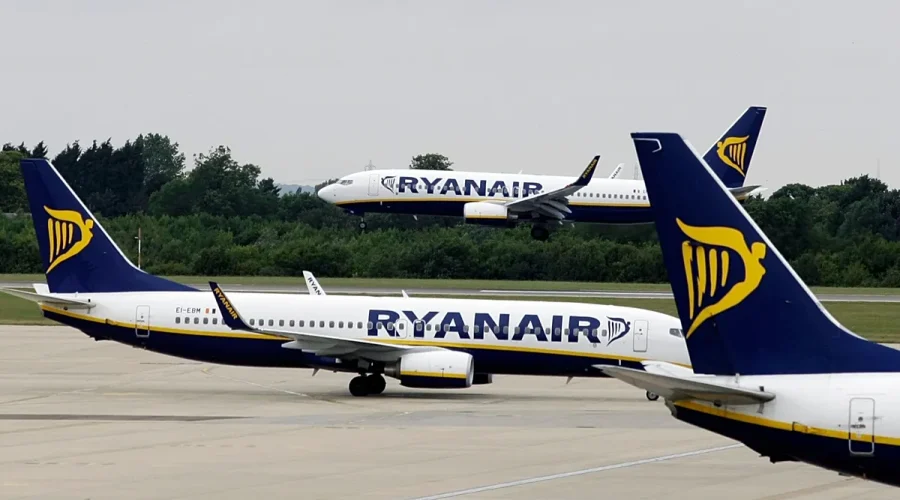
Usagevpn.com – Every time a Ryanair flight parks at a gate without ground crew waiting, passengers step onto a narrow, steep metal staircase bolted directly to the aircraft fuselage. For millions of travelers each year, that brief descent or ascent is the only interface between the cabin and the tarmac. Now a fresh Italian safety review has quantified what many flyers already suspect: that particular set of steps is where injuries happen far more often than on conventional airport-provided stairways.
The Numbers Behind the Hazard
Italy’s National Agency for Flight Safety (ANSV) published a study in August 2026 examining boarding and disembarkation falls recorded across Italian airports from 2023 through 2025. Out of 104 total incidents logged in that window, 85 — representing 82 percent — involved passengers using the forward-integrated staircase of a Boeing 737. The remaining 19 falls were spread among every other carrier operating in the country.
The disparity becomes starker when passenger volumes are factored in. During the same three-year span, Ryanair handled roughly 27 percent of all air passengers transiting Italian airports. The other airlines, collectively responsible for the remaining 73 percent of traffic, accounted for just 19 stairway-related falls combined. In other words, the integrated staircase on a single aircraft type generated more than four times the number of incidents expected from its share of the passenger pool.
A Wider Pattern Across Europe
The Italian data point is not an isolated anomaly. Since 2021, Ryanair has logged 489 stairway falls across its network. Of those, 360 — 73 percent — occurred on the Boeing 737’s built-in stairway. ANSV characterizes that ratio as roughly three times the fall rate observed on standard airport-provided steps. The agency compiled its findings through ECCAIRS, the digital safety-data platform operated by the European Union Aviation Safety Agency (EASA), which aggregates incident reports from member-state authorities.
Engineering at the Edge of Acceptable Limits
The integrated staircase exists to save time and money. When deployed from the forward cabin door while the aircraft sits on the ramp, it lets passengers disembark without waiting for a ground handler to roll up a mobile stair unit. For a low-cost carrier that turns aircraft around in minutes, the operational savings are substantial.
But the geometry leaves little margin. The stairway comprises 12 steps, each approximately 61 centimetres wide and 20 centimetres tall, with a tread depth of 25 centimetres and an overall inclination of 35 degrees. ANSV’s investigators judged those measurements
“are at the limits for step height and steepness”
when benchmarked against the stairways typically supplied by airport operators, which feature lower risers, gentler angles, and substantially larger platforms and treads. The agency additionally flagged a design quirk: because of how the fuselage curves around the forward door, the first step presents an asymmetrical profile to passengers descending, creating an uneven visual and physical cue at the most critical moment of the exit.
Three Incidents That Triggered the Review
The ANSV study was prompted by three separate events in early 2025, each producing what the agency classified as serious injuries:
In Genoa on 22 March 2025, a passenger fell from the integrated stairs and was transported by ambulance to hospital. The agency’s preliminary assessment attributed the fall
“most likely due to the inattention of the passenger.”
Two days later in Venice, another traveler sustained serious injuries after tumbling from the same type of stairway. Crew members reported that the individual was carrying two suitcases and had not been gripping the handrail. A similar scenario unfolded in Bologna, where a passenger also fell while managing two bags.
Ryanair’s Protocol Shift
In the wake of those three events, the airline revised its disembarkation briefing. Beginning 23 July 2025, cabin crew are required to repeat the handrail-usage warning not only in English but also in the national language of both the departure and arrival countries, aiming to close comprehension gaps among international travelers.
Earlier Scrutiny and Unresolved Design Questions
The stairway’s safety profile had already drawn attention before the Italian review. Ireland’s Air Accident Investigation Unit (AAIU) and Spain’s CIAIAC each examined falls that occurred in Dublin in 2021 and in Alicante in 2024. Following the Spanish investigation, CIAIAC formally urged Boeing to redesign the stairway — reducing its angle of descent and enlarging the usable surface area of each step. The agency also recommended that Ryanair discontinue reliance on the integrated system entirely and depend exclusively on airport-supplied stairways.
Notably, no investigation to date has concluded that the staircase is mechanically defective. ANSV itself endorsed the Spanish recommendations directed at Boeing and Ryanair while attributing the majority of falls to human factors: distraction, failure to hold the handrail, and the added difficulty of managing luggage on a narrow, steep structure.
What Passengers Should Know
For travelers, the practical takeaway is straightforward. The integrated staircase on a Boeing 737 is narrower, steeper, and less forgiving than the mobile stairs an airport might otherwise provide. Carrying multiple bags while descending 12 steps at a 35-degree angle, without a handrail, multiplies risk considerably. Until regulatory bodies mandate dimensional changes or airlines voluntarily retire the system, passengers boarding or deplaning a 737 at a gate without ground support should treat those steps with the same caution they would give a steep, narrow outdoor staircase — one hand on the rail, bags consolidated, and full attention on each footfall.
The broader implication for European aviation safety policy is equally clear. EU regulations currently impose no specific dimensional requirements on integrated aircraft stairways because they are not classified as flight-critical components. That regulatory gap means the design parameters remain governed by manufacturer engineering choices rather than by passenger-safety standards. Whether Brussels will close that gap in response to the accumulating incident data remains an open question, but the statistics from Italy, Ireland, and Spain make the case for intervention increasingly difficult to ignore.
Related Reading
Frequently Asked Questions
What is Ryanair s Boeing 737 stairs tied?
Ryanair s Boeing 737 stairs tied is the main topic of this guide. The article explains the context, practical details, and next steps readers should understand.
Why does Ryanair s Boeing 737 stairs tied matter?
Ryanair s Boeing 737 stairs tied matters because readers are looking for a useful answer, not just a short summary. Good content should match search intent and help them decide what to do next.