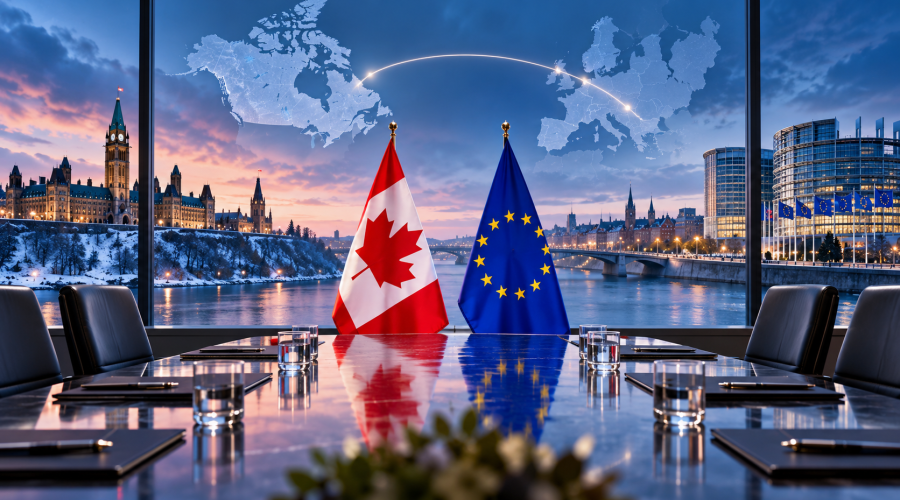
Canada Aims to Become EU’s First Associate Member by 2027
Usagevpn.com – Canada aims to become EU s first associate member by June 2027 under a proposed partnership that would go further than a standard association agreement while remaining short of full membership. Prime Minister Mark Carney outlined the goal after a bilateral summit in Montréal on Friday.
Carney said Canada and the European Union want to create their deepest institutional relationship yet. European Commission President Ursula von der Leyen also backed the ambition, though the proposed “associate membership” status is not defined in the EU’s founding treaties.
“We are working towards the deepest possible partnership short of accession, because of our geography, with Canada becoming the European Union’s first associate member,” Carney said.
A new kind of Canada-EU relationship
Canada cannot join the EU as a full member because EU accession is reserved for European states. The proposed arrangement would instead establish a new framework for closer cooperation in policymaking, EU programmes and governance.
Important details have yet to be settled. Negotiators must decide what rights and obligations Canada would have, how joint decisions would be organised and what approval process the eventual agreement would require in Canada and across the EU.
The wording has already proved sensitive among European governments. Germany objected to using the term “associate member” in negotiations over the summit’s joint declaration. The final document referred instead to an “ever closer association,” language also supported by European Council President António Costa.
Despite that compromise, Carney said Canada aims to become EU s closest non-member partner through the broader vision described at the summit.
“Today, we move towards associate membership for Canada, and we launch a new alliance for the future that will deliver now and in the future with like-minded nations,” Carney said. “We’re just getting started.”
Research, technology and Ukraine cooperation
Several elements of deeper cooperation are already in place or under development. Von der Leyen highlighted Canada’s full integration into the Horizon research programme and Erasmus education programme, as well as the €90 billion support loan for Ukraine.
The summit also expanded cooperation on digital trade, energy, critical raw materials, supercomputing, artificial intelligence and satellite technology. These areas combine economic interests with research capacity, energy resilience and strategic security priorities shared by Canada and EU countries.
For Canadian companies, researchers and students, stronger links with EU initiatives could offer more predictable opportunities to work with European partners. The precise benefits will depend on the final agreement and the access it provides to programmes and decision-making.
Von der Leyen said the proposed status would require both sides to develop a model without an existing precedent.
“The concept of an associate member is uncharted territory, but we have the ambition, trust and creativity to shape it together,” von der Leyen said. “Bilaterally, this is the highest form of partnership.”
June 2027 target for negotiations
The European Commission and the Canadian government plan to hold a college-to-cabinet meeting in the spring to develop the proposal further. Carney is expected to attend a summit of EU leaders in June, when he hopes negotiations can be concluded.
Canada aims to become EU s first associate member on that timetable, but ratification remains a major unanswered issue. EU agreements involving both EU and national powers can require different approval procedures, while Carney has said the proposal would be submitted to Canada’s Parliament for a vote.
“In the coming months, we will determine the full substance, scale and scope of this new form of membership,” Carney said.
FAQ: What would the proposed partnership mean for Canada?
Would Canada become an EU member state? No. Canada would not become a full EU member because EU treaties reserve accession for European states. The proposal concerns a separate, deeper form of partnership.
When could an agreement be reached? Canadian and EU leaders are aiming to complete negotiations by June 2027, although the details and ratification requirements have not yet been finalised.
Which areas could be affected? The partnership could deepen cooperation on research, education, digital trade, energy, critical raw materials, artificial intelligence, supercomputing, satellite technology and support for Ukraine.