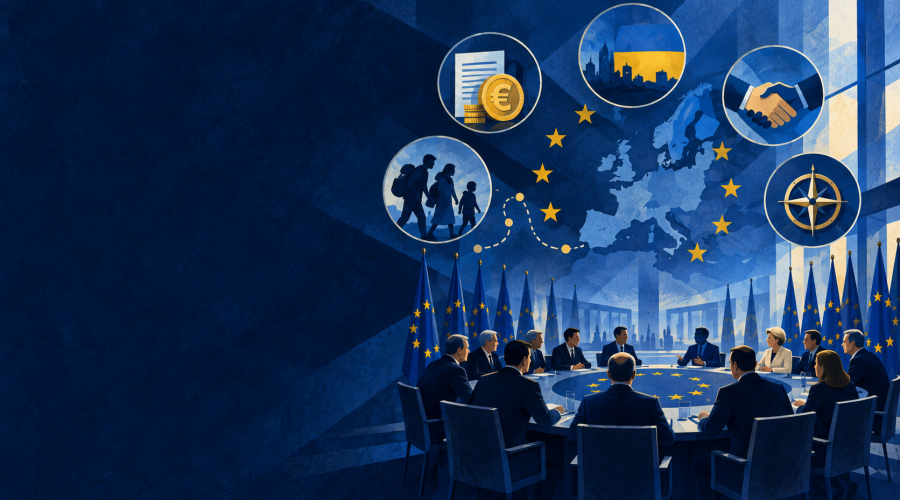
EU Summit Highlights Deep Divisions on Budget, Ukraine and Migration
Usagevpn.com – European Union leaders left Brussels facing unresolved disputes over the bloc’s future budget, Ukraine’s mounting financial needs and increasingly fraught migration policy. The two-day summit on Thursday and Friday brought together sharply different priorities, even as leaders sought to present unity in support of Ukraine.
Ukraine’s President Volodymyr Zelenskyy received a notably supportive reception from EU leaders at a moment of escalating tension with US President Donald Trump. Their dispute overshadowed much of the summit’s second day, with European leaders backing Kyiv’s right to defend itself against Russia’s full-scale invasion.
Support for Ukraine, but difficult choices ahead
Leaders agreed that sanctions against Russia should remain in force while Moscow continues its war. They also criticised a diesel arrangement reached by Trump and Russian President Vladimir Putin, though Bulgaria’s prime minister broke with the wider position and endorsed the deal.
The show of European solidarity offered Zelenskyy a diplomatic boost as Trump intensified his criticism, calling the Ukrainian president harder to negotiate with than Putin and pressing for fresh elections in Ukraine. Trump also described Ukrainian attacks on Russian oil refineries as a “disgrace”, despite the strikes being one of Kyiv’s principal means of applying pressure on Russia.
“I defend the interests of Ukraine and the Ukrainian people exclusively,” Zelenskyy said.
“We were attacked, occupied, and our people were killed. It is only logical that we have the right to defend ourselves.”
“We will keep living, fighting, and most importantly, living with dignity,” he added.
Zelenskyy asked the EU for a further €70 billion in military and financial assistance next year, arguing that more resources are needed to respond to Russia’s escalation. The request complicates existing EU assumptions. A €90 billion loan agreed last year had been expected to finance Ukraine’s needs through both 2026 and 2027.
Member states have now asked the European Commission to develop options for covering the shortfall. Each potential route carries political and financial risks. Higher borrowing costs have reduced enthusiasm for additional common debt, while the prospect of using immobilised Russian assets remains divisive among governments. Bilateral contributions could also leave a relatively small group of wealthier countries carrying most of the cost.
The debate underlined a central challenge for the EU: broad support for Ukraine does not automatically translate into agreement on the mechanism or scale of further funding. Decisions on military and economic help will have to be balanced against pressure on national budgets and the long-running negotiations over the Union’s own finances.
Long-term EU budget talks stall
Negotiations over the next Multiannual Financial Framework, the EU’s long-term budget, produced little movement. Net-contributing countries known as the “frugal” group remain opposed to higher spending, while southern and eastern states in the Friends of Cohesion camp are resisting reductions that could affect regional development funding.
A negotiating proposal issued only days earlier by the Irish presidency has effectively been abandoned. It would have reduced the overall budget by €141 billion in an effort to accommodate the frugal states.
European Council President António Costa will now take responsibility for pushing the talks forward. He is expected to present a revised compromise in the coming weeks, potentially before the special summit scheduled for 26 November, shortly before Spain’s elections.
Costa’s expected approach has three broad elements: limiting national payments where possible, revisiting EU-wide revenue sources and restoring flexibility tools that were cut from the Irish presidency’s proposal. Those instruments matter because they give the bloc greater room to react when crises or unforeseen spending demands arise.
The more immediate concern is the weakening sense of urgency. Representatives on both sides of the argument have indicated that they do not feel compelled to secure a deal before the end of the year. Experienced EU negotiators often rely on deadlines to force compromise, and the absence of pressure could allow talks to drift into an electoral period that may alter the political balance across Europe.
Migration remains a source of confrontation
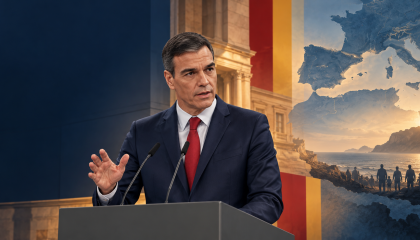
Migration was once again among the summit’s most sensitive subjects. The previous discussion in June had degenerated into a heated confrontation between Spanish Prime Minister Pedro Sánchez and, on the other side, Italian Prime Minister Giorgia Meloni and Danish Prime Minister Mette Frederiksen.
This time, Italy and Spain showed tentative signs of easing one dispute. Before migration was discussed on Friday, Rome and Madrid appeared to make an initial move towards settling their disagreement over border controls introduced after the Ceuta crisis.
Italy’s temporary checks had been due to lapse on Thursday evening. Instead, they were prolonged for another week so that their expiry would match Spain’s controls, which are set to end on 22 October. The two countries’ interior ministers are expected to agree on replacement arrangements before that deadline.
Although Meloni adopted a more conciliatory tone at the start of the summit, Frederiksen continued to criticise Sánchez over Spain’s plan to regularise the status of 600,000 migrants.
“I have asked the European Commission to examine what happens when a country does almost the exact opposite of what the rest of us are doing,” Frederiksen said.
The remark was directed at Spain without naming it explicitly. It illustrated how migration remains tied not only to border management but also to broader disputes over national approaches to residency, asylum and responsibility-sharing within the EU.
The Brussels meeting therefore exposed an uncomfortable reality for the Union. Leaders broadly agree that Europe must respond to the war in Ukraine, manage migration and finance shared priorities. Yet the summit showed how difficult it remains to turn those common objectives into detailed commitments on money, policy and political responsibility.
Related Reading
Frequently Asked Questions
What is Budget Ukraine migration?
Budget Ukraine migration is the main topic of this guide. The article explains the context, practical details, and next steps readers should understand.
Why does Budget Ukraine migration matter?
Budget Ukraine migration matters because readers are looking for a useful answer, not just a short summary. Good content should match search intent and help them decide what to do next.