Serbia and Uzbekistan Target More Trade
Usagevpn.com – Uzbek President Shavkat Mirziyoyev landed in Belgrade on Monday for a two-day state visit whose central objective is to push Serbia and Uzbekistan target more bilateral commerce and investment. On Tuesday he will sit down with Serbian President Aleksandar Vučić to sign a joint declaration upgrading the relationship to strategic-partnership status, alongside a sweeping package of sectoral documents spanning transport, mechanical engineering, light and food manufacturing, agriculture, pharmaceuticals, and information technology. Organised labour migration also features prominently, underscoring that both governments intend to build a durable economic corridor rather than stage a single diplomatic photo-opportunity.
The trip is the mirror image of Vučić’s own visit to Tashkent in October 2025 and arrives just as Belgrade prepares to open a permanent embassy in the Uzbek capital — a diplomatic milestone that marks how quickly political contacts between the two states have scaled over the past eighteen months.
Record Numbers and the Structural Leap Ahead
According to the Serbian Chamber of Commerce, two-way trade reached an all-time high of roughly $41.9 million (€36.1 million) in 2025, a 27 per cent surge over the $32.9 million recorded in 2024. Serbian exports accounted for $26.39 million of that total while imports from Tashkent stood at $15.46 million. For economies of their respective scale the absolute figures remain small, which is exactly why officials on both sides frame the next phase in terms of structural transformation rather than marginal percentage-point gains.
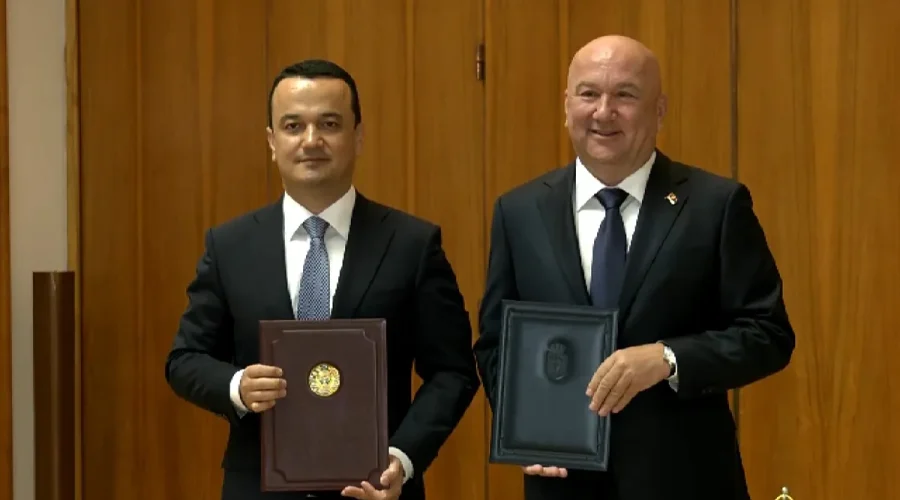
Hours before Mirziyoyev’s arrival, the inaugural sitting of the Joint Commission for Economic Cooperation convened in Belgrade. Serbian Minister of International Economic Cooperation Nenad Popović met Uzbekistan’s Minister of Investment, Industry and Trade, Laziz Kudratov. The session focused on deepening trade and investment flows, forging direct company-to-company links, and identifying sectors ripe for joint ventures.
“Our task is to convert this strong political momentum into concrete results — increased trade, new investments, joint projects, and a stronger presence of Serbian companies on the Uzbek market,” Popović stated.
Free-Trade Negotiations and the Gateway Thesis
The most consequential item on the table is the opening of bilateral free-trade-agreement talks. Kudratov confirmed that negotiations are now commencing and that such a deal, paired with duty-free trade, would materially widen the flow of goods between the two countries. The concept did not originate with this visit; Serbian and Uzbek officials had already discussed launching FTA talks during earlier meetings in Tashkent in May.
“We are also beginning talks on a free trade agreement, which, together with duty-free trade, would lead to increased trade in goods,” Kudratov said.
Uzbek economic planners have long positioned Serbia as a gateway for Tashkent-based firms seeking entry into Central and Southeast European markets. In the reverse direction, closer ties would open one of Central Asia’s largest domestic consumer markets to Serbian companies. At the close of Monday’s session the commission was formally designated as the principal institutional mechanism for tracking agreements and developing new economic initiatives going forward.
Agriculture Leads the Growth Curve
Among every sector under discussion, agriculture and food production show the steepest recent trajectory. Serbian exports of agricultural and food products to Uzbekistan climbed 54.1 per cent between January and July 2026, per data tabled at the commission meeting. Officials singled out seeds and planting material, agricultural machinery, and food-processing equipment as sub-sectors where further expansion appears immediately feasible.
The logic is straightforward: Uzbekistan’s population of over 36 million and its climate-constrained arable land generate sustained demand for imported seed technology and processing capacity, while Serbia’s established agro-industrial base in the Balkans positions it to supply both.
Beyond the Farm Gate
The sectoral agenda discussed in Belgrade stretches well past agriculture into mechanical and electrical engineering, pharmaceuticals, textiles, construction, energy, transport and logistics, alongside information technology, artificial intelligence, robotics, and digitalisation. A dedicated Serbia-Uzbekistan business forum is also planned in Belgrade to give firms a structured matchmaking platform.
FAQ
What is the strategic-partnership designation? It is a formal elevation of bilateral relations announced through a joint statement signed by the two heads of state. It signals a long-term commitment to deepen economic, political, and institutional cooperation beyond the level of ordinary diplomatic ties.
When did Serbia-Uzbekistan trade hit its record level? Two-way trade peaked at approximately $41.9 million in calendar year 2025, up 27 per cent from 2024, according to the Serbian Chamber of Commerce.
What sectors are covered by the new sectoral documents? Transport, mechanical engineering, light and food industries, agriculture, pharmaceuticals, information technology, textiles, construction, energy, transport and logistics, AI, robotics, and digitalisation.
Is a free-trade agreement already in force? No. Negotiations are only now opening. Earlier discussions took place in Tashkent in May, and the current visit formalises the start of talks.
What role does the Joint Commission play? It serves as the principal institutional mechanism for tracking implementation of signed agreements and for developing new economic initiatives between the two governments.