A State Gets Targeted: Trump Floats Renaming New Mexico to “New America”
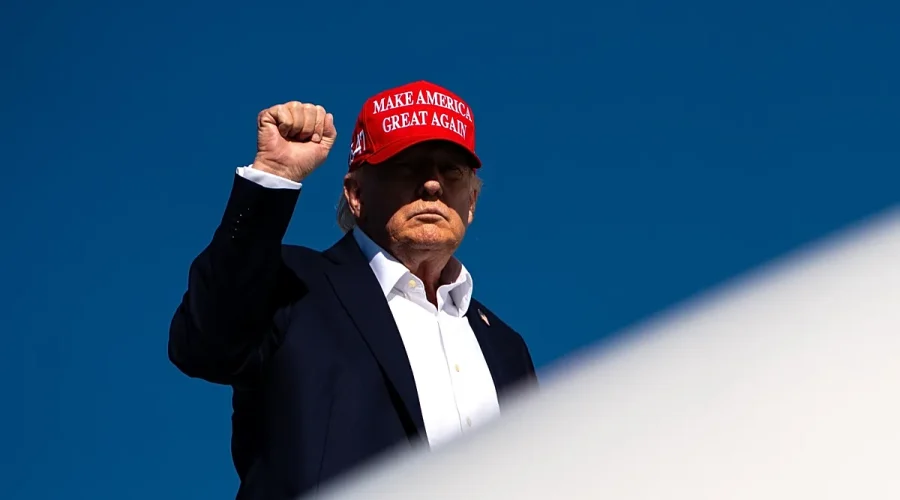
Usagevpn.com – The latest chapter in President Donald Trump’s sweeping campaign to rebrand geographic landmarks across North America has landed squarely on American soil. Earlier this week, the Republican commander-in-chief took to social media to propose that the state of New Mexico shed its current name entirely and adopt the moniker “New America” instead. The suggestion arrived just days after he signed an executive order attempting to rename Lake Ontario as “Lake America,” a move made amid an ongoing trade dispute with Canada that has strained bilateral relations to their lowest point in decades.
The Proposal and Its Immediate Aftermath
In a post on his Truth Social account, Trump wrote:
“Many people suggested changing the name of New Mexico…to NEW AMERICA. So much more prestigious and beautiful for the people of that potentially incredible State. Wow, I Love It!!!”
The White House amplified the message by reposting an edited graphic in which the word “Mexico” had been struck through and replaced with “America.” Several maps bearing the altered label circulated across the president’s social media channels within hours. Some American media outlets noted that the concept had initially surfaced online as a satirical internet hoax before being adopted by the administration.
The reaction from New Mexico’s leadership was swift and unambiguous. Governor Michelle Lujan Grisham told Fox News that the state’s name is settled history, not a matter open for executive revision:
“Isn’t up for debate, it’s been ours since before the United States existed.”
Grisham characterized the proposal as a deliberate diversion, arguing that the president sought to “distract Americans” from pressing domestic concerns, including sharply rising gasoline prices that have squeezed household budgets across the country.
A Pattern of Geographic Rebranding
The New Mexico suggestion is the most recent entry in a string of renaming moves that have defined Trump’s second term. On his first day back in the White House in January 2025, he signed an order changing the Gulf of Mexico to the “Gulf of America,” a designation that drew formal protest from Mexico’s foreign ministry. Last week, while the military conflict with Iran continued, he floated renaming the Strait of Hormuz the “Trump Strait,” only to imply within hours that he had not intended the remark as a literal policy directive. The Lake Ontario order, signed in the middle of a tariff standoff with Ottawa, was likewise rejected by the Canadian government, which noted that the lake’s name predates both nations and is embedded in international hydrological records.
Each of these moves has been met with institutional resistance. State names in the United States are not set by executive order; they derive from congressional acts, territorial charters, and, in New Mexico’s case, from Spanish colonial-era designations dating to the sixteenth century. Changing a state’s official name would require an act of Congress, approval by the state legislature, and likely a constitutional amendment or at minimum a state-level referendum. No such process has been initiated.
Why the Name Matters: Historical and Practical Context
New Mexico’s name traces back to the Spanish colonial province of Nuevo México, established in the early 1600s. The territory was formally admitted to the Union as the forty-seventh state in 1912. Its name appears on every federal document, postal code, driver’s license, and interstate compact governing the region. A wholesale replacement would ripple through federal statutes, state constitutions, tribal agreements, and the administrative infrastructure of every agency that references the state by name.
The governor’s office in Santa Fe has not issued a formal legal brief contesting the proposal, largely because no executive mechanism exists to impose a state-level name change unilaterally. The episode thus functions less as a policy initiative and more as a rhetorical gesture — one that underscores the administration’s willingness to treat geographic nomenclature as a branding exercise rather than a matter of historical record.
Reader-Facing Implications
For residents of New Mexico, the practical impact of the proposal is nil absent legislative action. For observers of American federalism, however, the episode highlights a recurring tension: the president’s authority over federal naming conventions (national parks, military installations, federal waters) versus the constitutional sovereignty of states over their own identity. The governor’s pointed reminder that the name predates the republic itself underscores that point. Whether the administration will pursue any formal mechanism to alter the state’s designation remains unclear, but the social-media spectacle has already served its apparent purpose of dominating the news cycle for a full news day.
Related Reading
Frequently Asked Questions
What is What s in a name Trump?
What s in a name Trump is the main topic of this guide. The article explains the context, practical details, and next steps readers should understand.
Why does What s in a name Trump matter?
What s in a name Trump matters because readers are looking for a useful answer, not just a short summary. Good content should match search intent and help them decide what to do next.