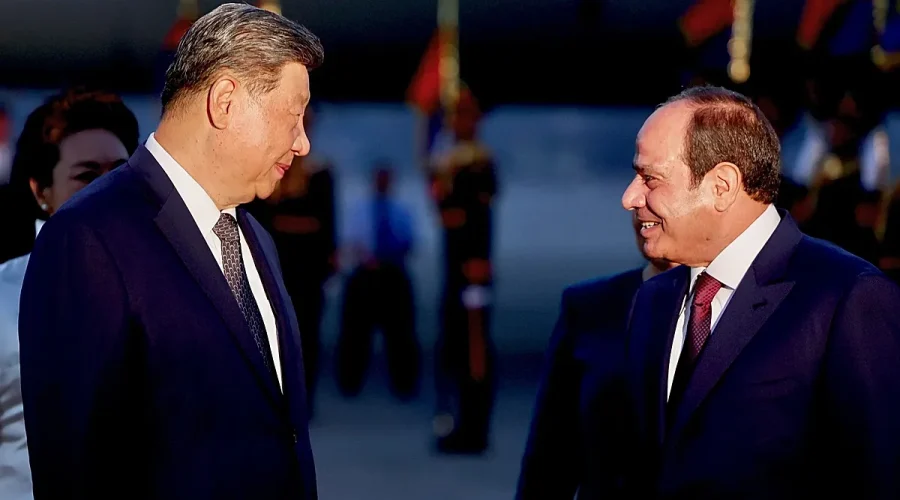
Xi’s Cairo Visit Marks a Decade-Long Shift in China-Egypt Ties
Usagevpn.com – Chinese President Xi Jinping stepped off his plane in Cairo on Tuesday, ending a ten-year absence from Egyptian soil and arriving at a moment when Beijing’s physical presence across the country has grown from blueprint to skyline. The trip coincides with the seventieth anniversary of formal diplomatic relations between the two states — a milestone dating back to 1956, when Egypt became the first Arab and African nation to recognise the People’s Republic. Beijing frames the occasion as a chance to deepen what it calls a
“comprehensive strategic partnership”
— a label that now carries considerably more weight than it did when the relationship was still largely ceremonial.
Concrete Already Cast: The Infrastructure Legacy
Walk through the New Administrative Capital east of Cairo and the Chinese imprint is impossible to miss. China State Construction Engineering Corporation raised the central business district, a cluster of twenty skyscrapers whose centrepiece is the 385.8-metre Iconic Tower — the tallest structure on the African continent. A light-rail network, built with substantial Chinese participation, now threads Cairo’s eastern periphery into the newly planned urban nodes. Closer to the water, a China-Egypt industrial zone adjacent to the Suez Canal corridor has drawn more than two hundred firms and generated over ten thousand direct jobs, by Chinese government counts. Cumulative Chinese investment in Egypt has surpassed $4.7 billion (€4.05bn), according to figures cited in Chinese media.
These projects defined the first phase of the partnership: roads, towers, rail lines. What the current visit is expected to unlock is something qualitatively different — technology transfer, advanced manufacturing, and joint development in sectors where Egypt still imports most of its inputs.
Trade Numbers and the Push for Local Production
Egypt’s Central Agency for Public Mobilisation and Statistics recorded bilateral trade of $11.3 billion (€9.75bn) in the first half of 2026, a 21.5 per cent jump over the same period a year earlier. Egyptian shipments to China — fuel, mineral oil, fruit, vegetables, cotton — nearly tripled to $840.8 million (€725.4m). The reverse flow, however, dwarfs it: imports from China totalled $10.4 billion (€8.97bn), with machinery and electrical equipment alone representing $4.1 billion (€3.5bn), followed by vehicles, iron and steel, plastics, and chemicals.
Cairo’s stated objective is to narrow that asymmetry. A five-year cooperation programme agreed for 2024 through 2028 explicitly calls for local production and technology transfer in electric vehicles, electronics, solar panels, chemicals, and modern agricultural technology, with artificial intelligence singled out as a priority. President Abdel-Fattah el-Sisi, speaking before Xi’s arrival, said Egypt sought Chinese capital in EVs, battery storage, renewable energy, and shipbuilding, alongside expanded technology sharing in telecommunications, AI, and space sciences.
Eagles of Civilisation: A Second Round of Joint Drills
The economic agenda is no longer the only front. Chinese and Egyptian fighter jets have been flying together at Egyptian air bases as part of the second edition of the Eagles of Civilisation joint air force exercise, running from mid-August into early September. The inaugural edition took place only last year, making the annualised cadence itself a signal of institutionalising the military link. Chinese officials outlined the 2026 programme as covering air-combat tactics, air-superiority operations, combat search and rescue, and joint force deployment.
The United States remains Cairo’s principal long-standing security partner, supplying large-scale military assistance and a significant share of Egypt’s diversely sourced equipment. Washington has not issued a public comment on the Chinese drills, though the Pentagon has previously voiced concern about Chinese military engagement with American partners across the Middle East and Africa. For Egypt, the exercises slot into a broader balancing strategy that also encompasses membership in BRICS, participation in the New Development Bank, and involvement in the Shanghai Cooperation Organisation — all pursued alongside continued reliance on Western economic and security support.
Why Egypt Matters to Beijing
In remarks preceding the visit, Xi characterised Egypt as a critical bridge between the Arab world and Africa, urging deeper China-Arab and China-Africa cooperation channelled through Cairo. For Beijing, the country offers a consumer market exceeding one hundred million people, a chokepoint position on the Suez Canal, and political influence across two continents. The two governments have also aligned on several regional questions, including backing for a Palestinian state, while Egypt continues to uphold its One China policy.
El-Sisi has made eight trips to China since assuming office in 2014, the most recent in May 2024. The agreements expected to emerge from this week’s talks are anticipated to sharpen the focus on newer cooperation domains — particularly technology transfer and advanced manufacturing — where Egypt has pressed hardest to move beyond the construction-and-infrastructure model that defined the relationship’s first decade.
Related Reading
Frequently Asked Questions
What is From infrastructure to military drills China?
From infrastructure to military drills China is the main topic of this guide. The article explains the context, practical details, and next steps readers should understand.
Why does From infrastructure to military drills China matter?
From infrastructure to military drills China matters because readers are looking for a useful answer, not just a short summary. Good content should match search intent and help them decide what to do next.