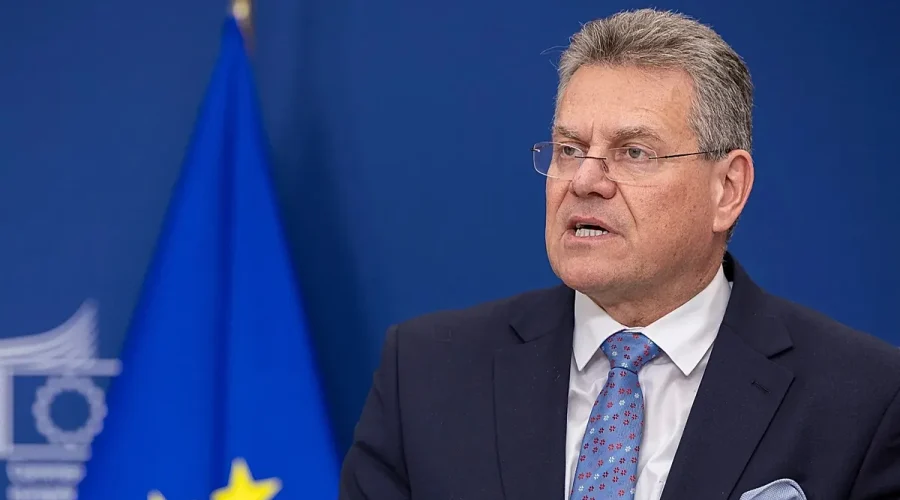
EU Trade Chief Rules Out Role in US-Canada Dispute, Pivots Toward Deeper Ottawa Partnership
Usagevpn.com – The European Commission has drawn a firm line beneath its own trade agenda: it will not insert itself into the escalating tariff confrontation between Washington and Ottawa. Speaking in an exclusive interview, EU Trade Commissioner Maroš Šefčovič made clear that Brussels considers itself outside the scope of mediation in what has become one of the sharpest bilateral trade ruptures in recent North American history.
The breakdown came roughly ten days before the interview, when Canadian Prime Minister Mark Carney abandoned ongoing negotiations with the Trump administration. Carney attributed the collapse to sustained American pressure on Canada regarding the use of French in official contexts — a cultural and linguistic flashpoint that had simmered beneath the commercial agenda for months. Within days of the walkout, President Donald Trump declared a 50 percent tariff on Canadian automobiles and trucks entering the US market. Ottawa responded swiftly, imposing duties on more than 700 categories of American imports valued at approximately $20 billion (€17.2 billion), effectively locking both economies into a tit-for-tat spiral.
“I don’t think that we are in a position to mediate,” Šefčovič said. “At the same time I know that they [Canada and the US] have such a close economic relationship that, despite the current tension, sooner or later there will be attempts to resolve it.”
Tariffs as a Domestic Burden
While declining the mediator role, the Commissioner did not shy from the economic arithmetic of the dispute. He reiterated a point he has pressed repeatedly over the past year amid the EU’s own trade friction with Washington: that tariff costs ultimately land on businesses and households, not on the governments that impose them.
“Tariffs are taxes which are paid in the end by the economic operators or by the citizens,” he stated. “We clearly support free and fair trade with the lower or no tariffs at all.”
That framing carries particular weight for European consumers and manufacturers already feeling the ripple effects of transatlantic trade friction. By naming the end-bearer of tariff costs, Šefčovič positions the Commission’s advocacy for lower barriers as a consumer-protection argument as much as a market-access one.
Ottawa’s Pivot Toward Brussels
The rupture with Washington has accelerated a strategic reorientation in Canadian foreign-trade policy. Carney has publicly called for a tighter institutional bond between Ottawa and Brussels and confirmed his attendance at European Commission President Ursula von der Leyen’s State of the Union address in Strasbourg in mid-September — one of the most prominent slots on the EU’s annual political calendar. A dedicated EU-Canada summit is additionally slated for later this autumn, signalling that both capitals intend to convert diplomatic momentum into concrete negotiation.
Šefčovič framed the Commission’s posture as open but conditional. The body is prepared to examine “all possibilities” for deepening cooperation, yet any new architecture of trade or investment arrangements would hinge on Ottawa’s own appetite for risk and ambition.
“[Any new arrangements] would very much also depend on how comfortable the Canadian side would feel and what is its level of ambition,” he noted.
Building on the 2016 Foundation
The existing Commercial and Economic Partnership Agreement (CEPA), concluded in 2016, has already reshaped bilateral flows. According to the Commissioner, EU-Canada trade expanded by roughly 75 percent in the years following the deal’s entry into force. Yet Šefčovič argued the agreement still leaves meaningful headroom.
“On both sides, we have certain elements which we can improve, still certain barriers, certain sensitivities for the products. I really think that we can explore much more that.”
Two near-term workstreams were highlighted. First, a digital trade agreement — covering data flows, e-commerce rules, and digital taxation — could be signed before year-end. Second, cooperation in critical raw materials, potentially including joint investment vehicles, is under active discussion. Both tracks would reduce Canada’s dependence on a single transatlantic market while giving European firms additional supply-chain resilience.
The CPTPP Dimension
Brussels views Ottawa as a like-minded partner sharing its vision of a rules-based global trading order. That alignment carries a specific strategic utility: Canada is a member of the Comprehensive and Progressive Agreement for Trans-Pacific Partnership (CPTPP), the 12-nation pact that has liberalised trade across the Asia-Pacific region and parts of the Americas. The United States is notably absent from the arrangement.
The UK became the CPTPP’s first — and to date only — European member in 2024. Canada’s full accession was ratified effective 1 September, deepening the country’s institutional commitment to the pact. Šefčovič expressed hope that Ottawa would lend its political weight to help the EU move closer to CPTPP membership, a step that would open access to markets spanning from Japan and Australia to Chile and Peru.
“Canadians are very important partners for forging a new level of cooperation with the CPTPP,” Šefčovič said, “which represents together 40 percent of global trade.”
For an EU economy still adjusting to the post-Brexit recalibration of its external trade architecture, the prospect of anchoring a second trans-Pacific relationship through a trusted North American ally represents not merely a commercial opportunity but a structural hedge against the kind of unilateral tariff shocks now unfolding south of the 49th parallel.
Related Reading
Frequently Asked Questions
What is Brussels will not mediate between US?
Brussels will not mediate between US is the main topic of this guide. The article explains the context, practical details, and next steps readers should understand.
Why does Brussels will not mediate between US matter?
Brussels will not mediate between US matters because readers are looking for a useful answer, not just a short summary. Good content should match search intent and help them decide what to do next.