Budapest’s Ruin Bar Culture Claims Europe’s Top Drinking Spot in New Annual Ranking
Usagevpn.com – There is a particular kind of knowledge that only surfaces after the second round of drinks. It lives in the way a bartender calls your name without looking up, in the argument over which corner table gets the last cigarette, in the particular slant of neon light cutting through cigarette haze. No museum exhibit or monument plaque replicates that texture of a city’s nightlife. And yet, for decades, travellers have relied on guidebooks that treat bars as mere checkboxes between the cathedral and the river walk.
That gap is what the European Bar Guide sets out to fill. The independent review platform, which evaluates pubs and bars across the continent, has just published its annual list of the 100 best bars in Europe. Its methodology deliberately sidesteps the usual metrics of luxury and spectacle. As the guide explains on its own site, venues are judged
“simply on how well they do what they’re trying to do,” with emphasis on “spectacle, atmosphere, social scene, intriguing customs, local culture and yes, the quality and choice of drinks.”
The guide adds a telling caveat:
“Sometimes a bar’s deficiencies can be handsomely compensated for in other ways.”
In practice, this means a crumbling interior with a legendary cocktail list can outrank a polished cocktail lounge. The result is a ranking that rewards character over polish, and it is precisely why Budapest’s most notorious ruin bar has claimed the number-one slot.
Szimpla Kert: The Original Ruin Bar Takes the Crown
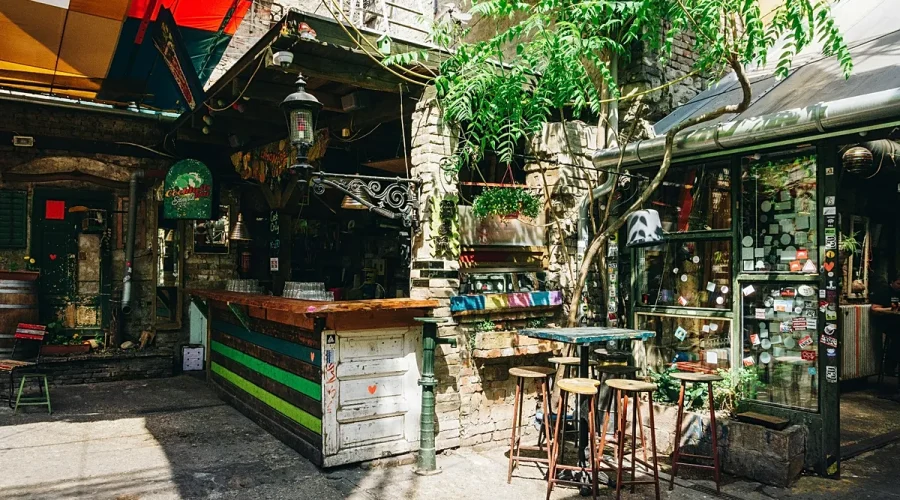
Budapest’s ruin bar scene is a distinctly Hungarian invention, born from the post-communist habit of repurposing derelict structures into drinking spaces. Szimpla Kert, which opened its doors in 2002 inside an abandoned factory complex, was the first of its kind and remains the archetype. The European Bar Guide describes stepping inside as
“like entering a portal to another dimension.”
The description is apt. Visitors navigate a labyrinth of graffiti-scarred rooms, mismatched furniture scavenged from unknown sources, tangled fairy lights, and objects whose placement seems governed by pure whimsy. All of it orbits a leafy central courtyard where the noise peaks. Weekdays bring pálinka — the traditional Hungarian fruit spirit — alongside shisha sessions conducted from inside a converted automobile or a bathtub sliced in half. On Sundays the tone shifts: local producers set up stalls of cheese, bread, honey, and other Hungarian provisions, often paired with live film screenings and musical performances.
The bar’s dominance of the ranking is less a surprise than a confirmation. Ruin bars have become as central to Budapest’s identity as the Chain Bridge or the Parliament building, and Szimpla Kert’s two-decade run as the genre’s founding institution gives it a cultural weight no newer venue can match.
Belgium’s Beer-Soaked Dominance
If Hungary owns the top spot, Belgium saturates the rest of the list. The small country appears five times among the top ten, a testament to the depth of its brewing tradition and the sheer density of its bar culture. Two of those entries deserve particular attention.
Retsins Lucifernum, Bruges
Ranked second overall, this Bruges establishment is described by the guide as
“a departure into another world entirely” and “simply unmissable.”
The bar is the private residence of local personality Don “Willy” Retsin, who greets guests at the door in the role of “butler” and maintains, with full commitment, that he is a vampire. Inside, antiques, gothic artwork, and ephemera crowd every surface before giving way to a downstairs bar and a courtyard garden. Capacity is limited to roughly 20 patrons, making advance reservations essential for anyone hoping to try the unusual cocktails or share the experience with fellow visitors.
La Fleur en Papier Doré, Brussels
A traditional Brussels brown café, this cosy neighbourhood pub takes its name from the dark wood panelling and warm, low lighting that define its interiors. Frosted windows, stained-glass panels, old tiled floors, and walls thick with medieval-style artwork and floral curiosities create an atmosphere that has long attracted the city’s surrealist crowd — René Magritte was a noted regular. Today the clientele is a cosmopolitan blend of locals and curious travellers. The Belgian beer list is priced accessibly, and occasional live music and local events reinforce the lived-in, unpretentious feel.
Goupil Le Fol, Brussels
Hidden just off the main tourist thoroughfare, this candle-lit den of low ceilings, vinyl records, old books, portraits, and 1950s jazz memorabilia requires a short walk down a narrow passage past the original Wurlitzer jukebox before reaching its cosy upholstered rooms. Records hang from the ceiling; books paper the walls. While the Belgian beer selection is solid, the guide notes that fruity wines laced with Cassis and Cognac are the true draw.
Zlatna Ribica, Sarajevo
The ranking’s authors observe that many bars in Bosnia and Herzegovina lean too heavily on Western influences, but this Sarajevo venue stands apart as a genuine expression of local character. Zlatna Ribica — “gold fish” in translation — is described as wonderfully eccentric, resembling a mad professor’s study crammed with antiques, ornate lampshades, waxed sideboards, and books, with the clutter spilling onto the street outside. Every surface conceals another oddity, from crenellated furniture to a tiny black-and-white television in the bathroom showing lions mating in the savannah. Patrons recline amid the chaos with a cocktail or local beer in what the guide calls one of Europe’s most idiosyncratic drinking spots.
Papa Joe’s, Germany
The ranking’s authors label Papa Joe’s
“one of the ultimate jazz bars on the globe.”
It is also one of Germany’s oldest jazz bars, a wonderfully unpretentious venue built around daily live concerts. Stage-like seating faces the performers, and a scoreboard tracks the night’s sets. The emphasis is squarely on fun and musical community rather than exclusivity.
What the Ranking Tells Us About European Drinking Culture
The list as a whole underscores a point that has long been true but rarely codified: Europe’s most memorable bars are rarely the most expensive or the most polished. They are the places where local identity, historical accident, and sheer eccentricity converge. Budapest’s post-1989 architectural salvage, Belgium’s centuries-deep brewing infrastructure, Sarajevo’s layered wartime and peacetime material culture, and Germany’s mid-century jazz scene all find expression in spaces that a conventional travel guide would reduce to a single line of text. The European Bar Guide’s methodology — rewarding atmosphere, social scene, and cultural specificity over glitz — ensures that these spaces remain visible to travellers who might otherwise walk past them.
Related Reading
Frequently Asked Questions
What is Where is the best bar in Europe?
Where is the best bar in Europe is the main topic of this guide. The article explains the context, practical details, and next steps readers should understand.
Why does Where is the best bar in Europe matter?
Where is the best bar in Europe matters because readers are looking for a useful answer, not just a short summary. Good content should match search intent and help them decide what to do next.