Frecciarossa Starting Tests for New Rome Rail Links
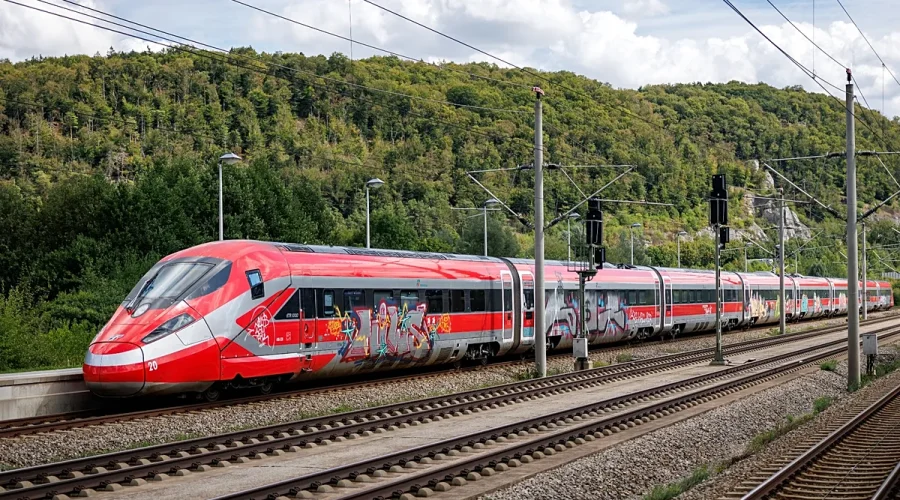
Usagevpn.com – Frecciarossa starting tests for new Rome and Milan high-speed connections to Munich have officially begun, as Italy’s state railway operator Ferrovie dello Stato (FS) rolled its flagship trains onto German and Austrian track for the first time. The test programme marks the opening of the international certification window that must be cleared before any passenger revenue service can run across the Brenner corridor. Both the Milan–Munich and Rome–Munich itineraries are slated to open commercially in summer 2027, provided every foreign-jurisdiction approval for the rolling stock is secured on schedule.
The exercise is the newest instalment of a multi-year plan that has already put Italian high-speed stock into regular service on French and Spanish networks. FS leadership has publicly outlined ambitions to extend operations through the Channel Tunnel into the United Kingdom by 2029, effectively repositioning the group from a domestic carrier into a pan-European cross-border operator. On the ground, the German and Austrian segments are being run in tight coordination with Deutsche Bahn and Österreichische Bundesbahnen (ÖBB), the two national infrastructure owners whose lines the trains will cross.
Service Pattern and Journey Times
At full build-out the corridor will carry ten daily Italy–Germany connections, eventually encompassing departures from Naples and arrivals in Berlin. The initial commercial timetable, however, will be more restrained: four services per day divided between the Milan–Munich and Rome–Munich routes.
The shorter Milan–Munich leg, approximately six and a half hours door-to-door, threads through Brescia, Verona, Rovereto, Trento, and Bolzano before entering Austria at Innsbruck. The Rome–Munich itinerary stretches to roughly eight and a half hours, inserting Florence and Bologna into the sequence before converging on the same Alpine corridor via Verona, Rovereto, Trento, Bolzano, and Innsbruck. Travellers continuing onward to Frankfurt or Krakow will find that the new trunk line eliminates the awkward transfers and long road segments that have characterised the journey to date.
The Brenner Base Tunnel Variable
No discussion of the corridor’s long-term performance is complete without the Brenner Base Tunnel, a 64-kilometre bore beneath the Alps whose shorter, flatter alignment will cut roughly an hour from present journey times. From December 2028 the complete service pattern — including the extended Naples and Berlin legs — is projected to be in place, with the tunnel’s geometry permitting higher sustained speeds through the mountain section that today forces trains onto slower, more winding alignments.
Statements from FS Leadership and Government
“The start of test runs in Germany and Austria is a step towards delivering a project that confirms our ambition to make the train the benchmark mode of transport for mobility across Europe,” said Gianpiero Strisciuglio, chief executive and general manager of FS. “Thanks to our partnership with Deutsche Bahn and ÖBB, we are moving towards creating the High-Speed ‘European Metro’, offering passengers a service able to bring regions, people and economies closer together.”
Strisciuglio framed the milestone as an export of Italian industrial capability, describing Frecciarossa as “continuing its international growth path, taking the FS Group’s technological and industrial excellence abroad and helping to develop an increasingly integrated European rail network.”
“A further step confirming the growth of the FS Group and its ability to win new markets abroad, while providing better services and infrastructure in Italy. More jobs, more connections, more Italy in Europe,” declared Matteo Salvini, Italy’s Minister for Infrastructure and Transport.
Certification and Crew Readiness
Validating a single trainset across multiple national networks is a complex undertaking. The Frecciarossa platform was engineered to European interoperability technical specifications from the outset, with design provisions for operation in Italy, France, Germany, Spain, Austria, Switzerland, the Netherlands, and Belgium. Each country nonetheless imposes distinct power-supply voltages, signalling protocols, and gauge tolerances that demand individual validation. The Trenitalia–Deutsche Bahn agreement explicitly contemplates parallel sharing of technical expertise so that adaptation work proceeds concurrently rather than sequentially, compressing timelines and containing costs.
In parallel with prototype construction, structured training programmes were opened for German and Austrian locomotive drivers, ensuring that crews are familiar with the train’s handling characteristics before any revenue service commences.
Frequently Asked Questions
When will passengers first board a Frecciarossa service between Rome and Munich? The commercial launch of both the Rome–Munich and Milan–Munich routes is targeted for summer 2027, subject to completion of all foreign regulatory approvals.
How long will the Rome–Munich journey take once the Brenner Base Tunnel opens? Present estimates put the Rome–Munich itinerary at roughly eight and a half hours. The tunnel, expected to be in service by December 2028, should shave approximately one hour from that figure.
Which cities are served along the route? The Milan–Munich leg stops at Brescia, Verona, Rovereto, Trento, and Bolzano before crossing into Austria. The Rome–Munich leg adds Florence and Bologna to that sequence. Later phases will extend the corridor to Naples and Berlin.
How many daily services will operate initially? Four services per day will be split between the Milan–Munich and Rome–Munich itineraries at launch. The full pattern of ten daily Italy–Germany connections, including the Naples and Berlin extensions, is projected for December 2028.