We Have to Contribute to Nature: Villagers Marry Glaciers
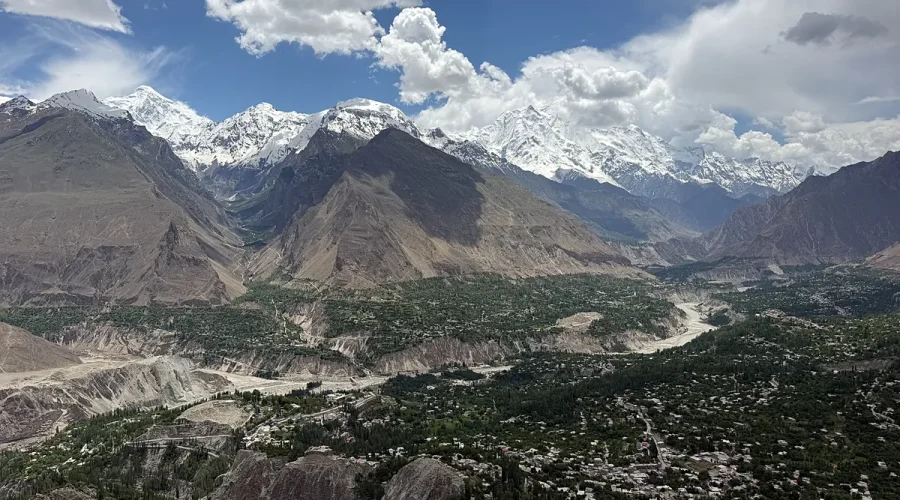
Usagevpn.com – “We have to contribute to nature” is not a slogan in Gilgit-Baltistan; it is a survival instruction. Across the high valleys of this autonomous territory in the wider disputed Kashmir region, summer meltwater arrives later every year while glacial lake outburst floods grow more frequent. In response, residents have revived a centuries-old Indigenous technique called Gang Khswa — the physical transplantation of ice fragments from existing glaciers to a new site where they can accrete into a self-sustaining water source for irrigation, livestock, and household use.
How a “Glacier Marriage” Works
The method rests on a gendered metaphor rooted in local ecological knowledge. A grey, debris-laden glacier carrying soil, sand, and pebbles is designated the “male” parent; a lighter, nearly transparent glacier free of impurities and yielding greater meltwater volume serves as the “female” parent. Dozens of porters harvest ice blocks from both sources, load them into wooden baskets strapped to their backs, and haul them toward a community-selected planting site. Where roads permit, vehicles carry the load; beyond that, the journey continues entirely on foot.
The destination must satisfy strict environmental criteria. Dr. Zakir Hussain Zakir, Director of Planning and Development at the University of Baltistan, explains the requirements:
“The ideal grafting site to create a new glacier needs to be at an altitude of at least 4,000 metres, have a high permafrost level, have maximum wind exposure and minimum exposure to sunlight, and ideally should be north-facing.”
At the chosen spot, workers excavate a shallow well or identify a pre-existing cave. Inside, alternating layers of male and female ice are stacked, separated by clay pots filled with water drawn from the Indus River. Each stratum is blanketed with sawdust, charcoal, and crushed apricot kernels, forming a thick insulating matrix that shields the ice from premature thaw. The layering repeats until the structure is complete. As Dr. Zakir puts it, the guiding principle is simple: “We have to contribute to nature” by giving the ice the conditions it needs to grow rather than melt.
A Marathon Measured in Hours and Decades
The physical labour is relentless. From the first block cut at the source glacier to final placement at the grafting site, the operation can consume up to 48 hours, and continuity of movement is non-negotiable.
“From the collection of the ice pieces from the source to the destination, the ice has to be kept continuously moving,” Dr. Zakir explains. “The ice is not allowed to touch the ground at any time during the journey.”
Site surveys and preparatory work occur during summer, but the actual planting takes place in October. By then, temperatures above 4,000 metres have fallen below freezing while the first snows have yet to arrive, creating a narrow window in which the transplanted ice can settle without being buried or melted. Once successive snow cycles blanket the structure, the nascent glacier slowly accretes. Roughly a decade later it begins to “root,” releasing meltwater into the valley below. After approximately twenty years from planting, the formation matures into a dependable seasonal water source comparable in output to a natural glacier of modest size. For the communities that built it, the payoff validates the old maxim: you must give back to nature before nature will give back to you.
Derivative Techniques: Ice Towers and Avalanche Nets
Two offshoots of the grafting tradition have gained traction in neighbouring high-altitude regions. Ice towering — sometimes called ice stupa because of its conical silhouette reminiscent of a Buddhist shrine — channels glacier meltwater through buried pipes and atomises it into sub-zero air, building a compact ice reservoir whose reduced surface-area-to-volume ratio slows melting relative to an open ice field. The technique was developed in Ladakh and has since been replicated across parts of the western Himalaya.
A more recent innovation, avalanche harvesting, installs a mesh net across a narrow gorge to intercept snow and ice fragments thrown by periodic avalanches, storing them in place for gradual release during dry months. Both methods extend the same underlying logic: if communities cannot wait for glaciers to arrive on their own schedule, they must engineer the conditions for ice to persist.
Roots in Oral Tradition
Although the practice was formally revived in the 1990s as communities faced accelerating glacial retreat, its lineage stretches far deeper. Nazir Ahmed, CEO of the Baltistan Culture & Development Foundation, notes that the craft’s history is transmitted primarily through oral tradition rather than written records, though scattered references appear in older texts.
“The history of glacier grafting is largely oral, not written, although some books contain references [to the craft].”
Local accounts trace the earliest grafting traditions to pre-colonial pastoral cycles, when seasonal migration patterns required reliable water points at altitude. The technique passed from shepherd to shepherd, encoded in song and proverb, until formal documentation became possible. Today, elders who remember the old songs are consulted alongside university planners, ensuring that the ecological knowledge embedded in the practice survives alongside its modern applications.
FAQ
What does “We have to contribute to nature” mean in this context? It is the guiding principle behind glacier grafting in Gilgit-Baltistan: communities actively supply ice, water, and insulation to a high-altitude site so that a new glacier can form and eventually provide meltwater. The phrase frames human labour as a reciprocal contribution to the natural water cycle rather than an extraction from it.
How long does a transplanted glacier take to become a usable water source? Approximately ten years after planting, the structure begins to release meltwater (“rooting”). Full maturity comparable to a small natural glacier takes roughly twenty years.
Where is this practice carried out? Primarily in Gilgit-Baltistan, an autonomous territory in the wider disputed Kashmir region, at altitudes above 4,000 metres in the Karakoram range. Related techniques such as ice stupa construction operate in Ladakh and other parts of the western Himalaya.
Is glacier grafting scientifically validated? The technique draws on long-standing Indigenous ecological knowledge and is now supported by planning and development research at the University of Baltistan. Its success depends on meeting strict site criteria — permafrost depth, wind exposure, solar shielding, and north-facing orientation — rather than on any single technological intervention.