The Quiet Comeback of the European Coach
Usagevpn.com – For decades, the image of a long-distance coach crossing the continent carried a certain stigma: a rattling, windowless affair reserved for pensioners clutching paper maps and thermoses of tea. That stereotype is rapidly dissolving. Across Europe, intercity and tour coaches are shedding their dated reputation and repositioning themselves as a practical, comfortable, and surprisingly sustainable mode of travel. The shift is not merely anecdotal. Industry bodies are actively championing the format, and operators are investing in upgraded fleets that rival short-haul flights in passenger experience.
The Geneva-based International Road Transport Union (IRU) has been vocal in endorsing the trend, framing coaches as a backbone of accessible tourism rather than a budget afterthought.
“Coaches bring visitors from airports, ports and railway stations to historic cities, coastal destinations, mountain villages and cultural landmarks,” the IRU stated. “They make school trips possible, support business events and conferences, enable group travel and provide affordable holidays for families, young people and seniors alike.”
Beyond the headline convenience, the union highlights a structural advantage: coaches can thread through smaller towns, rural valleys, and nascent destinations where rail networks are sparse or absent. That flexibility opens doors that no airline or high-speed train can replicate.
The Environmental Case
Perhaps the most compelling argument for coach travel in the current climate is its carbon arithmetic. Because a single vehicle carries dozens of passengers, the greenhouse-gas emissions allocated per traveller drop sharply. The IRU notes that, on a per-passenger basis, coach journeys compare favourably with long-distance rail and sit well below short-haul flights. For travellers who want to reduce their footprint without surrendering the experience of watching the landscape unfold at ground level, the coach occupies a uniquely defensible middle ground.
Cost remains another factor. A multi-day coach itinerary typically undercuts the price of equivalent rail or air segments, making it an entry point for younger travellers and families who might otherwise skip the trip entirely.
Five Routes Worth Considering
Insight Vacations – “Road to Rome” (12 days)
Departing from Paris, this multi-country sweep threads through France, Switzerland, Liechtenstein, Austria, Italy, and Vatican City. Insight positions the experience at the luxury end of the spectrum: coaches fitted with double legroom, reliable onboard Wi-Fi, and a cabin finish that reads more like a first-class rail carriage than a transit bus. Accommodation lands at four-star properties throughout, and expert guides accompany the group with skip-the-line entry at major attractions. For a traveller testing the waters of organised coach travel without sacrificing comfort, this itinerary removes most of the friction.
Trafalgar – Italy in Depth (13 days)
Where the previous route favours breadth, Trafalgar’s offering favours depth. Beginning and concluding in Rome, the thirteen-day programme moves through Tuscany, Venice, Florence, and Pompeii, giving passengers time to absorb each destination rather than skim its highlights. A boat excursion to Capri is built into the schedule, and the itinerary also pauses at Lake Maggiore – a quieter, less crowded alternative to the far more famous Lake Como, which also features as a stop. Staying within a single national framework means travellers can pick up basic Italian phrases and customs without cycling through four or five languages in quick succession.
Penguin Travel – Balkan Kaleidoscope
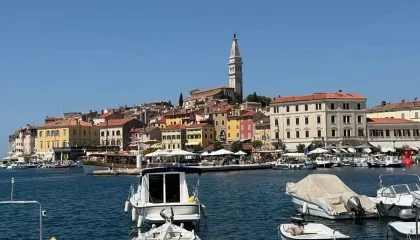
The Western Balkans remain one of Europe’s least-visited regions, and a coach is arguably the most practical way to connect its scattered capitals and coastal gems. Penguin Travel’s programme launches in Sofia, Bulgaria, before rolling through Belgrade, Sarajevo, and onward into Croatia, Montenegro, Kosovo, Albania, and North Macedonia. UNESCO-listed sites such as Dubrovnik’s Old Town and the dramatic Kotor Bay anchor the cultural itinerary. Air-conditioned coaches and three-star hotels form the backbone of the trip, which loops back to Sofia at its conclusion – a convenient point for either flying home or extending the journey deeper into the region.
Globus – Central and Eastern Europe (14 days, ~2,048 km)
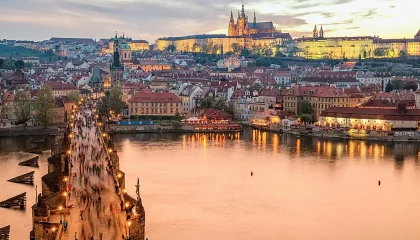
Bookending in Berlin, this fourteen-day circuit covers Germany, Poland, Slovakia, Hungary, Austria, and Czechia. The operator labels the sweep “Eastern Europe,” though purists will note that several of the countries involved sit squarely in Central Europe. Along the roughly 2,048-kilometre route, passengers encounter landmarks as varied as Berlin’s Brandenburg Gate, Warsaw’s Gothic Cathedral of St. John, and Prague’s Astronomical Clock. The itinerary also allocates time at Auschwitz, the Jasna Góra Monastery in Częstochowa, and Dresden’s Zwinger Palace, each accompanied by specialist commentary. The luxury coach specification keeps long driving days tolerable.
FlixBus – The DIY “Trip-Maxxing” Route
Not every traveller wants a fixed itinerary. FlixBus, the low-cost intercity operator, has leaned into the idea of self-directed coach travel, publishing what it calls “trip-maxxing” recommendations: multi-stop routes where each individual leg stays under five hours. The standout suggestion links Berlin, Prague, Vienna, and Budapest in sequence. The combination delivers Berlin’s renowned nightlife alongside the layered history and architecture of the other three capitals. Because each segment is short, passengers can choose where to sleep each night, adjust budgets on the fly, and tailor the pace to personal preference. The trade-off is social: shorter legs mean fewer chances to strike up conversation with fellow passengers, but the freedom to shape the journey day by day is a draw for independent travellers.
Why Now?
The timing of the coach’s resurgence is not accidental. Post-pandemic travel budgets have tightened, short-haul flight prices remain elevated, and a growing cohort of travellers – particularly those under thirty-five – prioritise experiential depth over speed. A coach that glides through the Alpine foothills at 100 km/h, pausing at a hilltop village no airline will ever serve, offers something no other mode replicates: the slow, granular encounter with a landscape. Pair that with the environmental arithmetic and the cost advantage, and the once-maligned coach is quietly becoming one of Europe’s most rational travel choices.
Related Reading
Frequently Asked Questions
What is Is coach travel underrated Here are five?
Is coach travel underrated Here are five is the main topic of this guide. The article explains the context, practical details, and next steps readers should understand.
Why does Is coach travel underrated Here are five matter?
Is coach travel underrated Here are five matters because readers are looking for a useful answer, not just a short summary. Good content should match search intent and help them decide what to do next.