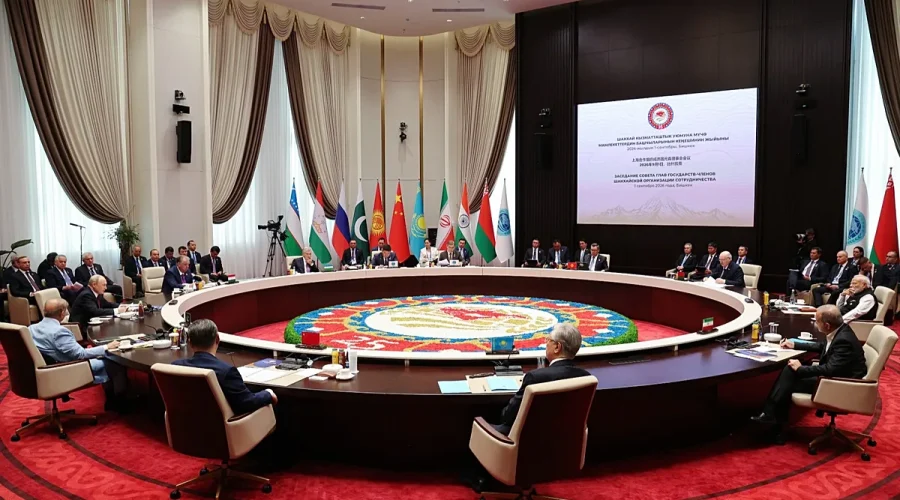
SCO Summit in Kyrgyzstan Ends With Sharp Divisions and a Direct Indian Challenge to Moscow
Usagevpn.com – The 25th summit of the Shanghai Cooperation Organisation closed on Tuesday in Kyrgyzstan, leaving behind a trail of competing agendas, unresolved infrastructure disputes, and one of the most pointed public rebukes delivered to a sitting head of state in recent diplomatic memory. Ten member states — China, India, Iran, Pakistan, Russia, Belarus, Kazakhstan, Kyrgyzstan, Tajikistan, and Uzbekistan — convened alongside dialogue partners drawn from Central Asia, the Caspian littoral, the Middle East, and broader Asia. The gathering was framed as a forum for navigating a world in which power is redistributing rapidly, yet the proceedings made clear that the bloc’s internal cohesion remains fragile.
Modi’s Live-Television Rebuke to Putin
The summit’s most globally resonant moment came when Indian Prime Minister Narendra Modi addressed Russian President Vladimir Putin directly, on live broadcast, urging him to end the war in Ukraine. The exchange caught both leaders off guard in tone, and the clip circulated widely within hours.
“Every single day spent in war pushes humanity backwards. We need to move from endless war to the end of war, to the end of hostilities.”
Modi pressed the point further, invoking the moral heritage of his own country.
“This is India’s message — the message from the land of Gandhi, the land of Buddha: a message of peace, a message of humanity.”
Putin offered no immediate reply. In a separate address later that day, the Russian president chose instead to anchor his remarks in historical memory, noting that 1 September marks the anniversary of World War II’s outbreak.
“We must do everything to exclude from world practice any provocation of armed conflicts.”
The timing carried an unintended irony: Russia’s full-scale invasion of Ukraine, launched in February 2022, had by this point outlasted the entire duration of the Second World War, a fact that underscored how far the conflict had stretched beyond its original parameters.
The Siberian Pipeline Stalls
Bilateral talks between Putin and Chinese President Xi Jinping yielded no breakthrough on a long-discussed Siberian natural gas pipeline. Moscow has pressed the project as a lifeline for an energy sector already strained by sustained Ukrainian strikes on refineries, storage terminals, and transit infrastructure deep inside Russia. The absence of a deal left the Kremlin without the additional export capacity it had hoped to secure through its largest neighbour.
Tehran Seeks Validation and Material Support
Iran arrived at the summit under the weight of an active war, and its delegation worked to extract maximum diplomatic and material benefit. President Masoud Pezeshkian publicly thanked Putin for Moscow’s positions at every stage of the conflict, while the Russian president affirmed that Russia is “supplying the needed goods” to Tehran and expressed solidarity with the Iranian people defending their interests against the United States and Israel.
“I admire their courage and steadfastness.”
Pezeshkian framed the broader stakes in terms that resonated with smaller states watching the order of things unravel.
“Today we are experiencing an erosion of the foundations upon which international order is built. If such actions are met with no effective response from the international community, what state can be certain that its sovereignty and security will be protected in the future against the use of force?”
Iranian Foreign Minister Abbas Araghchi held bilateral meetings with counterparts from China, Pakistan, Kazakhstan, Uzbekistan, Tajikistan, and Russia, while Pezeshkian himself met his Azerbaijani, Indian, and Pakistani peers. The density of contacts signalled Tehran’s determination to convert SCO membership into tangible security guarantees.
Beijing Positions the SCO as a Western Alternative
China, which has increasingly treated the organisation as a structural counterweight to Western-led bodies such as the G7, used the summit to articulate a vision of expanding the bloc’s scope and normative reach. Xi warned against what he called “hegemony, unilateralism, and protectionism,” describing these tendencies as running “counter to the tide of history.”
“The SCO should foster an environment of universal security… Multipolarity is an irreversible trend. Dominance by just one or several countries, or bloc politics, are not true multilateralism.”
He urged leaders and partners to “shoulder the responsibility of the times,” a formulation that blends Confucian duty language with the language of great-power competition.
Ankara Balances NATO Ties with Eurasian Ambition
Turkey, which holds observer-partner status within the SCO rather than full membership, used the platform to reinforce its positioning in Central Asia and the Caspian. President Recep Tayyip Erdoğan described the organisation as “a rising” force in global affairs, a characterization consistent with Ankara’s broader strategy of maintaining traditional Western alliances through NATO while simultaneously deepening economic and security linkages across Eurasia. For Turkey, SCO participation is neither a departure from the West nor a full embrace of the East, but a hedge that preserves optionality.
What the Summit Reveals
Read as a whole, the Kyrgyzstan gathering exposed the SCO’s central tension: it is simultaneously a vehicle for non-Western coordination and a space where its members’ interests diverge sharply. India’s public call for an end to the Ukraine war, China’s silence on that question, Russia’s dependence on both Beijing and Tehran, and Iran’s urgent need for material support all sit within the same institutional frame. The organisation’s stated goal of a “more representative and fairer multipolar world order” remains, for now, an aspiration rather than a shared operational doctrine. Whether the next summit can convert rhetorical multipolarity into concrete coordination — on energy corridors, supply-chain resilience, or conflict mediation — will determine whether the SCO outgrows its current role as a talking shop for states that disagree on nearly everything except the desirability of a world less dominated by Washington and Brussels.
Related Reading
Frequently Asked Questions
What is SCO challenges West as diverse group?
SCO challenges West as diverse group is the main topic of this guide. The article explains the context, practical details, and next steps readers should understand.
Why does SCO challenges West as diverse group matter?
SCO challenges West as diverse group matters because readers are looking for a useful answer, not just a short summary. Good content should match search intent and help them decide what to do next.