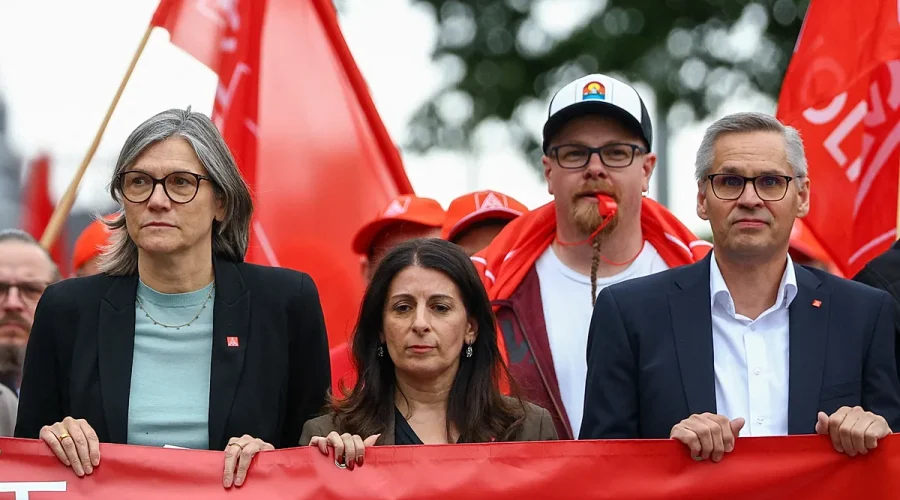
German Auto Workers Turn Fury on Volkswagen Leadership After Morale Survey Exposes Deep Distrust
Usagevpn.com – The relationship between Volkswagen’s workforce and its executive board has fractured along lines that go well beyond the usual tensions surrounding headcount reductions. A company-wide morale poll, commissioned by the works council in the week preceding a scheduled round of executive-worker dialogues, revealed that employees’ single most pressing complaint is not the prospect of losing their jobs but rather the way management has handled — or failed to handle — communication about those very jobs. Workers described the board’s messaging as “disastrous,” a verdict that placed transparency above even existential fears about factory closures and layoffs in the hierarchy of grievances.
A Survey That Cut Deeper Than Expected
The works council, which represents roughly 300,000 employees across Volkswagen’s German operations, opened an intranet channel allowing staff to voice criticisms and expectations directed at CEO Oliver Blume and his fellow board members. The response was immediate and blunt. Communication topped the list of concerns, edging out anxieties about personal job security and the fate of specific production sites. Families of workers were reportedly left feeling “uncertain and frightened,” a characterization that underscores how the ambiguity surrounding future headcount and plant decisions has spilled beyond the factory floor into households across Lower Saxony, Saxony, and Bavaria.
The finding is notable because it inverts the usual assumption that workers will rank their own employment above all other issues. In this case, the perceived opacity of leadership became the dominant source of distress, suggesting that the manner in which difficult decisions are framed can generate more anxiety than the decisions themselves.
Nine Days of Extraordinary Works Meetings
In direct response to the survey results, Blume and other board members have launched a nine-site tour of Volkswagen facilities, structured as extraordinary works meetings. The first session takes place on Tuesday, 25 August, in Wolfsburg, the group’s headquarters city. Subsequent meetings will rotate through Emden, Zwickau, and Braunschweig before concluding in Hannover on 31 August. Executives are expected to deliver initial answers to employee questions and respond directly to the criticisms catalogued in the poll.
The scheduling compresses nearly two weeks of face-to-face dialogue into a single fortnight, a pace that reflects both the urgency felt by the works council and the pressure on management to contain what has become a reputational crisis inside the company.
Financial Pressure Behind the Rhetoric
The communication breakdown does not exist in a vacuum. Volkswagen reported an 11.6 percent decline in its first-half operating result, bringing the figure down to €5.9 billion. The operating margin simultaneously slipped from 4.2 percent to 3.8 percent. The group is navigating a convergence of pressures: intensifying competition from Chinese manufacturers, softening European demand, and the cost impact of United States tariff measures on export volumes.
In a separate intranet message viewed on Sunday, Blume acknowledged the severity of the position:
“The situation is more than critical.”
He added that the company was not generating sufficient revenue to
“ensure we have the means over the long term for new technologies, new products and our locations.”
The Scale of Potential Job Cuts
Volkswagen has already negotiated approximately 50,000 position reductions across its brand portfolio, encompassing the namesake marque alongside Audi and Porsche. Since those agreements were reached, however, the group has signalled that a further tranche of roughly 50,000 roles could come under review. Blume confirmed in July that up to 50,000 additional positions might be affected, though he noted the figure had reached the media without his authorisation — a detail that has only deepened employee suspicion about what else may be leaking from the boardroom.
Four German plants sit in particular uncertainty: the Volkswagen sites at Emden and Zwickau, the Volkswagen Commercial Vehicles facility in Hannover, and Audi’s Neckarsulm operation. For communities in those regions, where a single plant can account for thousands of direct jobs and tens of thousands of indirect ones, the ambiguity itself constitutes a form of economic risk.
Industry-Wide Cost Disparity
Volkswagen’s predicament is not isolated. Other German manufacturers have publicly flagged the country’s elevated production costs as a structural competitive disadvantage. Mercedes-Benz chief executive Ola Källenius stated last month that labour and overhead costs at the company’s German plants run approximately 70 percent above those at its Hungarian facilities. That gap, compounded by energy prices and regulatory overhead, places sustained pressure on every German-based automaker to rationalise capacity or absorb margins that competitors in lower-cost jurisdictions do not face.
Supervisory Board and the Road Ahead
Volkswagen’s supervisory board is currently deliberating turnaround plans that would reshape the group’s cost base, product architecture, and geographic footprint. Blume framed the challenge in historical terms on Sunday, declaring that Volkswagen and the broader German automotive sector are confronting
“the biggest upheaval in their history”
driven by global headwinds and the competitive surge from Chinese rivals.
For the workforce, the coming weeks of works meetings will serve as a litmus test: whether the board can translate the financial necessity of restructuring into a communication strategy that restores a minimum degree of trust, or whether the gap between leadership and the shop floor widens further. The survey has made clear that, for now, the latter is the prevailing sentiment.
Related Reading
Frequently Asked Questions
What is Volkswagen workers condemn disastrous communication over?
Volkswagen workers condemn disastrous communication over is the main topic of this guide. The article explains the context, practical details, and next steps readers should understand.
Why does Volkswagen workers condemn disastrous communication over matter?
Volkswagen workers condemn disastrous communication over matters because readers are looking for a useful answer, not just a short summary. Good content should match search intent and help them decide what to do next.